Classic search gives you a rank. AI answer engines give you a citation. If you build pages just to compete in a list of ten blue links, you are already losing traffic to ChatGPT, Perplexity, and Google’s AI Overviews.
Generative Engine Optimization (GEO) — or what we call LLM visibility — is the mechanism of structuring your information so a machine can retrieve, understand, and quote it directly.
This is not traditional SEO. You aren’t just optimising for a click anymore; you are optimising for extraction.
When an AI Overview appears, standard webpages usually see their click-through rates drop. To survive the shift, you have to ensure the models understand your content, trust the entities within it, and synthesise it accurately.
Key Takeaways
- LLM retrieval does not replace classic SEO; it sits on top of it as a new layer of infrastructure.
- AI models bypass their outdated training data by using Retrieval-Augmented Generation (RAG) to pull live facts from the web.
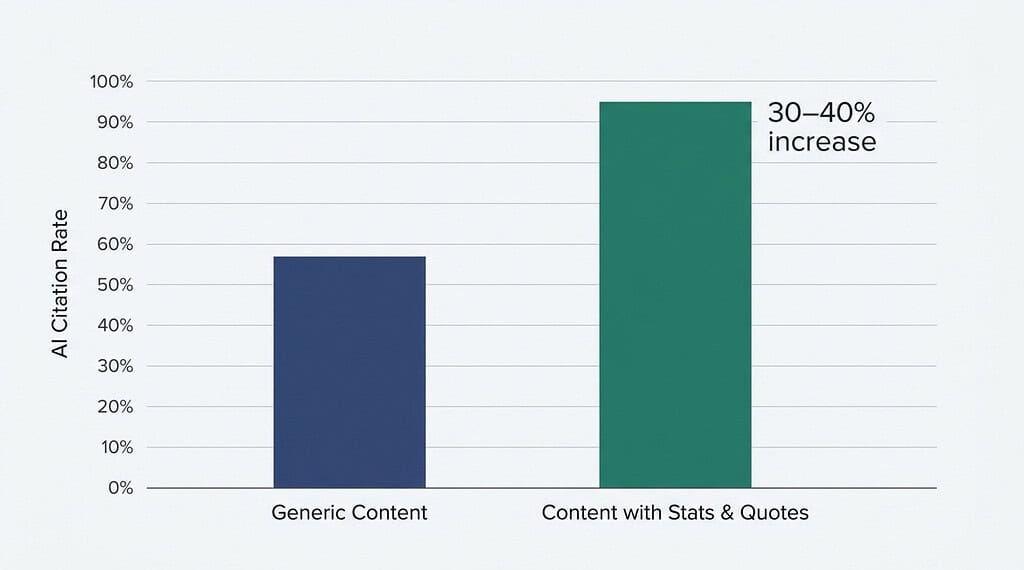
- Information density wins. Pages embedding verifiable statistics and direct quotes are cited up to 40 percent more often.
- Brand mentions on external platforms build your entity, even if they don’t include a backlink.
- Hiring more writers to chase AI algorithms is a tax. Building AI-native content infrastructure is how you scale.
What Is the Role of AI in Generative Engine Optimization?
AI models don’t just store your pages; they parse them. When a user asks a complex question, an answer engine doesn’t return a directory. It runs a process called Retrieval-Augmented Generation (RAG).
Think of RAG as a bridge: the AI uses standard search ranking systems to pull relevant, live pages, reads the entities inside them, and synthesises a response with clickable citations.
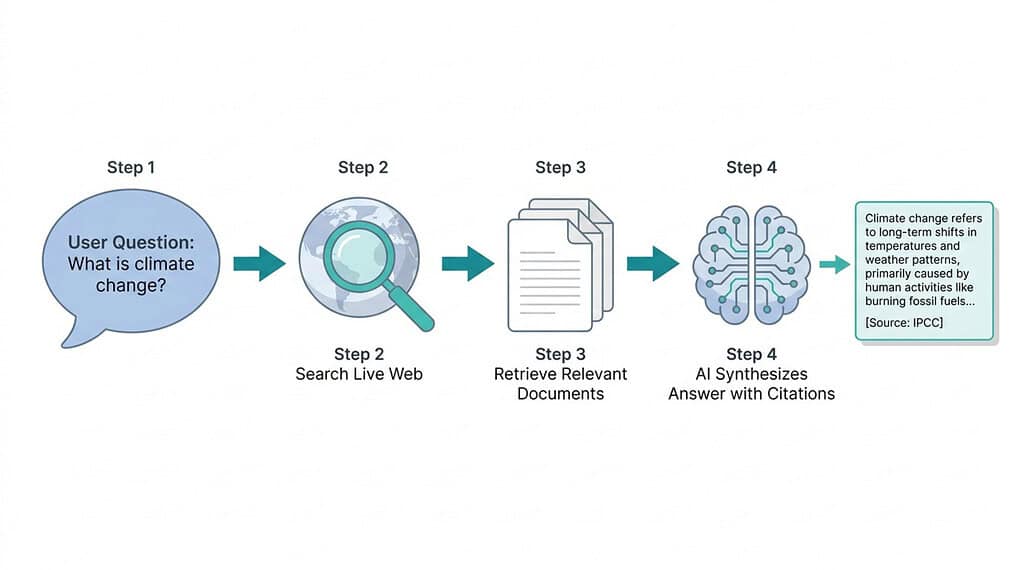
Natural Language Processing (NLP) is the engine underneath this. NLP maps the semantic relationships between words, allowing the model to understand context rather than just matching keywords.
This mix of traditional search retrieval and generative synthesis keeps AI answers accurate and limits hallucinations.
How Is Training Data Used by Generative Engines?
Every large language model has a knowledge cutoff. When a model is released, its base training data (the massive set of text it learned from) is already in the past. It uses this foundation for language patterns and static facts, blending what it learned to predict the next word.

The cutoff is the mechanism that forces models to search. For established queries, the engine might serve a cached response built purely from its internal weights. But for anything dynamic, it must trigger RAG to pull live web results.
For challenger brands trying to outrank the giants, this dictates your strategy. You can’t wait for the next model update to learn who you are. You have to feed the live retrieval system by publishing high-quality, entity-rich pages that stay relevant long enough to be pulled when the model seeks fresh context.
How Do Generative Engines Process and Surface Content?
When an AI answer engine hits your site, it executes three steps: it assesses relevance, parses the text, and extracts the answer. Classic search was a matching game. GEO is an extraction game. If a model cannot easily read the entity behind the page, no amount of on-page polish will save you.
To engineer visibility across these systems, your data needs to be structured for machines while remaining readable for humans.
Here is how you build that out:
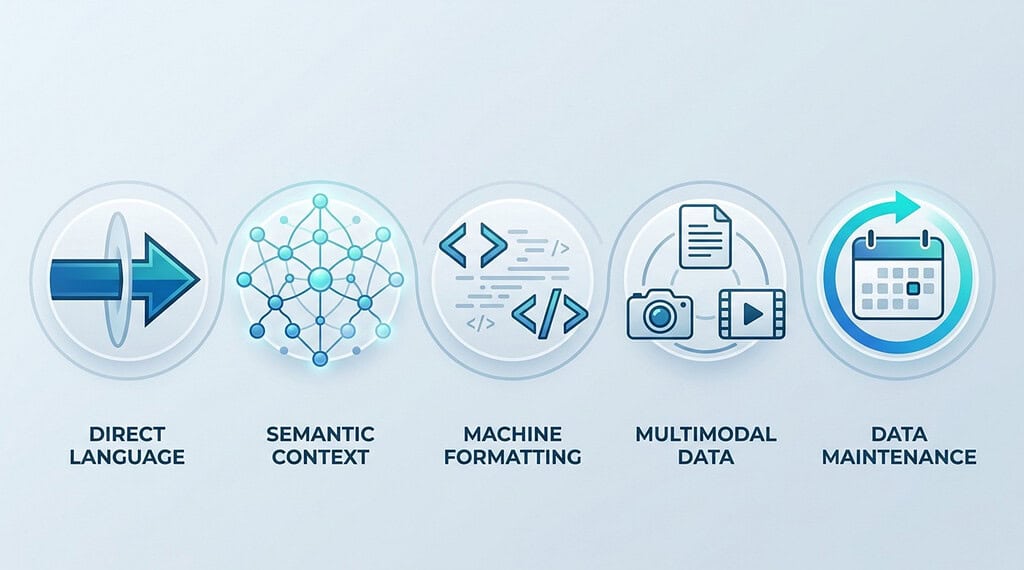
- Write in direct, active English. Convoluted syntax and corporate filler break the extraction process.
- Target the semantic distribution of the topic. Answer the core question immediately, then map the related entities and sub-questions around it so the AI has complete context.
- Format for the machine. Use standard HTML structures — clear headings, bulleted lists, and tables — to bracket your facts.
- Diversify your inputs. Many models now process multimodal data, combining text, clear images, and video to verify an answer.
- Maintain your data. Models are built to retrieve the most reliable recent signal. Stale pages get bypassed.
Why Are Content Signals Important for GEO?
Content signals are the proof AI models use to judge whether your information is reliable. They dictate whether your page makes it into the summary or gets left in the crawl queue.
The strongest signal is verifiable data. A large-scale study of 10,000 real queries showed that pages embedding direct quotes and hard statistics saw a 30 to 40 percent jump in AI citations.
The mechanism here is simple: numbers and named sources act as hard data nodes the model can confidently extract and verify against other sources.
Then there is the off-site signal. Your brand is an entity. Mentions of your company on Wikipedia or user-generated platforms like Reddit and industry forums map how often your entity appears next to a topic — even without a link.
Google’s own documentation confirms this indirectly by demanding content built on real, firsthand experience. Publish generic commodity content, and you send zero unique signals.
The Bottom Line
The shift to Omnichannel Search and AI answer engines isn’t a tech update you can bolt onto an old process. It is a fundamental change in how information is retrieved.
GEO relies on the same technical foundations as classic SEO (clean code, crawlable architecture, fast rendering) but it demands absolute semantic precision instead of keyword repetition.
The hard truth is that models misattribute sources, hallucinate details, and change their extraction rules without warning. You cannot control the model. You can only control your infrastructure.
Businesses that adapt will track their LLM visibility through new reporting tools, but the real work happens at the structural level. If your search visibility is stuck because you can’t hire fast enough to chase these changes, that’s the resource barrier.
Build the system that answers the machine, and the traffic follows.