Getting to the top of Google doesn’t mean what it used to. Today, if your content isn’t cited by AI search tools, a growing chunk of your audience will simply never see it.
Traditional SEO gets you into a list of links. Generative Engine Optimization (GEO) gets your brand included inside the AI-written answer users see first.
Here is how GEO actually works, how to measure it, and how to update your site to get cited.
What Is Generative Engine Optimization?
GEO Definition and Core Concepts
Generative Engine Optimization (GEO) is the process of formatting your content so AI engines can read, trust, and cite it.
Instead of ranking links, tools like ChatGPT, Gemini, and Perplexity read multiple sources and combine them into one conversational response. They don’t just extract text. They synthesize it.
Your goal isn’t just to earn a click. Your goal is to become the trusted source the AI uses to build its answer.
Because these systems prioritize facts, they reward content that features clear data, expert quotes, and checkable statements. The playbook changes often, but clean structure and strong authority signals always win.
Origins and Evolution of Generative Engine Optimization
The term started in late 2023 with a Princeton University research paper.
The researchers found that classic SEO tricks, like keyword stuffing, actively hurt visibility in AI answers. But adding citations and clear data could boost visibility by up to 40%.
By 2026, this isn’t just academic theory.
It’s a daily workflow for any company that wants to survive in an AI-first search environment.
Key Characteristics That Distinguish GEO
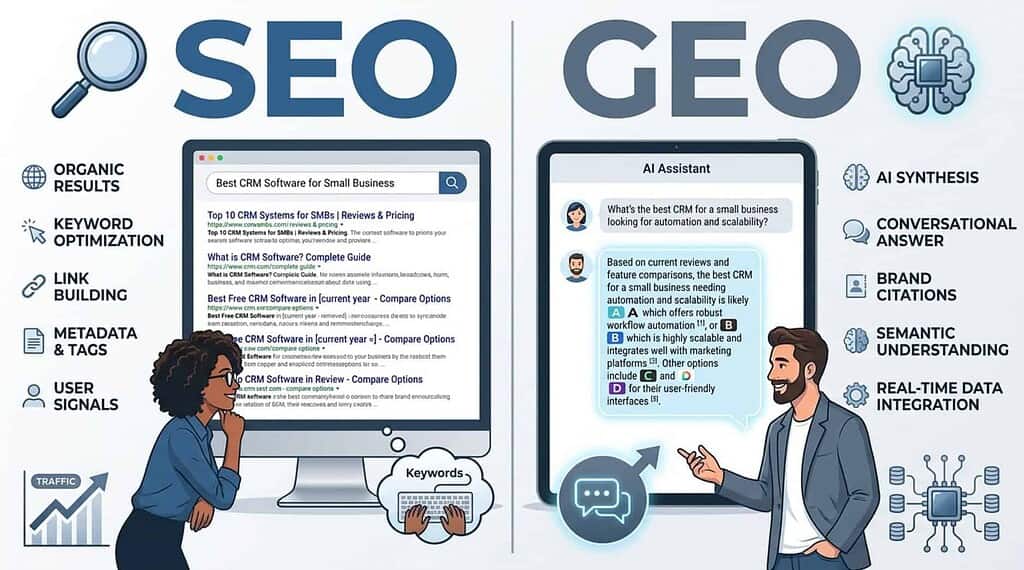
SEO wants your page on a search results page (SERP). GEO wants your facts inside the AI’s written summary.
AI queries are also completely different. They average around 23 words. People ask full, complex questions, and the AI hands them the exact answer, which naturally reduces website clicks.
What this means for you:
You aren’t just tracking traditional rankings anymore. You track citations, brand mentions, and Share of Model (SoM). SEO asks if you rank. GEO asks if you are part of the answer.
Why Does Generative Engine Optimization Matter in 2026?
Impact of Generative AI on Search Behavior
People are tired of scrolling through ten links.
If someone asks for the best project management tool for a remote team, they want a direct recommendation and the reasoning behind it.
This shift drives zero-click searches up. By 2025, 60% of Google searches ended with no click, hitting 77% on mobile. When Google AI Overviews appear, the top classic organic result can lose a third of its clicks.
If the AI answers the question without citing you, you lose the user.
User Adoption and Growth of AI-Driven Search Engines
This isn’t a niche behavior anymore.
By late 2025, ChatGPT hit 800 million weekly active users. Perplexity processed nearly 800 million queries in a single month. Google’s AI Overviews reach billions.
Apple integrating AI-native search into Safari just makes this the default way millions of people find information.
The shift has already happened.
Business and Traffic Implications for 2026
AI search might only drive 5% of your total organic traffic right now. But that traffic converts.
People who click an AI citation have already had their basic questions answered by the chat interface. They arrive ready to act.
Some B2B sites report up to five times higher conversion rates from AI referrals compared to standard search.
As of late 2026, nearly half of brands still don’t have a GEO plan. That leaves a massive opening if you move early.
GEO vs SEO vs AEO: What Are the Differences?
How Traditional SEO Works
Classic SEO optimizes pages to rank as blue links.
You fix technical issues, build links, and match search intent. The user searches a short, four-word phrase, clicks around, and pieces together the answer themselves.
SEO still matters, but it’s no longer the only layer.
How Answer Engine Optimization (AEO) Functions
AEO focuses on featured snippets and voice search.
The goal is to be the single, definitive answer that Google Assistant or Siri reads out loud. It relies heavily on strict Q&A formatting and structured data (schema).
AEO wants the direct answer box.
How Generative Engine Optimization Works
GEO goes a step further. It feeds the AI.
Systems like Claude and Perplexity don’t just extract your text. They rewrite and combine it with five other sources.
To win here, your content needs clear structure, specific facts, and expert quotes that the model deems safe to cite.
Success is measured by how often your brand shapes the final response.
GEO, SEO, and AEO: Relationship and Strategy Layers
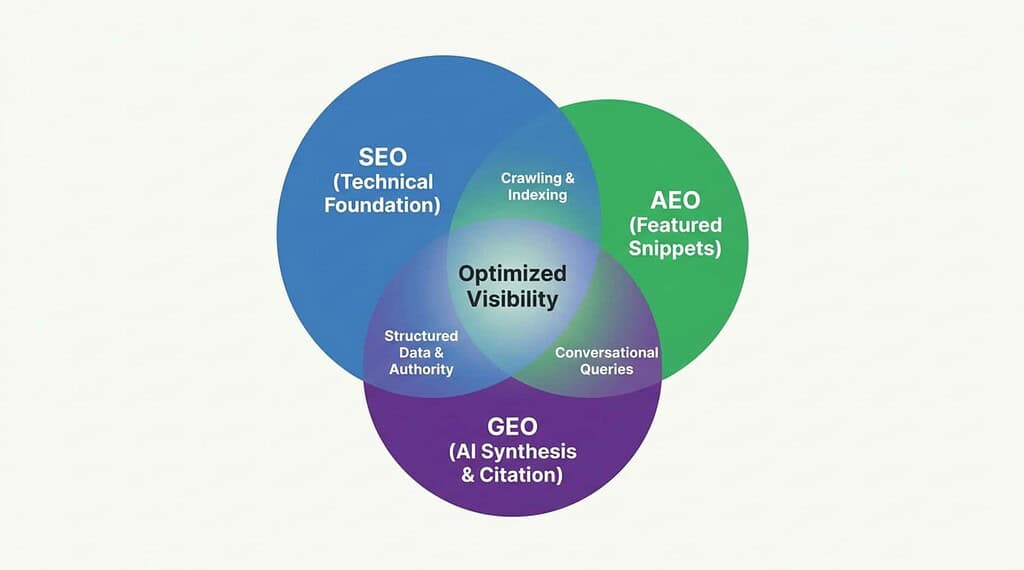
You still need SEO. Google’s AI features rely heavily on its standard ranking systems.
But being number one in standard search doesn’t mean you get the AI citation. We call this the “Great Decoupling.”
By late 2026, the link between ranking high and being cited by AI dropped below 20%.
A strong strategy uses SEO to get crawled, and GEO to get cited.
How Do Generative AI Search Engines Process and Cite Content?
The Content Synthesis Process in Generative Engines
When a user asks a complex question, the AI breaks it into smaller pieces.
A search for “best VPN for Netflix in Europe” becomes three separate background searches: best VPNs, Netflix streaming, and European servers.
The system grabs live web pages, checks them for authority, and synthesizes the best parts into one clean response with citation links.
What Makes Content Citation-Worthy?
AI wants facts it can verify.
It loves simple definitions, statistics with a named source, and expert quotes with real names attached. An expert quote can raise your visibility by 30%.
Tables and lists make data easy to pull. Freshness is also critical. If your data is more than three months old, many AI models will quietly drop it in favor of a newer page.
The Role of RAG (Retrieval-Augmented Generation) Architecture
Most AI search tools use Retrieval-Augmented Generation (RAG).
RAG is just a system that forces the language model to read live web pages before it speaks. Here’s how it works:
- Retrieval: It fetches relevant, recent web pages.
- Generation: It uses those specific pages to write the answer.
This is exactly why you get a citation link. If you feed the retrieval phase, you earn the citation.
What Are the Core Strategies for Generative Engine Optimization?
1. Create Comprehensive, Authoritative Content
Don’t just answer the main question. Answer the immediate follow-ups.
If you explain how software works, include the pros, cons, and setup steps.
Write from real experience. AI ignores content that just repeats the consensus. Original research and internal data prove your brand is a primary source.
2. Structure Information for AI Parsing and Extraction
Structure is half the battle.
Use strict, descriptive headings (H2, H3). Keep your paragraphs short. Put the direct answer in the very first sentence of the section, then explain.
A clean, predictable HTML structure is much easier for a machine to parse.
Number your steps and bullet your lists. Pages with well-structured lists see significantly higher visibility in AI responses.
3. Build Entity and Brand Authority for AI Trust
AI systems filter for trust.
Quote real experts and include their job titles. Support your claims with sourced statistics, not vague industry assumptions.
Build author bios that prove real credentials. If you have a Wikipedia page, keep it completely accurate, because language models heavily weight Wikipedia in their training data.
4. Leverage Citations and External Validation
If you want to be cited, you have to cite others.
Link out to research papers, government data, and respected industry reports. It signals reliability.
External validation matters just as much. Getting mentioned on sites that the AI already trusts is the fastest way to build your own authority.
5. Optimize for Conversational and Long-Tail Queries
AI prompts average over 20 words. People talk to these tools like they’re coworkers.
Target comparison searches and highly specific use cases.
Write in plain English, and stop worrying about exact-match keywords. Match the conversational tone of the prompt.
6. Target Sub-Queries Relevant to AI Synthesis
Since the AI breaks long prompts into smaller searches, you need to answer those smaller pieces.
Build “atomic” sections in your content. For example, a prompt about “marketing automation platforms for small e-commerce” breaks down into:
- best email platforms 2026
- e-commerce specific features
- small business pricing
Answer all three clearly on the page.
7. Implement Technical GEO Best Practices
If the bot can’t crawl the page, nothing else matters.
Here’s what that looks like in practice:
- Check your robots.txt so you aren’t accidentally blocking AI crawlers.
- Render your main content server-side, not in JavaScript.
- Don’t hide important text behind UI elements or paywalls.
- Use specific schema markup for FAQs, articles, and products.
- Keep the HTML semantic and fast.
- Check your server logs to see which AI bots are actually visiting.
How to Optimize for Different Generative AI Search Engines
Google AI Overviews and Gemini
Google’s AI leans heavily on its traditional search index.
If you perform well in organic search, you have a massive head start here. Use schema markup heavily, and keep your Google Business Profile updated if you have local intent.
OpenAI’s ChatGPT and GPT-4o
ChatGPT uses a mix of training data and live web search.
It strongly prefers detailed, deeply sourced content. If you provide clear explanations and attribute your facts to real experts, ChatGPT is more likely to use your page.
Anthropic Claude
Claude is built to process massive amounts of text and prioritize logical reasoning.
It rarely quotes directly; it summarizes. To win in Claude, your argument needs to flow perfectly from one point to the next. Keep the logic simple.
Perplexity AI
Perplexity is essentially a live citation engine.
It aggressively searches the web and prioritizes recency above almost everything else. If your page is outdated, Perplexity will skip it.
Write in a direct, factual style and cite your numbers clearly.
Building a GEO Strategy for 2026
Assessment and Audit: Establishing a Baseline
Start by asking the AI about your brand.
Open ChatGPT, Perplexity, and Gemini. Search for your core products and category terms. Look at who gets cited and how your brand is described.
This gives you an immediate map of your citation gaps.
Pick five high-value pages to update first, based on business value.
Optimizing Existing Content for Generative Engines
Take those pages and rebuild the formatting.
Add clear H2s and H3s. Move the direct answer to the top of each section. Add bulleted lists where appropriate.
Then, inject fresh data and expert quotes to boost the authority signal. Update these core pages quarterly so they never look stale to the crawlers.
Developing Authority Beyond Your Own Website
AI reads the whole web, not just your blog. You need a footprint.
Publish original research with real numbers that other people want to link to. Participate in Reddit discussions and industry forums.
External mentions validate what you say on your own site.
Ongoing Measurement and Iteration
AI models change constantly, which means your visibility will fluctuate.
Track your referral traffic from domains like chat.openai.com in GA4. Check your conversion rates on that traffic.
Update your content plan based on what actually leads to real revenue.
How to Measure Generative Engine Optimization Performance
Metrics That Matter for GEO in 2026
You can’t track GEO with standard keyword rankings.
The primary metric is Share of Model (SoM). This tracks how often your brand appears in AI answers compared to competitors.
You should also track:
- Citation Frequency: How often AI links to you.
- Brand Mention Rate: Mentions without a link.
- Sentiment: Is the description positive or negative?
- Citation Position: Where the link appears.
- Response Inclusion Rate: How much your content shapes the final answer.
Tools and Methods for GEO Visibility Tracking
For Google’s AI features, Search Console is your best starting point.
For broader visibility, manual testing works perfectly fine. Pick 20 prompts and test them monthly.
If you need to scale, paid tools are available:
| Tool | Main use | Starting price (as stated) |
| Geoptie Pro | GEO tracking across AI engines + competitor monitoring | Varies |
| Profound | Enterprise citation tracking across 9+ engines + GA revenue attribution | $499/month |
| Semrush AI Visibility Toolkit | Market analysis, sentiment, share-of-voice | $99/month per domain |
| Otterly.AI | Prompt-level tracking + link citation detection | $29/month |
Avoid any software claiming to have insider Google data.
Share of Model (SoM): GEO’s Key Measurement
Share of Model is the most important metric in AI search.
It proves your influence. The formula is:
(Your Citations / Total Citations) × 100
Pick 50 high-value prompts. Run them across the major platforms. Count your citations versus the total, and track that percentage monthly.
Common Generative Engine Optimization Mistakes to Avoid
1. Neglecting Traditional SEO Foundations
Do not abandon your technical SEO.
If your site has crawl errors or zero backlinks, AI bots won’t trust it. GEO is a layer on top of SEO, not a replacement.
2. Over-Optimizing for Specific AI Engines Only
Don’t build a strategy just for Perplexity.
What works there might fail in ChatGPT. Focus on the fundamentals they all share: clear structure, authoritative authors, and checkable facts.
3. Sacrificing User Experience for AI Optimization
If you format a page entirely for robots (endless bullet lists and stiff phrasing) human readers will bounce.
High bounce rates eventually signal to the AI that the page is low quality. Write for humans first.
4. Ignoring E-E-A-T Principles
Experience, Expertise, Authoritativeness, and Trustworthiness matter more here than anywhere else.
Language models are built to avoid hallucinating dangerous answers. If your content lacks clear attribution and expert proof, the model simply won’t risk citing you.
5. Expecting Immediate Results
GEO is a slow, compounding channel.
You might see a citation in a few weeks, but stable visibility takes three to six months. The indexes have to update, and the models have to learn to trust your domain over time.
6. Measuring Success with Outdated Metrics
If you judge GEO by looking at overall organic traffic, you will think it’s failing.
AI answers often result in zero clicks. Look at referral traffic from AI bots, brand search volume, and lead quality instead.
Best GEO Tools and Resources for 2026
Free GEO Analysis Tools
You can start without spending much.
Check Google Search Console. Review your server logs for the “ChatGPT-User” bot. If you use Cloudflare, look at their AI Crawl Metrics dashboard.
Manual testing costs nothing and teaches you exactly how the models format their answers.
Paid GEO Platforms for Professional Use
When manual testing gets too slow, paid tracking helps.
Geoptie Pro and Otterly.AI track prompts and citations. Semrush has an AI Visibility Toolkit. Profound handles enterprise-level tracking and revenue attribution.
Pick the one that fits your stack and budget.
The Future of Generative Engine Optimization
Emerging Trends and Predictions for 2026-2027
AI search is getting embedded into our devices.
As Google expands AI Overviews and Apple pushes AI into Safari, the market will fragment. You won’t be able to rely on just one search engine anymore. Freshness will become the ultimate ranking signal.
Role of Multi-Modal and Personalized Search
Soon, text won’t be enough.
AI is getting better at watching video and reading audio. Your strategy will need to include YouTube and infographics.
Answers will also become highly personalized, meaning the AI adapts the response based on the user’s history.
Merging of GEO and SEO Strategies
Eventually, the line between SEO and GEO will disappear.
You optimize for the user, make it technically sound for the crawler, and format it clearly for the AI. Run both strategies together so you don’t lose traffic during the transition.
Frequently Asked Questions About Generative Engine Optimization
Is GEO Replacing SEO?
No. SEO gets you indexed. GEO gets you cited. You need both.
How Long Does GEO Take to Show Results?
Usually three to six months. It is a long-term effort with results that build over time.
What Content Types Work Best for GEO?
Guides, glossaries, comparisons, and original research. If it has facts, data, and expert quotes, it works.
Do I Need Different Content for GEO vs SEO?
Not usually. You just need to structure your existing content better and update it more frequently.
What Role Do Citations Play in GEO?
Citations are the new top rankings. They build trust and drive high-intent referral traffic.
Can Small Brands Compete in GEO?
Absolutely. AI cares about niche expertise and checkable facts, not just massive domain authority. If you have the best data, you can beat the biggest competitors.