How do you scale search visibility across multiple countries without multiplying your headcount or splitting your domain authority?
You build an international SEO infrastructure that maps local search intent, isolates technical routing with precise hreflang signals, and treats content as market-specific transcreation rather than automated word substitution.
What Is an International SEO Strategy and Who Needs One?
An international SEO strategy is the technical and editorial architecture that lets search engines index, understand, and rank your content across multiple countries and languages. The objective is commercial relevance: ensuring a user searching in Munich sees your German-targeted page, while a user in London hits your UK catalogue.
Without explicit routing signals, search engines guess. When they guess, your English pages rank in Germany, bounce rates spike, and your local URLs cannibalise each other in the index.
What Separates International SEO From Local SEO?
Local SEO anchors an entity to a physical coordinate: a shopfront, a service radius, or a municipal market. It runs on Google Business Profiles, local directory citations, and geographic proximity signals.
International SEO solves an entirely different mechanical problem. It maps digital entities across national boundaries, languages, and legal jurisdictions. The work involves complex URL architectures, multi-region indexation signals, currency and checkout localisation, and hreflang tag clusters.
Local SEO wins a neighbourhood; international SEO engineers visibility across entire sovereign markets.
Who Benefits From a Global SEO Approach?
Any company whose unit economics support cross-border demand needs this framework. SaaS companies expanding across borders, e-commerce challenger brands taking market share from legacy incumbents, and digital publishers scaling global readership all hit a wall if they rely solely on domestic search.
Most searches globally do not happen in English. Markets across the EU, Latin America, and Asia offer massive search volume, often with significantly lower competition than saturated US and UK search results. If you ignore these regions, you leave revenue on the table for local competitors who understand the local search intent.
When Should a Company Launch an International SEO Strategy?
You launch an international search operation when operational readiness meets organic search demand.
The first diagnostic is simple: review Google Search Console. If you see sustained impressions and clicks coming from Germany, France, or Japan on unoptimised pages, international searchers are already looking for your product.
Entering a new territory without search infrastructure wastes capital. If your corporate roadmap includes opening a new market, your search architecture needs to be live weeks before launch to give search engines time to discover, crawl, and evaluate your localized entity footprint.
Core Components of a High-Impact International SEO Framework
A scalable international SEO framework rests on four operational pillars: technical URL architecture, local keyword transcreation, culturally grounded content, and regional authority building.
These pillars must align with your supply chain, legal compliance, and customer service capabilities.
How Market Selection Drives Your Global SEO Roadmap
International search campaigns rarely fail because of bad code; they fail because of bad capital allocation. International expansion is an investment decision. You must decide which markets justify direct technical and editorial spend, which order to tackle them in, and when data tells you to scale or pull back.
Score prospective markets across three explicit variables: search demand, SERP competition, and operational readiness.
- Search demand requires local keyword research to uncover how native speakers frame problems.
- Competition analysis exposes the authority and content depth of incumbent ranking domains.
- Operational readiness evaluates whether your business can actually fulfil orders: local payment gateways, shipping logistics, customer support in the local language, and regulatory compliance.
Enter one or two markets at a time. Validate the infrastructure, capture rankings, and establish revenue before opening the next market.
In France, for example, search volume is high and competition is often moderate, but consumer expectations and legal requirements around French-language communication demand thorough localisation. Attempting a superficial machine-translated subfolder in that market will waste budget and burn brand equity.
Should You Target by Language or Country?
Choosing between language targeting and country targeting dictates your entire technical architecture.
Language targeting groups all speakers of a single language into one regional bucket, such as a single Spanish version for both Spain and Latin America. This model suits pure-content publishers, ad-supported media, or software companies with global, unvarying pricing. You build the page once and capture volume across multiple countries.
Country targeting isolates specific national markets, such as separate pages for /es-es/ and /es-mx/. This approach is necessary for e-commerce, fintech, and regulated industries where currencies, shipping fees, tax laws, and inventory vary by territory. It also allows you to tailor vocabulary and cultural references to match local dialects.
If you have the operational bandwidth, country targeting consistently delivers superior conversion rates.
Technical SEO Foundations for Global Growth
Technical search architecture forms the foundation of every multilingual site. Your URL setup and routing signals determine whether Google serves the correct page or drops your international assets entirely.
1. Selecting the Ideal International URL Structure
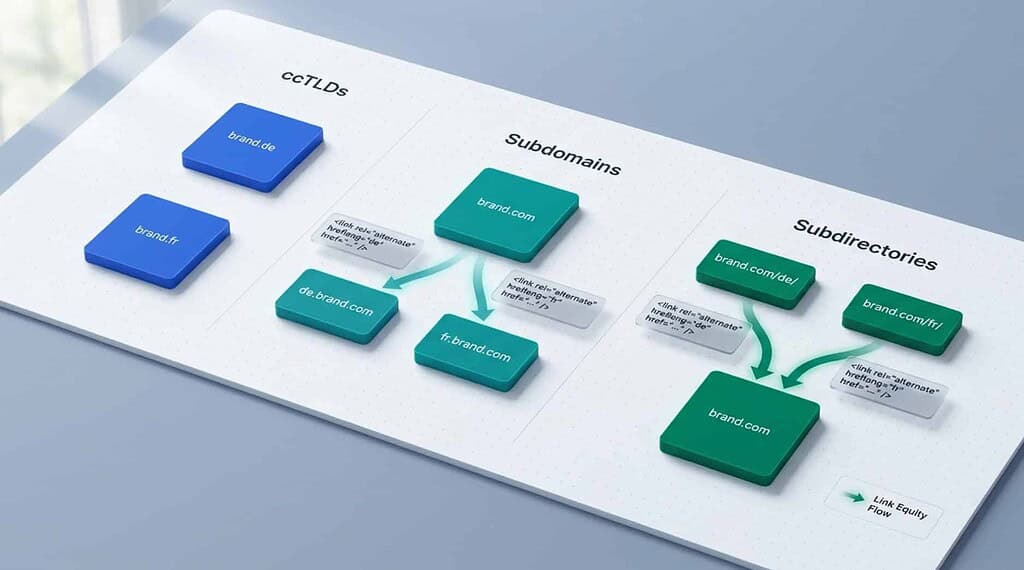
You have three standard options for organizing international URLs:
- Country-code Top-Level Domains (ccTLDs): These use national extensions like example.de or example.fr. They send the clearest geographic signal to search engines and build strong initial trust with local users. However, they are expensive and operationally demanding: every ccTLD is treated as an isolated domain, meaning you must build link authority from zero for each country.
- Subdomains: These look like de.example.com or fr.example.com. They allow you to host different regions on distinct servers or CMS setups. However, search engines frequently treat subdomains as separate entities, which dilutes your root domain’s accumulated link equity.
- Subdirectories (Subfolders): These look like example.com/de/ or example.com/fr/. This is the most efficient structure for scaling challenger brands. All localized assets sit on a single domain, consolidating authority, backlink signals, and brand equity into one root. You maintain full geographic control via hreflang implementation.
Unless you run an enterprise organisation with dedicated marketing teams in every country, subdirectories provide the best balance of authority retention, crawl efficiency, and operational speed.
2. Implementing Hreflang Tags for Language and Region Targeting
Hreflang tags are explicit HTML or XML instructions that tell search engines which regional and linguistic variant of a page to serve to a specific user. They prevent internal cannibalisation and keep your international URLs from competing against each other.
Three operational rules govern hreflang setup:
- Return tags: Every page in a language cluster must point to all other versions in that cluster, including a self-referencing tag pointing to itself. If Page A links to Page B, Page B must link back to Page A.
- Canonical alignment: The URL listed in the hreflang tag must be the self-canonical URL of the destination page. Never point hreflang tags at non-canonical or redirected URLs.
- The x-default directive: Always include an x-default tag to specify the fallback page for searchers whose language or region is not explicitly covered in your cluster.
On enterprise websites with thousands of URLs, placing hreflang in XML sitemaps is cleaner and easier to manage than injecting massive tag blocks into page headers.
3. Managing International Sitemaps and Geotargeting
International XML sitemaps ensure Googlebot discovers and indexes your regional pages without wasting crawl budget. You can build individual sitemaps for each directory (e.g., sitemap-de.xml) or create an index sitemap containing hreflang alternate clusters. Submit every local sitemap directly to Google Search Console.
If you use a generic top-level domain (.com, .io, .agency) with subfolders, configure separate Google Search Console properties for each subdirectory. This lets you monitor search performance, indexing errors, and query impressions for specific target countries.
Keep market mechanics in mind: while Google dominates Western markets, Yandex drives search in Russia and Baidu leads in China. Baidu ignores hreflang tags entirely and requires local hosting, Chinese ICP licenses, and dedicated Simplified Chinese content structures.
4. Handling Site Speed and CDN Deployment Across Regions
Latency degrades user engagement and search engine crawl efficiency. If your origin server sits in London, a user in Sydney will experience sluggish page loads that hurt conversion rates and organic visibility.
A Content Delivery Network (CDN) with edge servers across your target markets caches static assets close to the end user. This reduces round-trip times and ensures consistent Core Web Vitals performance in Tokyo, Berlin, or Chicago.
5. Avoiding Common Technical SEO Mistakes in Multilingual Sites
The fastest way to break an international search footprint is implementing automatic IP-based redirects. Because Googlebot predominantly crawls from US-based IP addresses, forcing automatic IP redirects blocks the crawler from ever accessing your German, French, or Japanese subfolders.
Instead, serve all language variants directly on crawlable URLs and use non-intrusive banners to suggest local versions to visitors.
Another common mistake is publishing thin, duplicate pages. Translating meta titles while leaving body copy in English produces duplicate content flags and offers zero value to local searchers.
Mobile experience must also be checked locally: page load speeds, local payment UI, and layout rendering must be audited for the hardware and mobile networks dominant in each specific market.
Localized Keyword Research Across Markets
International keyword research is not a translation exercise. Direct translation fails because search intent, industry jargon, and regional dialect vary significantly across borders.
Why Keyword Localization Matters for Ranking
Translating an English keyword list into German with a dictionary ignores how people search in the real world.
Search behaviour is rooted in regional culture. A product described one way in the United States might be searched for using an entirely different mental model in the UK, let alone in non-English speaking markets.
If your pages use terminology that native speakers never type into search boxes, your content will fail to rank.
How To Research Search Intent and Demand in Each Target Market
Start your research with first-party search data. Pull your top-performing domestic queries from Google Search Console and map them against regional search trends. Use tools like Ahrefs and SEMrush set specifically to target country databases, and validate the queries with native market specialists.
Map the search intent behind every term. A keyword that carries transactional intent in the US may be purely informational in Germany. Build an independent keyword matrix for each market rather than copying a central strategy across regions.
Even within the same language, regional differences dictate search volume: German in Germany (de-de), Austrian German (de-at), and Swiss German (de-ch) use different technical and commercial phrasing.
Transcreation vs. Direct Translation of Keywords
Translation converts words from one language to another. Transcreation adapts the underlying meaning, emotional context, and commercial intent to match local user behaviour.
In international search, transcreation uncovers the exact queries local users type.
- In technical sectors like software or life sciences, native speakers often use English terms directly, making literal translation incorrect.
- In consumer industries, colloquial phrases and local idioms dictate query structure.
Build your keyword framework market by market based on actual search behavior.

Content Localization: Beyond Translation
Once your technical routing and keyword maps are in place, your editorial focus moves to content localization. This process transforms translated text into native, high-trust assets.
Tailoring Content for Cultural and Regional Preferences
Content localization puts transcreation into daily practice. You adapt your message to match local cultural norms, legal requirements, and commercial expectations so the page converts like a native business. This requires local case studies, native currency pricing, metric units, local industry statistics, and culturally relevant comparisons.
The tone of voice must also adapt. German B2B buyers expect a formal, fact-dense tone with minimal marketing adjectives. American readers respond to narrative and direct address.
Localise your calls to action, date formats, contact telephone numbers, and legal disclosures. Content designed for a London office will not resonate with a procurement team in Zurich.
Leveraging Local Terminology and User Expectations
Incorporate your transcreated keyword list naturally into primary on-page elements: H1 tags, descriptive subheadings, body paragraphs, meta titles, and URL slugs. Writing URL slugs in the target market’s language strengthens semantic relevance and increases click-through rates in regional search results.
If a page reads well but lacks the semantic entities that local users search for, search algorithms will ignore it. If it contains awkward, automated phrasing, users will bounce immediately. The goal is content written with native fluency that answers the specific intent of the local searcher.
SEO-Aware Localization vs. Automatic Machine Translation
Raw machine translation from automated tools is not enough to compete in high-value search results. While it produces grammatical sentences quickly, it misses cultural nuance, ignores keyword intent, and fails to build commercial trust with readers.
SEO-aware localization combines computational scale with human editorial oversight. An AI-native pipeline generates the initial localized draft while preserving HTML structure, headings, and data tables. Native-speaking editors then refine the copy, adjust the tone, and ensure local search terms are naturally integrated. This keeps your costs manageable without sacrificing quality.
Ensuring High-Quality Translation and Revision Management
Maintaining localized content across multiple markets requires continuous editorial management. Whenever you update a product page or core guide on your primary site, your localized versions must update in parallel. Leaving regional assets out of date harms search performance and leads to customer churn.
Translation Management Systems (TMS) integrated with your CMS automate change detection and streamline the editorial workflow. A clear review cadence ensures that all regional URLs stay accurate, culturally sharp, and aligned with changing search intent.
Building International Authority and Local Links
Search engines evaluate authority through backlinks. In international search, links carry the most weight when they originate from trusted domains inside your target geographic market.
Local Link Building Tactics That Boost Rankings
A backlink from a respected German publication (a .de domain or Germany-hosted site) sends a stronger regional trust signal to Google for your German URLs than an extra link from an American website. Proven regional authority tactics include:
- Regional PR and Media Outreach: Pitch localized industry reports, data studies, and commentary to trade journals and business publications in your target country.
- Local Business Directories: Secure accurate citations on respected national directories and chamber of commerce platforms.
- Commercial Partnerships: Collaborate with local distributors, suppliers, or industry associations on joint content and co-marketing initiatives.
- Transcreated Thought Leadership: Adapt your best research and data for local industry problems, then pitch it directly to regional editors.
- Local Event Sponsorships: Sponsoring regional trade shows and community conferences earns authoritative, geographically focused links.
Focus on link quality and semantic relevance within the target market rather than raw backlink volume.
Earning Trust and Credibility in New Markets
Search engines assess trust based on user engagement and external brand mentions. Social platforms and review ecosystems vary widely by region. While Western markets rely on LinkedIn, X, and Trustpilot, other regions prioritize local platforms like WeChat, LINE, or regional review portals.
Displaying authentic reviews from customers within the target country directly on your product pages increases conversion rates and reduces bounce rates. When search engines see high engagement metrics from local traffic, your ranking stability in that market improves.
Operational Choices for International SEO Success
International SEO is an ongoing operational system, not a one-off technical build. Your team structure and tooling choices dictate your speed to market, content consistency, and international margins.
Team Models: In-House, Hybrid, or Agency Collaboration
Organisations typically manage international search operations through three structural models:
- Centralized Team with Native Freelancers: A lean in-house SEO lead manages the technical setup and builds briefs, while vetted native-speaking contractors handle writing and localization. This model keeps overhead low but requires strict editorial quality control.
- In-Market Teams: Hiring full-time regional marketers provides deep local knowledge, but it is slow and expensive. This model only makes financial sense once a national market is producing steady revenue.
- Specialist Agency Partnership: Working with an agency provides immediate access to multilingual infrastructure without hiring a large team. The main risk is operational bloat if the agency relies on slow, manual processes.
Most growing brands use a hybrid model: an internal lead directs market strategy while leveraging automated systems and native editors to scale execution across markets.
Selecting Tools and Workflows for Managing Multilingual SEO
Managing hreflang tags, localized keyword clusters, and multi-region content across dozens of markets quickly breaks down if handled manually in spreadsheets. You need integrated systems that scale.
Modern translation APIs and localization platforms connect directly to your CMS to pull new content automatically. These systems translate drafts using custom glossaries, apply your transcreated keyword maps, and preserve core layout structures. They also automate the generation of XML sitemaps, manage self-referencing hreflang clusters, and format local URL slugs.
Automating these manual tasks lets a lean team manage international search across multiple countries without ballooning headcount.
Measuring International SEO Performance
You cannot manage what you do not measure separately. Global averages hide regional failures; you must track your international search performance market by market.
Key KPIs: Separating Progress From Motion
Track metrics that tie directly to market health and commercial return:
- Market-Specific Organic Traffic: Unbranded organic visits segmented by country and language subfolder.
- Regional Keyword Rankings: Tracking high-intent commercial terms within national search engines.
- Click-Through Rate (CTR): Evaluating whether local-language meta titles and descriptions match user intent on regional search engine result pages.
- Localised Conversion Rate: Tracking form submissions, leads, or checkouts by geographic audience.
- Regional Backlink Velocity: Monitoring the growth of inbound links from target ccTLDs and local industry domains.
- Engagement Metrics: Bounce rates, scroll depth, and dwell times evaluated per locale to spot content disconnects.
How To Track Organic Growth by Market and Language
Configure your analytics platforms to separate regional traffic cleanly. In Google Analytics, build dedicated reporting views filtered by country and subfolder paths.
Set up dedicated Google Search Console properties for every subfolder (e.g., example.com/de/, example.com/fr/). This isolates crawl errors, indexing status, and click data per market, giving you clean data without the noise of global aggregates.
Connect your rank-tracking tools to country-specific search engine databases to monitor real local rankings.
Building Go/No-Go Checkpoints for ROI-Based Decisions
To prevent overspending on underperforming regions, establish clear operational checkpoints before committing more capital:
- Technical Indexation Checkpoint: Are all regional subfolders indexed without crawl errors? Are hreflang tags resolving correctly with return tags? Do not publish more content until the technical foundation is clean.
- Early Search Traction Checkpoint: Are impressions and initial rankings for priority transcreated keywords climbing after 90 days? If the data remains flat, audit your search intent mapping and on-page terminology.
- Conversion Validation Checkpoint: Is incoming regional traffic converting on your localized landing pages? If visitors arrive but fail to buy, resolve local UX friction, pricing displays, and payment methods before investing in external authority building.
- Market Scaling Checkpoint: Is the initial target market generating stable, profitable organic revenue? If yes, document the process and apply the framework to the next target market.
If a market misses a checkpoint, fix the underlying mechanism before spending more. Expect leading indicators like indexation, impressions, and early rankings to show within three to six months, with commercial revenue growth following as authority builds.
Risks and Common Pitfalls in International SEO
International search expansion carries specific operational and technical risks. Avoiding common structural errors saves engineering time and protects your domain authority.
Frequent Technical Errors To Avoid
As covered earlier in this guide, avoid automatic IP-based redirects that push users and search bots based on IP addresses. Because search engine crawlers frequently use US IP addresses, these redirects block them from ever discovering your localized subfolders. Keep all language versions accessible on distinct URLs and use non-intrusive banners to suggest local options.
Do not publish machine-translated text without native editorial review. Low-quality, unedited translations produce duplicate content issues, create a poor user experience, and damage brand credibility. Ensure mobile performance is tested on regional mobile devices and networks, with fully localized checkout interfaces.
Content and Keyword Localization Mistakes
The most expensive content mistake is literal keyword translation. Direct translation ignores real-world search behaviour and results in targeting keywords with zero actual search volume.
Never treat distinct countries that share a language as a single homogenous market. Mexican Spanish differs from Castilian Spanish; UK English differs from US English. Each market has its own idioms, buying triggers, and spelling conventions. Failing to segment these locales leads to generic copy that fails to convert.
Finally, never rely on global aggregate reporting. If you do not monitor Google Search Console properties per country subfolder, you will fail to spot indexation drops and technical errors until they hit your revenue.
Driving Global Growth With an International SEO Framework
Building an international search footprint is an engineering and operational challenge. The rewards are significant: scalable international pipeline, stronger domain authority, and sustainable organic revenue across multiple markets. Success requires an approach that integrates market selection, technical URL routing, transcreated search intent, and localized authority building.
Technology continues to lower the cost of producing multilingual content, making translation speed alone a weak competitive advantage. The brands that win international search are those that build efficient systems to understand local search intent, fix technical bottlenecks, and deliver native digital experiences for every market they enter.
Frequently Asked Questions About International SEO Strategy
Should international websites use ccTLDs, subdomains, or subfolders?
Subfolders (e.g., example.com/de/) offer the best balance for most businesses. They keep all backlink equity on a single root domain, simplify technical management, and allow clean hreflang targeting. ccTLDs provide strong local trust signals but require building domain authority from zero for each country. Subdomains split your domain authority and add unnecessary management complexity.
Is hreflang required for global SEO?
Yes. While search engines can occasionally determine a page’s language on their own, hreflang tags explicitly tell them which regional URL to serve to which user. This prevents duplicate content issues between country variants (like US and UK English) and ensures the correct regional page ranks in local search results.
How long does it take to see results from international SEO efforts?
Search engines usually begin crawling and indexing localized pages within 4 to 8 weeks. Initial ranking movement and impression growth generally appear within 3 to 6 months. Substantial organic traffic and revenue growth typically take 6 to 12 months, depending on your domain’s existing authority, market competition, and link-building velocity.
Can machine translation replace human localization?
No. While automated translation is useful for rapid initial drafting, it misses cultural nuance, local search terminology, and conversational tone. High-ranking international search campaigns rely on human editors to transcreate copy, naturally integrate target keywords, and tailor the messaging for local buyers.
Do I need separate Search Console properties for each market?
Yes. Setting up a dedicated Google Search Console property for each country subfolder or subdomain lets you track indexing issues, regional query data, and technical errors specific to that market without data contamination from your primary domain.