A 2026 field guide to the consultants and operators who treat each market — and each search engine — as its own problem to solve.
In 2017, Nitin Manchanda inherited a problem most marketers never face: one website living in 55 markets across 65 separate domains, every product feature requiring translation into dozens of languages before a single line could ship. He was running global SEO for trivago, the hotel-search giant, and he learned the lesson that separates international SEO from everything else in the discipline. “Pet friendly hotels” drew real demand across parts of Europe. In India, the same phrase was close to dead. Same product, same intent, wildly different search behavior. There was no one-size solution — there never is.
That gap between markets is where international SEO specialists earn their fees. And in 2026, the gap has widened, because the destination itself has changed. It is no longer enough to rank on Google in each country. The moment a business crosses a border, the language changes, the dominant engine sometimes changes — and increasingly the customer is not on a search engine at all, but asking ChatGPT which brand to trust.
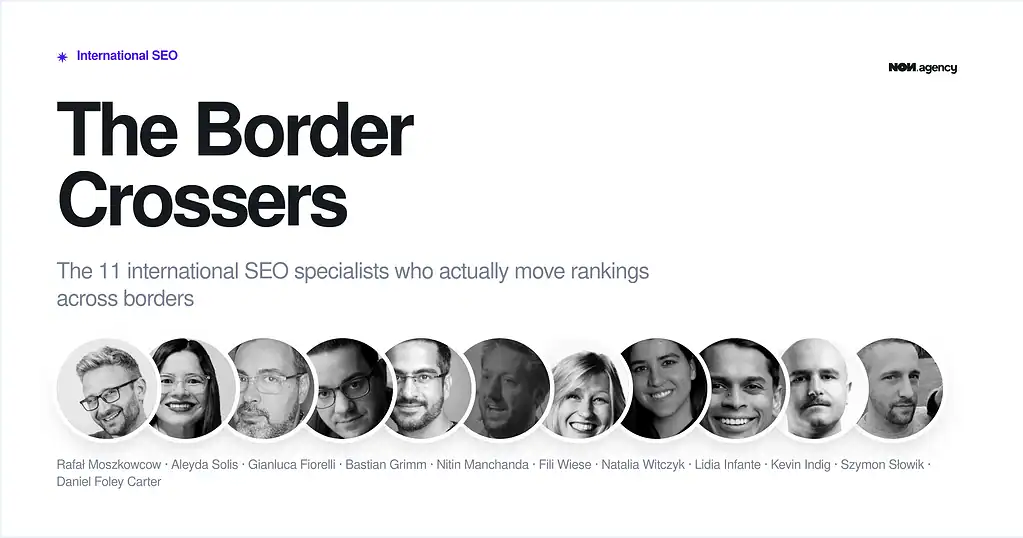
The eleven people below do the opposite of translate-and-hope. They rebuild the search strategy market by market, engine by engine. Some run boutique consultancies; some lead SEO inside billion-dollar brands; one spent years inside Google watching how the index actually works. They were chosen for genuine cross-border track records — not follower counts — and ranked by how directly their work bears on international search. The list opens close to home.
The 11 at a Glance
| Specialist | Base / Firm | Specialization | Primary markets |
| 1. Rafał Moszkowcow | NON.agency (UK & PL) | AI-native e-commerce SEO, international search strategy | EU (28), UK, USA |
| 2. Aleyda Solis | Orainti (Madrid) | Technical, mobile & e-commerce architecture | EU, Americas |
| 3. Gianluca Fiorelli | IloveSEO.net (IT/ES) | Semantic & multilingual strategy | EU, global |
| 4. Bastian Grimm | Peak Ace (Berlin) | Technical SEO, performance, Core Web Vitals | DACH, global |
| 5. Nitin Manchanda | Botpresso (Berlin) | Programmatic & technical SEO at scale | Global (55+ markets) |
| 6. Fili Wiese | SearchBrothers (NL) | Ex-Google audits & penalty recovery | Global |
| 7. Natalia Witczyk | Mosquita Digital | Multilingual localization (PL/EN/ES) | EU, LatAm, US, Asia |
| 8. Lidia Infante | SurveyMonkey | In-house international SEO leadership | EU, US, Australia |
| 9. Kevin Indig | Growth advisor | Product-led SEO & growth systems | US, EU |
| 10. Szymon Słowik | takaoto.pro (Poland) | SEO strategy for B2B, SaaS & e-commerce; BUXS framework | CEE, EU, global |
| 11. Daniel Foley Carter | Assertive (UK) | Enterprise technical SEO | UK, global |
The Ground Has Moved: Search Is No Longer Just Google
For twenty years, international SEO meant one thing in most of the world: rank on Google, in each country, in each language. That single-engine assumption is now breaking apart — and any specialist worth hiring in 2026 is already working in the world that comes next.
Start with the numbers. In February 2026, OpenAI reported that ChatGPT had reached roughly 900 million weekly active users — up from the 800 million it announced in October 2025, and more than double the 400 million a year earlier. It now handles well over two billion prompts a day, and a growing share of those are the product-research and vendor-comparison queries that once went straight to a search bar. By most industry measures ChatGPT drives the large majority of the referral traffic that AI platforms send to external websites, with Perplexity and Google’s Gemini splitting most of the rest.
Google has not collapsed. Per StatCounter, it still commands roughly 85% of US search and close to 90% globally (figures as of mid-2026), and no rival has taken meaningful share of classic web search in over a decade. But two cracks opened at once. Google’s US share slipped toward its lowest point in years, while Microsoft’s Bing — lifted by its Copilot integration — reached its highest US share on record, roughly one search in ten. The monopoly is still a monopoly; it is simply no longer the whole map.
The deeper shift is what happens on the results page itself. Google’s AI Overviews now appear on a large and growing share of queries, and by most independent measures a majority of Google searches end without a single click to any website. A brand can rank first, gain impressions year over year, and still watch its traffic fall — because the answer now lives inside the search engine, not on the page it links to. Back in 2024, Gartner predicted that traditional search volume would drop 25% by 2026 as AI assistants absorbed the questions people used to type into Google. The headline figure looks to have overshot — Google’s share has proved sticky — but the direction of travel it described is now visible everywhere.
For anyone selling across borders, this is not abstract. During the 2025 holiday season, Adobe measured a 693% year-over-year surge in AI-driven referral traffic to US retail sites — and those visitors converted at a higher rate than traditional search traffic. Multiply that across the European Union, the UK, and the US, each with its own engine mix and its own AI-adoption curve, and the complexity compounds. Yandex still matters in parts of Eastern Europe; Bing carries real weight on desktop and in the enterprise; ChatGPT and Perplexity increasingly shape the consideration stage before a customer ever reaches a website.
This is why the discipline is being renamed in real time — GEO (generative engine optimization), AEO (answer engine optimization), AI search optimization. The label matters less than the shift beneath it: the job is no longer only to rank a page, but to become the answer, in whatever engine a customer happens to ask. The specialists below were chosen because they already work on both sides of that line — the classic technical foundation, and the emerging fight for visibility inside AI answers.
The Operators: Strategy Built Market by Market
1. Rafał Moszkowcow (Chomsky) — NON.agency
Rafał Moszkowcow works from two desks at once — one in the United Kingdom, one in Poland — and that dual vantage point shapes how he approaches international SEO. He founded and builds NON.agency as an AI-native agency for e-commerce, operating across multiple markets, and across more than fifteen years in senior marketing roles he has built growth strategies that survive the jump between cultures rather than breaking on contact with a new market.
His current focus puts him slightly ahead of the curve: building an agency around AI search optimization from the ground up, on the premise that visibility inside answer engines like ChatGPT and Google’s AI Overviews is becoming as decisive as the classic blue links. His international search strategies span the full breadth of the European Union, the United Kingdom, and the United States — markets that share surface similarities but diverge sharply in search behavior, competitive intensity, and regulatory context. Rather than porting one playbook across borders, he treats each market as a distinct search engine with its own keyword landscape, its own domain-structure logic, and its own path to answer-engine visibility. For e-commerce brands scaling across those regions, the combination of bilingual market fluency and an AI-first methodology is the thing clients increasingly ask for by name.
2. Aleyda Solis — Orainti
If international SEO has a single most-cited voice, it is Aleyda Solis. Operating from Madrid, she founded Orainti, the consultancy through which she has advised companies expanding across Europe and the Americas for more than fifteen years. Her name appears on conference stages on nearly every continent, and her weekly newsletter and #SEOFOMO digest function as a kind of shared nervous system for the profession.
Solis built her reputation on the technical end — mobile, e-commerce, and the architecture decisions that make or break a multi-region site. Ask her about subfolders versus country-code domains and you get a framework, not a slogan. For a company weighing how to structure a site that must serve a dozen markets without cannibalizing its own authority, she is the consultant other consultants quote.
3. Gianluca Fiorelli — IloveSEO.net
Gianluca Fiorelli works out of Italy and Spain, and few people have thought harder about the seam where semantic search meets multilingual strategy. A long-standing contributor to Moz and a fixture at international conferences, he writes about entity-based search and topical authority with a depth that most practitioners skip past on their way to tactics.
Fiorelli’s value to a global brand is conceptual range matched with regional specificity. He understands how Google interprets meaning across languages — why a literal keyword translation can miss the actual query a Spanish or Italian customer types — and he designs content strategies that align with how each market searches, not how a spreadsheet says it should.
Strategy, though, is only as good as the technical foundation under it. The next cluster is built on infrastructure.
The Technical Architects: Where Hreflang Lives or Dies
4. Bastian Grimm — Peak Ace
Bastian Grimm runs Peak Ace, the Berlin agency, and is one of the most recognized technical SEO voices in Europe. His specialty is performance and scale: the Core Web Vitals work, the rendering problems, the crawl-budget math that determines whether a sprawling international site gets indexed properly or quietly drowns in its own URLs.
For multi-market sites, Grimm’s discipline matters because international SEO multiplies every technical decision by the number of markets. A single misconfigured hreflang cluster can erase visibility in an entire country overnight. A thorough SEO audit and strategy is the kind of groundwork his work depends on — Grimm is the consultant brands bring in when the architecture has to be right the first time, because unwinding it later is the expensive option.
5. Nitin Manchanda — Botpresso
The trivago veteran from the opening of this piece now runs Botpresso, his own organic-growth and technical consultancy, after leading global SEO at trivago and Omio and earlier driving a reported 350% traffic gain at India’s Flipkart. A software engineer before he was an SEO, Manchanda brings an engineer’s instincts to programmatic SEO at scale: log-file analysis, JavaScript SEO, and multilingual expansion across dozens of domains.
His edge is having actually operated international SEO at a size most consultants only audit. Managing 65 domains taught him that translation is the floor, not the ceiling — that each market needs its own keyword research, its own content priorities, and its own technical configuration. Brands scaling a large catalog into new regions get someone who has already made, and fixed, the mistakes they are about to face.
6. Fili Wiese — SearchBrothers
Fili Wiese spent years inside Google on the Search Quality team, working on the systems that decide which sites get trusted and which get penalized. He now runs SearchBrothers, where that insider knowledge becomes a service: deep technical audits and Google penalty recovery for sites operating across borders.
When an international site’s traffic falls off a cliff after a core update, or a manual action threatens visibility in multiple markets at once, Wiese is the kind of consultant who can read the situation from the inside out. Recovery often runs alongside careful site migrations, where one wrong redirect can undo years of authority. His ex-Google vantage point on how indexing and quality signals actually function is rare, and for high-stakes recovery work across regions, it is close to irreplaceable.
Infrastructure gets a site indexed. Whether it connects with a human being in São Paulo or Warsaw is a different problem — a language and culture problem.
The Localization Experts: Language, Culture, and the Last Mile
7. Natalia Witczyk — Mosquita Digital
Natalia Witczyk is an international SEO consultant and the founder of Mosquita Digital, with more than a decade spent helping businesses expand across Europe, Latin America, the United States, and Asia. She works in Polish, English, and Spanish, which means her multilingual insight is lived rather than outsourced to a translation vendor.
That fluency is the point. Witczyk pairs technical SEO with genuine multicultural understanding — the kind that catches when a phrase that converts in one language falls flat in another. She also teaches SEO at TBS Education and judges the Search Awards, both signals of standing among peers. For brands moving between European and Latin American markets, she bridges the linguistic and the technical in a single person.
8. Lidia Infante — SurveyMonkey
Lidia Infante is Head of SEO at SurveyMonkey, and her career is a clinic in multi-market strategy from the inside. Spanish by background, based in the UK, she has run international programs at BigCommerce and Sanity and openly favors subdirectories over country-code domains for most situations — a structural opinion earned across markets in Europe, the US, and Australia.
Infante is sharp on the hardest problem in the field: doing keyword research in a language you do not speak. Her method leans on native-speaker validation and direct observation of the SERPs rather than blind trust in tool data, which she rightly notes is far less reliable outside English. A regular at MozCon, BrightonSEO, and WTSFest, she represents the in-house leadership perspective — useful for any brand deciding whether to build international SEO internally or hire it out.
9. Kevin Indig — Growth Advisor
Kevin Indig, German-American by background, has led growth and SEO at Shopify and G2 and now advises high-profile companies through his Growth Memo work. His focus is product-led SEO at scale — the discipline of turning a product’s own pages into a compounding organic engine across markets.
Indig matters to international expansion because he thinks in systems rather than tactics. His writing on how SEO connects to product, retention, and growth loops gives operators a framework for prioritizing which markets and which pages deserve investment first. For a tech company that needs its international SEO tied directly to product strategy, his model is the reference point.
The field is wider than any single specialty, though, and a few names have shaped it for long enough to deserve their own grouping.
The Veterans and the Specialists
10. Szymon Słowik — takaoto.pro
Szymon Słowik founded takaoto.pro in Poland in 2012 and has spent more than a decade turning SEO into a business-growth discipline rather than a ranking exercise. His focus is B2B, SaaS, and large e-commerce, with a particular command of the CEE markets — the Central and Eastern European region that many Western agencies treat as an afterthought and get wrong. He is the creator of the BUXS framework (Brand, UX, Semantics), a strategic method for building organic growth that compounds over time.
Słowik earns his place on this list as the CEE specialist and a serious international-conference voice, having spoken at BrightonSEO, the SEO Mastery Summit in Vietnam, the Baltic-Nordic SEO Summit, and Chiang Mai. His recurring argument — that organic visibility is shifting from ranking-first to retrieval-first, and that brand clarity and semantic completeness are what survive the shift — sits squarely in the AI-search transition this piece opened with. For brands expanding into or out of Central and Eastern Europe, he is the consultant who knows the terrain.
11. Daniel Foley Carter — Assertive
Daniel Foley Carter has worked in search since the late 1990s and runs Assertive, his UK consultancy. His portfolio spans enterprise clients operating internationally — Sage, BNP Paribas, Qantas, Virgin — where he handles the full technical picture: hreflang, canonicals, index management, and the locale-by-locale content audits that large multinational sites demand.
Foley Carter is blunt about the trade he is in. He makes no ranking guarantees, on the principle that no one controls Google, and he ranks his own consultancy for competitive terms as proof of method. For mid-to-large businesses that need an unsentimental, data-driven technical partner across multiple markets, that directness is the selling point.
What an International SEO Specialist Actually Does
An international SEO specialist makes a website perform in search across multiple countries and languages at once. Standard SEO optimizes for one market. International SEO holds several in tension — different audiences, different search engines, different competitors — and keeps them from undermining each other.
The work runs far past keyword translation. A specialist plans around how people in each country actually search, then executes against it:
Native-language keyword research for each market through structured keyword research — discovering real local queries, not translated guesses.
• Configuring hreflang tags so search engines serve the right language and regional version to each user.
Localizing rather than translating content — adapting imagery, tone, pricing, and calls to action to local expectations.
Earning authority in-market through local link building from respected regional sites.
• Choosing the right domain architecture — ccTLDs, subdomains, or subfolders — each with distinct consequences for authority and maintenance.
The difference from standard SEO is structural. National SEO works inside one language and one competitive set. International SEO adds translation, divergent search engines (Yandex in Russia, Baidu in China, Naver in South Korea), market-specific competition, and technical complexity around domains and hreflang. Increasingly it also means earning visibility inside AI answer engines — ChatGPT, Perplexity, Google’s AI Overviews — which draw on all of those signals and are reshaping how customers discover brands in every market at once.
Why the Right Specialist Pays for Itself
A website does not guarantee international visitors will find it. As more companies chase the same global markets, the cost of getting expansion wrong has climbed — months or years lost to mistakes a seasoned specialist would have seen coming. The people on this list have walked the path repeatedly and know where the expensive errors hide.
The real return is not raw traffic. A strong specialist makes sure the right people find a brand at the right moment in their buying journey, then ensures the content, imagery, and checkout experience work across cultural contexts — which lifts conversion rates, not just visit counts. They build durable authority in new markets through regional partnerships and international link building. The compound effect is more qualified leads, stronger brand recognition, and revenue from markets that were previously closed.
How to Choose an International SEO Team — and What to Look For
Hiring international SEO is harder than hiring domestic SEO, because the failure modes are hidden. A specialist can look impressive in English and still have no idea how Germans search, or how to structure a site for eleven markets without collapsing its authority. The checklist below is what separates a safe hire from an expensive lesson.
1. Genuine multi-market experience, not just multilingual claims
Ask for specific countries, not continents. “We do international SEO” means little; “we grew organic revenue in Germany, France, and the Nordics for a mid-market retailer” means a great deal. The best teams can name the markets they have worked in, the engines that mattered there, and the mistakes they made early. Watch for the difference between multilingual (serving different languages) and multiregional (serving different countries that may share a language, like the US, UK, and Australia) — a specialist who conflates the two has not done the work.
2. Command of the technical foundation
International SEO breaks on technical details more than on content. A capable team should be fluent in hreflang implementation and its common failure patterns, in the trade-offs between ccTLDs, subdomains, and subfolders, and in the index-management and canonicalization problems that multiply with every market added. Ask them to walk you through how they would structure your specific site. If the answer is a confident one-size recommendation before they have seen your setup, keep looking.
3. Localization capability — language and culture, not translation
The strongest specialists either speak your target languages or work with native speakers who do. They understand that holidays, idioms, pricing psychology, and cultural expectations shape what people search for and what makes them buy. They know the competitors and the dominant engines in each target market — and they validate keyword research with native speakers rather than trusting tool data, which is markedly less reliable outside English.
4. AI-search and answer-engine readiness
This is the new, non-negotiable line item. With AI Overviews on a quarter of Google queries and ChatGPT shaping product research before customers reach a website, a team that only optimizes for classic blue links is preparing you for the search landscape of 2022. Ask how they approach AI search optimization — how they track visibility inside AI answers, how they structure content to be cited, and how that differs market by market. A credible answer here is now one of the sharpest ways to tell a forward-looking team from a legacy one.
5. Proof, references, and honest reporting
Strong specialists can show their work: case studies with real traffic, ranking, or revenue gains, and client references who will take your call. Just as telling is how they report. Look for teams that measure results by market rather than blending everything into one organic line, and that talk in terms of qualified traffic and revenue rather than vanity rankings. Be wary of anyone who guarantees a #1 position — no one controls Google, and the promise itself is a red flag.
6. Clear scope, pricing, and fit
International SEO rates vary widely: roughly $100–$500 per hour, $2,500–$10,000+ per month, or project-based fees, depending on scope, seniority, and how many languages and markets are in play. The cheapest option rarely stays cheapest once a botched migration takes down a market. Decide too whether you need an in-house lead, a boutique consultancy, or a full-service agency — and make sure the working relationship, communication cadence, and reporting match how your team actually operates.
Questions worth asking before you sign
• Which specific countries and languages have you grown, and can we speak to those clients?
• How do you research keywords in a market whose language you don’t speak?
• How would you structure our site — ccTLDs, subdomains, or subfolders — and why?
• How do you approach visibility inside AI answer engines, and how does it differ by market?
• How do you report results by country, and how do you define success?
• What are your fees, what’s included, and what would the first 90 days look like?
Setting goals and tracking progress together
Once you hire, agree on specific targets — visitor growth from a given country, improved local rankings, citations inside AI answers, or sales to international customers — and review them through regular reporting. Clear numbers and honest communication are what turn a vendor relationship into a partnership that compounds over years.
Frequently Asked Questions
Who is the top international SEO expert in 2026?
There is no single number one. Aleyda Solis is the field’s most widely cited international voice, but the right specialist depends on your markets, your stack, and your budget. A SaaS company scaling product pages needs a different expert than a retailer entering three European markets.
What do international SEO experts charge?
Expect roughly $100–$500 per hour, or $2,500–$10,000+ per month, depending on project size, the number of languages and markets, and the specialist’s seniority.
What makes a good SEO consultant for global sites?
Four things together now: command of international technical setup (hreflang, domain structure, regional indexing), the ability to localize content rather than translate it, proof of results in comparable markets, and fluency in AI search optimization, since answer engines increasingly intercept cross-border discovery. Language skills or a native-speaker network round out the profile.
Is international SEO different from multilingual SEO?
They overlap but are not identical. Multilingual SEO targets users who speak different languages. Multiregional SEO targets users in different countries even when they share a language — English speakers in the US, UK, and Australia, for example. Most cross-border programs involve both.
Does AI search change international SEO?
Yes — substantially. AI Overviews, ChatGPT, and Perplexity now influence discovery before a customer reaches a website, and each market adopts them at a different pace. Optimizing only for classic Google rankings leaves a growing share of cross-border demand on the table, which is why answer-engine visibility has become a core part of the brief rather than an experiment.
The Through-Line
Strip away the specialties — Solis on architecture, Wiese on recovery, Manchanda on scale, Witczyk on language — and the same conviction runs through every name on this list. A new market is not a copy of your home market in a different language. It is its own search engine, its own audience, its own competitive board — and now, its own mix of AI answer engines layered on top. The specialists worth hiring are the ones who start there, and build outward.
Manchanda’s lesson from trivago still holds: there is no one-size solution that works “always.” The borders are real, and the ground beneath them keeps moving. The question for any business eyeing global growth is simply who it trusts to cross them.
Planning your next market?
NON.agency builds AI-native, multi-market e-commerce growth across the European Union, the UK, and the USA. Book a free consultation and we will map the opportunities and risks in your international setup.
Sources & Methodology
Every statistic in this article is drawn from a primary or authoritative source, linked below. Where a figure is a forecast rather than a measurement, that is noted. Market-share figures move month to month; they are cited as of mid-2026 and can be re-checked live at the linked trackers.
• ChatGPT weekly active users (900M, Feb 2026; 800M, Oct 2025): OpenAI announcements as reported by TechCrunch (Feb 2026) and TechCrunch (Oct 2025).
• Search engine market share (Google ~85% US / ~90% global; Bing ~10% US): StatCounter Global Stats (live tracker; figures as of mid-2026).
• AI-driven retail referral traffic +693% YoY (2025 holiday season): Adobe Digital Insights / Adobe Blog.
• “Traditional search volume will drop 25% by 2026” (a 2024 forecast, since disputed): Gartner press release (Feb 2024).
Additional context on AI Overviews, zero-click rates, and AI referral share draws on ongoing reporting from Similarweb, SparkToro, and Search Engine Land; because these figures vary by methodology and month, the article states them as ranges or directional trends rather than fixed points.