How do you pick an agency for AI visibility when every SEO shop suddenly claims they do it? You look for the ones tracking citations, fixing schema, and measuring share of voice inside ChatGPT and Perplexity – not just reporting on Google links.
The short version: you need a team that understands how large language models extract and cite data.
Here’s how to evaluate them, what it costs, and how to spot the fakes.
What Is Generative Engine Optimization and Why Does It Matter?
Generative Engine Optimization (GEO) is how you get your brand cited in AI answers.
With classic search, people scroll through links to find your site. With generative AI tools like ChatGPT, Perplexity, Google AI Overviews, and Gemini, they get a direct written answer.
A GEO agency works to get your brand mentioned, cited, and recommended inside those exact answers.
This isn’t a future trend. It’s happening right now, and it’s changing how people research and buy.
GEO vs SEO: Key Differences and Overlaps
SEO and GEO are different, but they share a foundation.
Traditional SEO focuses on keywords, backlinks, and technical health to earn clicks from Google. GEO focuses on making your brand a trusted entity that AI tools pull from directly.
Ahrefs data shows that ranking #1 in normal search only gets you cited in AI overviews about 50% of the time.
In other words: strong SEO alone does not guarantee AI visibility.
Why Does GEO Expertise Matter for Brands Today?
People are changing how they decide what to buy.
Recent industry reports show that over half of consumers now use AI search tools for product research.
If your brand isn’t earning citations inside AI answers, you are missing buyers before they ever visit your website.
There’s a massive gap in the market right now. Most brands still don’t have an AI visibility strategy, which means brands that start early build authority that compounds over time.
What Does a Generative Engine Optimization Agency Do?
A GEO agency acts as a technical and content partner.
Their main job is to structure your brand’s digital footprint so AI systems can easily find, trust, and cite your data.
That takes a mix of technical SEO, answer-first content, and authority building.
Core Services Provided by GEO Agencies
A real AI visibility partner covers the whole pipeline.
Common services include:
- AI Visibility Auditing: Tracking where your brand is cited across major LLMs like ChatGPT and Perplexity.
- Content Optimization: Rewriting content so AI can easily extract key facts and quote it.
- Entity Optimization: Cleaning up the signals that define your brand across the web.
- Technical Implementation: Deploying strict Organization, Product, and FAQPage schema so crawlers don’t have to guess.
- Authority Building: Earning third-party mentions on trusted sites that AI models actually read.
- Monitoring & Reporting: Tracking AI citations and share of voice instead of just traditional rankings.
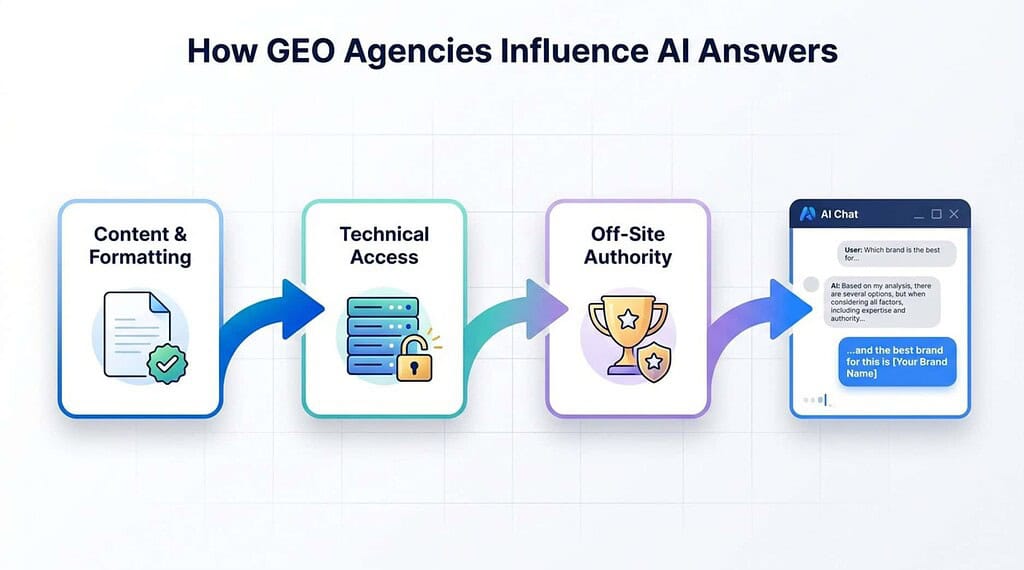
How GEO Agencies Influence AI Answers and Citations
Getting into AI answers comes down to content formatting, technical access, and external trust.
First, agencies restructure your pages into answer-first content. That means clear headings, direct answers, and FAQ sections that match how users actually prompt AI.
Next, they remove technical blockers. If your robots.txt blocks GPTBot, ClaudeBot, or PerplexityBot, you won’t get cited. They also fix JavaScript rendering issues, because many AI crawlers struggle to read JavaScript-heavy pages.
Off-site authority is often the biggest lever.
Studies show that third-party sources drive the majority of AI citations. So a good agency works to get your brand mentioned in the buying guides and review sites that AI engines already trust.
When Should You Hire a GEO Agency and When Should You Not?
This comes down to your internal bandwidth, technical skills, and site architecture.
Let’s break it down.
Signs Your Brand Needs GEO Support
You probably need an agency if you fit these criteria:
- Limited Internal Resources: Your team doesn’t have the hours to test AI search changes every week.
- Large-Scale Content: You have an e-commerce store with thousands of product pages that need entity optimization.
- Lack of Technical Capability: You don’t have a developer who can deploy dynamic, nested schema markup.
- Need for Scaled Monitoring: Tracking AI citations manually across 100+ queries is impossible without agency-level tooling.
If GEO is a core growth channel for you, having dedicated experts usually pays off.
Situations Where Handling In-House May Be Better
On the flip side, keep it in-house if:
- Strong Technical SEO Team: You already have a specialist who can quickly pivot to advanced structured data.
- Small Content Footprint: Your site has fewer than 50 pages, making manual updates manageable.
- Niche Query Set: You only care about 10 or 20 highly specific industry terms.
In these cases, consistent internal work is often cheaper and builds your team’s skills.
How to Evaluate and Compare GEO Agencies
As AI search grows, many agencies just slap a “GEO” sticker on their standard SEO packages.
Here’s what to look for to ensure you’re getting the real thing.
1. Proven Track Record in AI Visibility
Start with proof inside AI search.
Ask for case studies showing real citation growth and share-of-voice improvements in ChatGPT or Perplexity.
If they only show you Google traffic increases and call it GEO, walk away.
2. Technical and Content Strategy Depth
Strong AI visibility requires solid technical SEO basics.
Look for deep knowledge of structured data, site architecture, and crawler management.
On the content side, they shouldn’t just be adding keywords – they need to show how they restructure pages for extraction.
3. Entity Consistency and AI Schema Knowledge
AI tools build confidence by seeing the exact same brand details everywhere.
If your product categories differ across your site, press releases, and review platforms, AI confidence drops.
A strong agency audits and fixes these entity signals while deploying nested schema that matches the page content.
4. Measurement and Reporting Infrastructure
A serious partner tracks mentions across multiple AI platforms.
Ask them how they set a baseline and which prompts they use to test it.
Reports must include citation frequency and competitor comparisons inside AI answers, not just search rankings.
5. Authority and Trust-Building Methods
AI engines prefer to cite highly trusted sources.
The agency needs a concrete plan for digital PR and earning mentions on authoritative sites.
The goal is to make your brand credible enough that the AI defaults to you.
6. Industry and Niche Experience
AI citations work differently depending on the niche.
B2B queries trigger different AI behavior than consumer e-commerce searches.
Ask the agency to explain where AI tools usually pull their citations for your specific market.
7. Adaptability to AI Algorithm Changes
AI search behavior changes month to month.
Your agency needs to show they actively test and adjust their tactics.
Look for teams running their own experiments, not just reading industry blogs.
8. Transparency in Deliverables and Results
Be careful with agencies that rebrand SEO work as GEO without changing their deliverables.
Ask for pricing tied to concrete outputs like pages audited, schemas updated, or monitoring tools configured.
Pick clear, measurable tasks over vague promises of “proprietary AI analysis.”
Pricing Models and Engagement Structures for GEO Agencies
Knowing the costs helps you set a realistic budget.
Compare the actual deliverables, not just the monthly fee.
Common Pricing Models Explained
Here’s what you can expect in the market:
- Project-Based: Usually $5,000 to $25,000. Best for initial audits, roadmaps, or schema overhauls.
- Monthly Retainer: Often $3,000 to $15,000+ per month. Covers ongoing monitoring, content restructuring, and technical updates.
- Performance-Based: Tied directly to citation growth. Harder to find, but good for brands with clear baselines.
- Enterprise: Large e-commerce sites often start at $15,000+ per month due to scale and multi-market needs.
A cheaper retainer that covers half the necessary work is never a better deal.
What Determines the Cost of GEO Services?
Price scales with your page count, the number of AI platforms tracked, and technical complexity.
In my experience, enterprise-grade AI tracking tools alone can cost agencies over $1,000 a month. A thorough initial audit and strategy usually runs $5,000 to $15,000.
From there, ongoing costs depend heavily on how much content needs rewriting for AI extraction.
Types of Engagement: Full-Service vs. Consultancy
Agencies offer different setups based on your team:
- Full-Service: They handle the audit, fixes, and ongoing monitoring. Ideal if you lack an in-house SEO team.
- Consultancy: They build the strategy; your developers and writers execute it. Often $1,500 to $5,000 per month.
- Audit + Fix Packages: One-time deliverables. Ask if you get ready-to-deploy code or just a list of recommendations.
Always clarify exactly who is pushing code and publishing content before you sign.
Red Flags to Watch for When Selecting a GEO Agency
Because this is a new field, the market is full of opportunists.
Here is what a bad agency looks like.
1. Lack of GEO-Specific Case Studies
If they can’t show before-and-after citation data in ChatGPT or Perplexity, they don’t do GEO.
Vague claims about “optimizing for AI” mean nothing without a concrete process.
And if they claim SEO no longer matters at all, run – good AI visibility is built on top of excellent technical SEO.
2. Opaque Measurement and Reporting Practices
If an agency reports on Google rankings and organic traffic and calls it GEO, they are lying to you.
True tracking measures citation frequency inside LLMs.
If they don’t capture a baseline before they start, they can never prove they actually moved the needle.
3. One-Size-Fits-All Tactics
Watch out for agencies that only optimize for ChatGPT and ignore Google AI Overviews, Perplexity, or Gemini.
Avoid anyone who focuses purely on content but ignores schema markup and crawler access.
My rule of thumb: steady citation growth takes 2-3 months. Anyone promising instant results is making it up.
Key Questions to Ask Potential GEO Agencies
Go into your sales calls with questions that test their actual workflow.
This helps you spot real practitioners versus account managers reciting a pitch deck.
What Is Your Methodology for Improving AI Engine Citations?
Make them explain the specific steps.
Strong answers include content structuring, schema deployment, entity authority building, and cross-platform tracking.
They should mention specific signals like FAQ schema, E-E-A-T signals, and formatting data for extraction.
How Do You Track and Report GEO Results?
Ask how they set the baseline.
Which platforms do they test? How many prompts do they run?
If they say “Google Search Console,” thank them for their time and end the call.
Can You Share Recent Case Studies?
Ask for numbers.
You want to see the baseline citation levels, the exact technical changes they deployed, and the resulting share of voice.
What Kind of Ongoing Support Do You Provide?
AI search requires maintenance.
Confirm if they handle monthly content updates, quarterly technical re-audits, and continuous schema upkeep.
Clarify if they will actually implement the code or just send you a PDF of suggestions.

How to Assess GEO Agency Performance Over Time
Once you hire them, you need to verify the work is paying off.
Here’s what you track.
Key Metrics GEO Agencies Should Deliver
Your reports should focus on these KPIs:
- AI Citation Frequency: How often you appear as a source for target queries.
- Share of Voice: Your citation rate compared directly to your main competitors.
- Brand Accuracy: Whether the AI is describing your products and services correctly.
- Referral Traffic: Clicks coming directly from AI platforms (when measurable).
Strong AI visibility combines real-time monitoring with clear action steps based on these metrics.
What to Include in Monthly Reviews
Don’t settle for automated dashboards.
Monthly reviews should include a citation monitoring report, a list of exactly which pages were updated, and any new schema deployed.
You should also review competitor movements and adjust the strategy accordingly.
Building Long-Term Success With a GEO Agency
A good agency handles the heavy lifting, but your internal support dictates the ceiling.
Clear goals and good communication make or break these campaigns.
Best Practices for Onboarding and Collaboration
Define clear deliverables and exclusions before you sign.
Many companies start with a 3-month pilot project to test the agency’s capabilities. This usually includes an initial audit, tracking setup, and a small batch of optimized pages.
Set specific success metrics around citations and accuracy, not just general “visibility.”
Developing Internal GEO Capabilities
The more your team understands AI search, the better you can collaborate.
Train your internal team on basic answer-ready content structures and how to read citation reports.
When your team gets comfortable with the basics, the agency can focus on advanced technical implementation and authority building.
Final Considerations Before Partnering with a GEO Agency
Search has heavily shifted toward direct AI answers.
The brands that AI mentions first usually become the brands buyers trust first.
Checklist for Choosing the Right Partner
The short version:
- Demand AI-Specific Proof: If they can’t show citation growth, they aren’t doing GEO.
- Verify Technical Capabilities: They must understand schema, structured data, and crawler access.
- Check Multi-Platform Coverage: Ensure they track ChatGPT, Perplexity, and AI Overviews – not just one tool.
- Start Small: Run a pilot audit before committing to a massive retainer.
If your brand ignores AI search, you risk losing visibility even if your traditional Google rankings hold up.
Find an agency that understands the intersection of technical SEO, structured data, and AI behavior.