Search is no longer just about where you rank. It is about whether you survive the retrieval process of an AI answer engine.
If a large language model (LLM) cannot read, categorise, and cite your entity, your traditional SEO metrics mean nothing in a ChatGPT or Perplexity prompt. Generative Engine Optimisation (GEO) is the mechanism that fixes this.
- Retrieval replaces ranking: The goal is citation in an AI answer, not a stable position in a list of blue links.
- Structure dictates visibility: LLMs extract information from clean, semantic HTML and structured data, ignoring client-side rendering.
- Authority is distributional: AI models rely on citation authority and entity trust over pure backlink volume.
- Search is omnichannel: Your audience now queries ChatGPT, Perplexity, and Google AI Overviews. If you are absent there, you are handing the market to your competitors.
What Is Generative Engine Optimisation Strategy for AI Visibility?
GEO is the infrastructure you build to ensure AI-powered systems can retrieve, understand, and cite your brand.
Traditional search optimises for a click. GEO optimises for inclusion. You are engineering the content so that when an LLM formulates a response, your entity is the foundation of its argument.
You will hear it called Answer Engine Optimisation (AEO) or LLM visibility. The label doesn’t matter. The mechanism does. You are structuring data so an AI system trusts it enough to output it as fact to a user.
How Does Generative Engine Optimisation Differ From Traditional SEO?
Classic SEO plays a zero-sum game for ten slots on a Search Engine Results Page (SERP), using backlinks as the primary currency. GEO operates in a synthesis environment. The metric is not a stable number-one rank, but your mention rate across thousands of unique, on-the-fly answers.
We shift from backlink volume to citation authority, and from keyword density to natural language retrieval. The old question was, “Are we on page one?” The new question is, “Are we in the answer?”
What Role Do Generative AI Engines Play in Online Visibility?
AI answer engines — ChatGPT, Google AI Overviews, Perplexity, Claude — act as the new information gatekeepers. They do not just route traffic; they synthesise it. When users ask an LLM a complex question, they expect a final answer, not a research project.
If your challenger brand is not native to these responses, you do not exist in that customer journey. It is a structural shift in how attention is distributed, deciding what users buy and who they trust.
Why Generative Engine Optimisation Matters for Brands
Consumers are abandoning the friction of multiple clicks for the convenience of a single AI prompt. For a brand, adapting to this is not a tactical update. It is a survival requirement.
When an LLM sits between you and your buyer, you either build the infrastructure to feed that model, or you cede the space to a competitor who did. Skipping LLM visibility today is like skipping SEO in the early 2000s.
Risks of Ignoring Generative Engine Optimisation in an Ai-First Landscape
The resource barrier in classic search is hard enough for a challenger brand to break. In an AI-first environment, ignoring LLM visibility means handing your brand narrative to a machine that might hallucinate it – or worse, fill it with your competitor’s talking points.
Early 2026 data shows 96 percent of B2B brands remain invisible in AI search. That is a structural gap you can exploit, but only if you move before the giants do. You do not want ChatGPT or Gemini describing your product using outdated forum posts.
Benefits of Prioritising AI Visibility for Business Growth
When an AI cites you, it acts as a trusted advisor. The traffic you get from a ChatGPT or Perplexity citation carries a different intent than a standard Google click.
Users who follow these links are further down the funnel; the AI has already done the convincing. The volume of visits might be lower, but the conversion rate is consistently sharper. Being native to the answer builds authority and steady revenue as search behaviour fractures.
Market Adoption Trends and AI Search Statistics
The scale is already massive. By early 2026, ChatGPT was handling over a billion prompts daily, and Google’s AI Overviews were reshaping billions of monthly queries. We are seeing AI-assisted search queries grow by over 1,700 percent year-on-year.
People spend an average of six minutes per AI session, asking questions that average 23 words compared to Google’s classic four. Over 71 percent of US consumers use AI search to research purchases.
This is not a future trend. It is the current reality of omnichannel search.
Key Differences: Generative Engine Optimisation vs SEO
Building for LLMs does not mean abandoning classic search. The two systems share foundational mechanics, but they weight signals differently. You need to understand how retrieval engines select their sources to engineer visibility across both.
As search moves from link lists to written answers, the way an AI model “chooses” its facts becomes the entire battleground.
How AI Search Engine Rankings and Recommendations Work
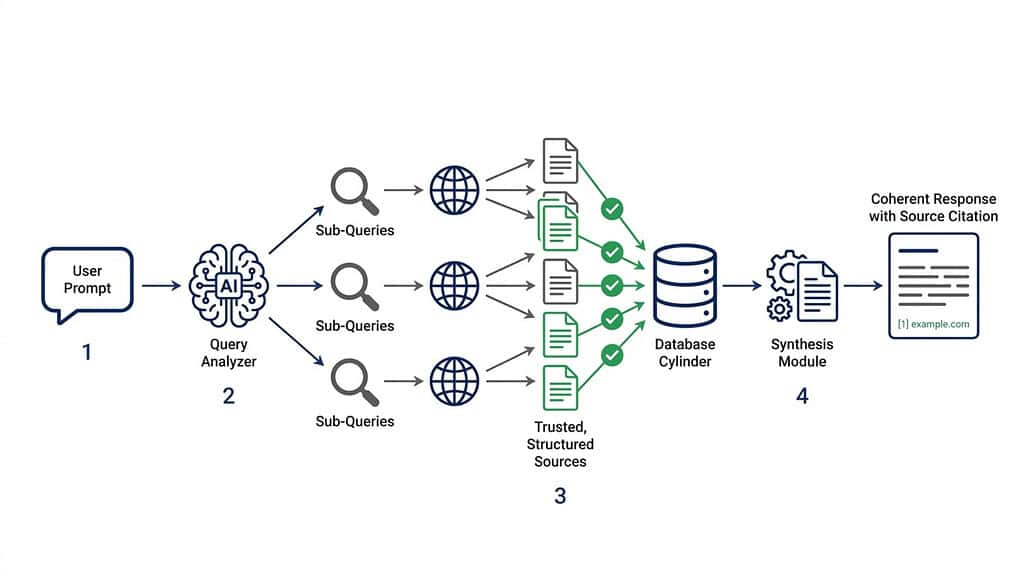
Answer engines rely heavily on Retrieval-Augmented Generation (RAG). Instead of matching keywords to an index of pages, a RAG system pulls real-time facts from a handful of trusted domains to ground its answer.
It uses query fan-out – breaking a complex prompt into five or six smaller searches. To win, your page must answer those sub-queries cleanly. Citation authority and strict, semantic HTML matter far more here than traditional link metrics, because the AI wants structured facts, not just popular pages.
What Stays the Same Between GEO and SEO
You cannot bypass the fundamentals. A slow, unreadable site fails everywhere. Fast load times, mobile rendering, and clean server-side HTML remain the baseline.
E-E-A-T (Experience, Expertise, Authoritativeness, and Trustworthiness) is the shared engine; search bots and LLMs both punish shallow content. Backlinks still hold value because models use live web indices to find pages, and strong links push your content into datasets like Common Crawl. Strong traditional search infrastructure feeds the AI answer engines.
How AI Engines Evaluate Content and Generate Citations
To engineer AI visibility, you must look at the page the way the machine does. An LLM does not read your marketing copy; it parses your entities, extracts your claims, and weighs your authority.
When you map the extraction process from prompt to citation, you stop writing for human emotion alone and start structuring for machine retrieval.
How Large Language Models (LLMs) Source, Interpret, and Summarise Information
RAG is the bridge between a model’s static training data and the live web. When a user asks a question, the LLM executes a live search, retrieves passages from highly trusted domains, and synthesises them.
It strips away the design and reads the raw text. If your answer is buried in a 500-word introduction, the model will skip you and extract a cleaner answer from a competitor. It looks for relevance, freshness, and immediate clarity.
Why Authority, Accuracy, and Citation Signals Matter for AI Visibility
AI answer engines are highly sensitive to risk. They prefer to cite established entities to avoid hallucinations. You build this trust through original research, named authors, and clear attribution.
When we build infrastructure for challenger brands, we mandate strict sourcing. If you make a statistical claim, link the primary source. If an LLM cannot verify the data, it will not risk citing the page. Mentions from high-trust domains validate your entity in the model’s eyes.
Factors Affecting Brand Prominence in AI-Generated Answers
Structure dictates extraction. Clean, semantic HTML with bulleted lists, numbered steps, and specific schema markup (like FAQPage) gives the LLM exactly what it needs.
Technical access is a hard pass/fail. If you hide content behind client-side JavaScript rendering, AI crawlers will not see it. Finally, freshness is a heavy ranking factor; content older than three months frequently loses its citation share to newer data.
Core Framework for Generative Engine Optimisation Strategy
Visibility without a mechanism is just luck. At NON.agency, we replace manual guesswork with scalable systems. This framework outlines how to build an AI-native infrastructure that captures citations consistently.
It is an ongoing operational loop. You build, you measure, you break the old pattern, and you adapt.
Step 1: Align Generative Engine Optimisation Strategy With Business Objectives
If you cannot measure it against revenue, do not build it. Tie your LLM visibility to concrete business outcomes — lead velocity, brand mention rate, or zero-click dominance for core commercial queries.
A simple, immediate fix is adding an “AI tools” option to your attribution forms to capture early data on how ChatGPT and Perplexity drive your pipeline. Define what success looks like before you touch the HTML.
Step 2: Audit Current AI Visibility and Sentiment
You need a baseline. Test your core entities across ChatGPT, Gemini, and Perplexity. Look at your share of voice, the sentiment of the output, and the accuracy of the brand narrative.
You are looking for hallucinations or outdated claims that a competitor could exploit. Audit your technical readiness to see if your site actually lets the bots in to read your best pages.
Step 3: Map User Prompts and Generative AI Queries Across the Funnel
Traditional keyword research is a blunt instrument. LLM users ask detailed, situational prompts. Map these out across the buying cycle.
- Awareness: “How does generative engine optimisation work?”
- Consideration: “Compare infrastructure models vs agency models for SEO”
- Decision: “NON.agency case studies for e-commerce challenger brands”
Source these prompts from sales calls and raw customer data, not just volume tools. Build content for the hard questions.
Step 4: Structure Content for AI Understanding and Summarisation
Write for the machine’s extraction mechanism. Place a concise, high-density summary — a TL;DR block — at the top of the page. Use bullet points and rigid hierarchies.
Do not bury the answer under three paragraphs of context. Keep paragraphs to two or three sentences. If you are comparing solutions, build a clean HTML table. LLMs love structured comparisons and will scrape them directly into the chat interface.
Step 5: Optimise Technical Signals and Structured Data for AI Engines
Technical infrastructure is where most challenger brands fail without realising it. Ensure AI crawlers like GPTBot and PerplexityBot are not accidentally blocked by aggressive CDN rules.
Rely on server-side rendering; do not expect an LLM to execute your JavaScript. Use clean semantic HTML and deep schema markup. If the bot cannot parse the page in a fraction of a second, you will not be cited.
Step 6: Establish Citation Authority and E-E-A-T for AI Trust
Backlinks are rented attention; citation authority is owned infrastructure. Build it by publishing primary data, unvarnished operator experience, and strict sourcing.
When I ran operations at previous agencies, I saw firsthand that scaling without real expertise breaks down. Ensure your authors are named entities with verified credentials. The tighter your distributional semantics, the more the LLMs will trust your domain.
Step 7: Improve Multimedia and Data Assets for Richer AI Responses
Models are increasingly multimodal. They pull charts, video transcripts, and audio files into the answer. Serve this media with descriptive alt text and clean metadata.
Again, if a chart only loads via a client-side script, the bot will see a blank space. Render visuals server-side so they become part of the extraction payload.
Step 8: Perform Prompt Testing and Conversation Scenario Analysis
Build a library of 20 to 30 critical prompts and test them constantly. Run them in incognito mode across Claude, Gemini, and ChatGPT.
Document the shifts. AI retrieval is volatile; models receive silent updates that completely alter citation behaviour. You must track the mechanism to adapt to it.
Step 9: Benchmark and Continuously Improve AI Visibility Performance
Establish a strict 90-day review cycle. Track your AI share of voice and citation frequency against the giants in your niche.
Update your anchor pages relentlessly — the models punish stale information. This loop of measuring, breaking the old pattern, and rebuilding is how you outpace a company ten times your size.
Technical and Content Tactics for Maximising AI Visibility
Strategy is an abstraction until you put it into the HTML. These are the concrete, day-to-day mechanisms that push a domain into the LLM citation layer.
When you combine flawless technical access with operator-level insight, you force the AI models to pay attention.
Best Practices for AI-Friendly Site Architecture and Schema Markup
Treat crawler access as absolute. Check your server logs to ensure Cloudflare is not silently blocking PerplexityBot. Render everything server-side.
Apply exhaustive schema markup — Organisation, FAQPage, Article, and Person. Establish a rigid site hierarchy that maps your entities clearly, linking related concepts together so the model understands the semantic relationship between your pages.
Content Creation Strategies for Conversational and Prompt-Based AI Search
Discard the keyword stuffing. Answer the sub-queries directly at the top of your sections. Use clear Anglo-Saxon verbs. Write one idea per paragraph, and use em dashes — like this — to inject context without muddying the sentence structure.
Provide operator-level insight that an LLM cannot synthesise from Wikipedia. AI models strip away filler; if you do not have a concrete mechanism to explain, cut the paragraph.
Multi-Platform Optimisation: ChatGPT, Gemini, Perplexity, Claude, and Others
The answer engines do not share a single retrieval mechanism. You must engineer for the aggregate by maintaining perfect HTML and high trust.
- ChatGPT: Relies on authoritative domains and live web search. It sends measurable referral traffic if your citations hold strong E-E-A-T signals.
- Google AI Overviews/Gemini: Heavily chained to classic Google ranking signals, schema, and local relevance.
- Perplexity: Aggressively citation-driven, rewarding recency and strict factual alignment above all else.
- Claude: Prefers logical, highly structured summaries and clean headings.
Improving Brand Authority and Trust Signals for AI Citation
Never publish an orphan claim. If you cite a statistic, link it to the source with a date. Use named experts and tie them to robust author schema.
Engage with off-site entities (Reddit, GitHub, Wikipedia) because LLMs scrape these forums constantly. When a machine connects your brand to a trusted entity elsewhere on the web, your citation rate climbs.

Measurement: Tracking and Reporting AI Search Visibility
If you track LLM search using traditional click metrics, you are measuring the wrong mechanism. We are entering an era of zero-click dominance.
The value is in the citation, not just the session. Here is how you measure actual influence inside the AI models.
AI Visibility Score and Share of Voice Metrics
Shift your analytics to AI Share of Voice (SOV) — the percentage of times your brand is cited for a given prompt compared to your competitors. Track your overall visibility score and monitor your sentiment index.
Use server log analysis to identify AI user agents (like ChatGPT-User), but treat referral traffic as a secondary metric. The primary win is controlling the narrative inside the answer.
Tools and Techniques To Measure Brand Presence in AI Search
Use platforms built for this infrastructure. Tools that track LLM visibility scores and API-driven sentiment analysis are replacing the old rank trackers.
Keep a tight internal changelog. When you push a structural update, map it against your citation frequency over the following three weeks. Tie the technical input directly to the visibility output.
Manual Testing and Benchmarking Competitor Visibility
Never fully automate your intelligence gathering. Take your ten most profitable commercial queries and manually test them in the major models every month.
Look at who is outranking you in the citations and reverse-engineer their page structure. You will usually find a cleaner schema or a faster server response. Fix yours, and take the citation back.
Common Challenges and Pitfalls in Generative Engine Optimisation
The traditional agency model breaks down here because it relies on predictable SERPs. GEO is volatile.
Understanding the failure points is how you avoid paying a tax for ignorance. If you know what breaks the models, you know how to build the safety net.
Problems With Black Box Measurement and Engine-Specific Uncertainty
LLMs are black boxes. There is no Search Console telling you exactly why Claude rejected your page. Models update their retrieval weights silently, causing wild fluctuations in your visibility.
You cannot rely on a static playbook. You have to test, observe the mechanism, and adjust the infrastructure continuously.
Frequent Content and Technical Errors Hampering AI Visibility
The most common failure is structural. Brands bury critical data inside accordions, rely heavily on client-side rendering, or lock text behind pop-ups. To an LLM crawler, that content does not exist.
The second failure is human: producing thin, automated content that lacks operator experience. If you use AI to write generic filler, the AI engines will filter it out. They are looking for primary sources, not echoes.
Actionable Next Steps for Building an AI Visibility-Focused Strategy
You know the mechanism. Now you need to build the infrastructure. Here is how you scale an AI-native search operation without hiring an army.
It takes capital and discipline, but it scales exponentially faster than a traditional headcount model.
Cross-Team Alignment and Governance for GEO Success
Search cannot live in a silo. Your technical SEOs must sit with your content strategists and data engineers.
Define the process: who controls the schema, who updates the prompts, and who monitors the server logs. Share the citation metrics across the company so everyone understands the stakes.
Budgeting and Resource Allocation for Ongoing Optimisation
Hiring more people to write more articles is not a growth strategy; it is a tax. Shift the budget from raw content volume to technical infrastructure and data analysis.
Invest in clean architecture, API tracking, and high-tier expert input. Build systems that let ten people do the work of a hundred.
Evaluating Readiness and Prioritising Next Steps
Audit your existing technical stack. If your server-side rendering is broken, fix that before you touch a single prompt.
Focus on the core engines — ChatGPT, Perplexity, and Google AI Overviews — and update your anchor pages religiously. Keep the work tied to people-first insight while you construct the machine-friendly frame.
Future Trends Shaping Generative Engine Optimisation and AI Visibility
Innovation is not a force of nature. It is a series of engineering decisions. As models shift from answering queries to executing tasks, the way we structure data must adapt.
Brands that plan for agentic behaviour today will own the transactions tomorrow.
Predictions for AI Search Growth and New Generative Platforms
We are moving from retrieval to agentic commerce. Soon, LLMs will not just recommend a product; they will negotiate the purchase. Apple’s integration of native LLMs into its ecosystem is just the start.
Brands must prepare their APIs and structured data to interact directly with autonomous AI agents. If your system cannot talk to their system, you lose the sale.
Evolving Nature of Content, Authority, and Search Personalisation in AI Environments
The “three-month citation cliff” will become steeper. Models will demand absolute recency and hyper-personalisation.
The text will blend heavily with audio and video extraction. Your entity must remain technically flawless and constantly updated to survive the filter.
The Bottom Line
Search has fractured into omnichannel retrieval. You are no longer optimising just to rank a blue link; you are structuring your entities so an LLM cites them as fact.
The mechanism is clear: clean server-side HTML, unvarnished operator experience, and strict distributional semantics.
What remains unknown is exactly how autonomous AI agents will execute purchases in the future — but the brands that build the right infrastructure today will be the ones they buy from.
Frequently Asked Questions
When a field shifts this aggressively, basic definitions get lost. These answers cut through the noise and explain exactly how the old and new mechanisms interact.
Is SEO still necessary in the era of generative AI search?
Yes. The two mechanisms are completely intertwined. Answer engines rely on live search indices to ground their responses. If you fail at technical SEO, the LLM crawlers cannot reach you. We engineer for both simultaneously.
Are there risks of relying only on generative engine optimisation?
Yes. If you strip your content down to pure data points without operator insight, human readers will bounce, and Google’s classic algorithms will punish you. You must write for the person whose Monday is changed by your product, while structuring the page for the machine.
Can generative engine optimisation guarantee top AI citations?
No. Anyone promising guaranteed AI citations is lying to you. The retrieval models are dynamic and opaque. What we build is infrastructure that mathematically increases your probability of extraction — and if your search visibility is stuck because you cannot hire fast enough, that is the resource barrier we are built to break. Contact us!