How do you get cited by Google AI Overviews? You publish clear, direct answers in the top 30% of your page, structure your HTML so parsers can extract the text cleanly, and build entity authority across the web.
Ranking on page one gets you considered, but clean information architecture and verifiable data earn the actual citation.
Google has rolled out AI Overviews across the majority of U.S. search queries. Instead of handing users standard blue links, Google’s pipeline synthesizes answers using Retrieval-Augmented Generation (RAG) pulled from multiple index sources.
If you run a site, the problem in front of you is straightforward: you need to understand how the crawler parses your content and format your pages so the AI selects you as a primary reference.
What Are Google AI Overviews and Citation Benefits?
Google AI Overviews use generative models to answer search queries directly at the top of the SERP. The system takes information from multiple domains, summarizes it into a single passage, and adds reference links to the sources it relied on.
Because this summary sits above the organic results, earning a citation inside it is now a primary visibility target.
Some people call optimizing for this Answer Engine Optimization (AEO) or Generative Engine Optimization (GEO). I call it what it actually is: good information retrieval hygiene combined with solid technical formatting.
What Makes Google AI Overviews Different from Featured Snippets?
Featured snippets and AI Overviews both sit at the top of the page, but they rely on completely different systems under the hood.
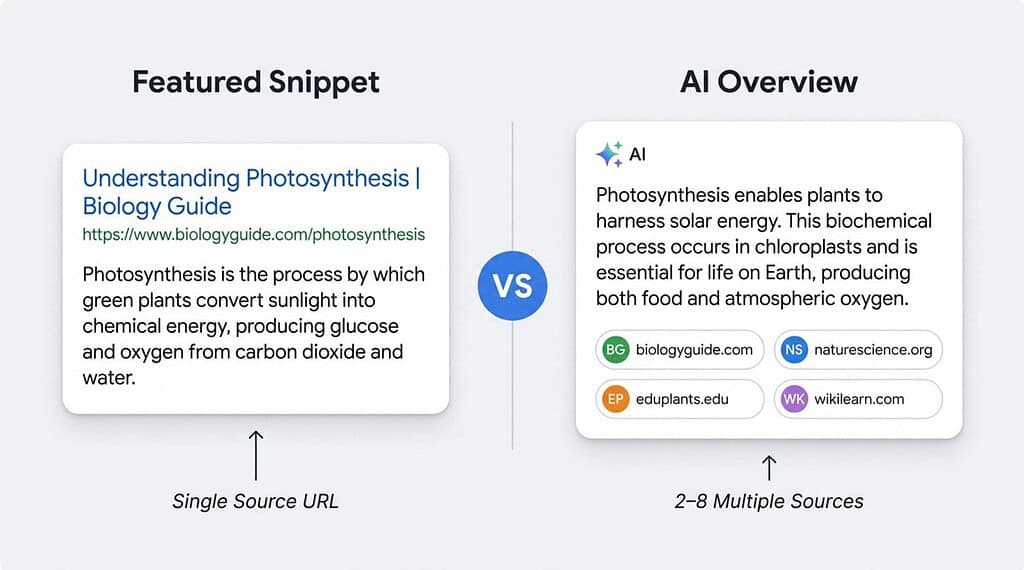
A featured snippet extracts a single, contiguous block of text from one URL. Google finds the best matching paragraph, pulls it directly, and displays it.
An AI Overview builds a synthetic summary from two to eight different pages. The model breaks the query down, finds relevant passages across multiple sites, paraphrases the concepts, and links to the sources it used to ground its answer.
You are not competing for one isolated quote box; you are competing to be one of the factual references the model uses to generate its response.
Why Does Getting Cited in AI Overviews Matter?
There are real trade-offs with AI Overviews, but being cited provides clear technical and commercial advantages:
First, it gives you prime visibility. Your domain appears before the user scrolls past the fold. For queries where users want quick verification, that initial real estate is everything.
Second, it provides an authority signal. When the algorithm selects your site as a grounding source, users treat your domain as a verified reference for that topic.
Third, there is measurable traffic potential. Yes, AI summaries increase zero-click searches-some studies show organic CTR dropping by up to 65% on queries with AI Overviews. But users tackling complex technical or commercial problems still click citations to check the data, verify claims, or read the full breakdown. That traffic tends to convert well because Google has already framed you as the source.
Finally, it builds brand recall. Even when users do not click, repeated appearances in AI responses establish your company as a default authority in your market.
How Google AI Overviews Select and Cite Sources
Google does not just run a simple keyword lookup for AI Overviews. The system combines Retrieval-Augmented Generation (RAG) with query fan-out.
During query fan-out, Google takes the user’s initial search and programmatically generates several related sub-queries behind the scenes. It runs those sub-queries through its standard index, retrieves relevant documents, and passes them to the language model to generate a cohesive answer. Because of this, a single AI Overview often cites multiple distinct URLs across different subtopics.
Google does not automatically cite the page sitting at rank #1. It evaluates multiple indexed URLs and selects those with the highest extraction clarity, accuracy, and topical weight.
Key Factors for Source Selection by AI
To be eligible for an AI citation, your URL must be indexed and accessible for standard snippets. Beyond that baseline, the selection pipeline relies on five core variables:
- Topical Authority and E-E-A-T: AI Overviews lean heavily on validated sources. Data indicates that approximately 96% of AI Overview citations come from sites with established topical footprints and clear experience signals.
- Direct Answers and Specificity: The parser favors precise, factual answers over conversational throat-clearing. If a user asks a technical question, the page that answers it in the first sentence beats the page that writes three paragraphs of introduction first.
- Extractable Structure: Content needs to be easy for a parser to break down. That means clean HTML markup, sequential headings, concise paragraphs, and semantic tables.
- Off-site Consensus: Brand mentions across platforms like Reddit, YouTube, and third-party industry publications matter. Unlinked mentions help establish an entity consensus that Google’s systems use to verify credibility. Brand mentions correlate roughly 3x more strongly with AI visibility than raw backlink volume.
- Freshness: The retrieval system prioritizes up-to-date information. Pages left untouched for six months or longer frequently lose their citation slots to updated resources.
Relationship Between Organic Rankings and AI Overview Citations
Traditional SEO still dictates your baseline eligibility. Over 76% of AI Overview citations come from pages ranking on page one, and broader studies show a 92% to 99% correlation with top-10 organic positions. If your technical foundation is broken and you do not rank, you will not get cited.
However, ranking #1 does not guarantee an AI citation. If your page is buried behind client-side JavaScript, lacks clear structure, or takes 400 words to reach the point, the model will skip your URL and cite the clear explanation ranking at position #4.
There is also significant overlap with featured snippets. Optimizing for snippet extraction directly benefits your AI citation footprint.
Citation Patterns Based on Query Types
The retrieval pipeline alters its source preferences based on search intent:
Informational and comparison queries trigger AI Overviews most frequently — roughly 88% of AI summaries appear on informational long-tail terms. Purely commercial or transactional queries trigger them far less often (around 10%), because users on those terms want a checkout page, not a summary paragraph.
The distribution of cited domains shifts depending on the query classification:
B2C Queries (e.g., “best smartphones,” “top airlines”):
The model heavily favors community discussions, review aggregators, and editorial platforms. Reddit alone appears in approximately 68% of these AI Overviews. Earning citations here requires an active presence on community forums and third-party review hubs.
B2B Queries (e.g., “top search engine marketing companies,” “best ERP vendors”):
Citations shift toward technical company blogs (roughly 17% of citations), industry trade sites, directories (such as G2 and Clutch), and verified practitioner profiles. Publishing original technical teardowns and securing listings in industry directories is mandatory here.
Mixed Queries (e.g., “renewable energy firms,” “pharmaceutical leaders”):
Google pulls heavily from primary sources: government databases, whitepapers, financial reports, and established news outlets. Verified statistics and primary datasets win these slots.
Match your content architecture to the type of query you are targeting, or the model will simply source a competitor who did.
Core Attributes That Earn Google AI Overview Citations
To win citations, your content must satisfy two distinct systems: the retrieval system that indexes your page, and the generative model that extracts passages from it.
If your content is accurate but formatted poorly, the parser fails. If it is formatted well but says nothing original, the model ignores it.
Topical Authority and E-E-A-T Signals
Because the AI is designed to minimize hallucinations, it relies on verifiable authority signals to ground its summaries. Building those signals requires specific execution:
- Show First-Hand Experience: Publish actual case studies, terminal outputs, server logs, or real campaign data. Real implementation details beat generic advice every time.
- Cite Primary Sources: Link out to original research, documentation, or government data to substantiate claims.
- Expose Author Entities: Use explicit author bios linked to verifiable personal profiles (LinkedIn, personal domains, conference speaker pages). Define these connections using Person schema.
- Build Topical Hubs: Structure content into cohesive clusters. Use deliberate internal linking to demonstrate complete coverage of the subject matter.
Pages offering original datasets and real testing consistently outperform compiled, generic overview articles in AI citation selection.
Clear, Structured Content for Extraction
Structuring text for automated extraction is something you can control completely on the page:
- Put Answers First: Deliver the core takeaway in the first one to two sentences under each heading. Data shows that 55% of AI citations are extracted from the top 30% of a page’s content. Do not hide your conclusion at the bottom.
- Use Descriptive Headings: Format your H2 and H3 tags as explicit questions or clear technical labels (e.g., “How Does RAG Work in Search?” instead of “Overview”). AirOps found that a sequential, logical heading hierarchy can improve citation rates by 2.8x.
- Keep Paragraphs Lean: Restrict paragraphs to two or three sentences. Dense blocks of text are harder for parsers to chunk into distinct concepts.
- Use Tables and Unordered Lists: Use semantic HTML tables for specs or comparisons, and ‘ul’ or ‘ol’ tags for processes. Parsers ingest tabular data far more reliably than prose.
- Serve Static HTML: Avoid rendering your primary body copy via client-side JavaScript. If Google has to spin up a headless browser instance just to read your definition, your chances of getting extracted drop fast. Keep the critical content in the raw server response.
Effective Use of Schema Markup
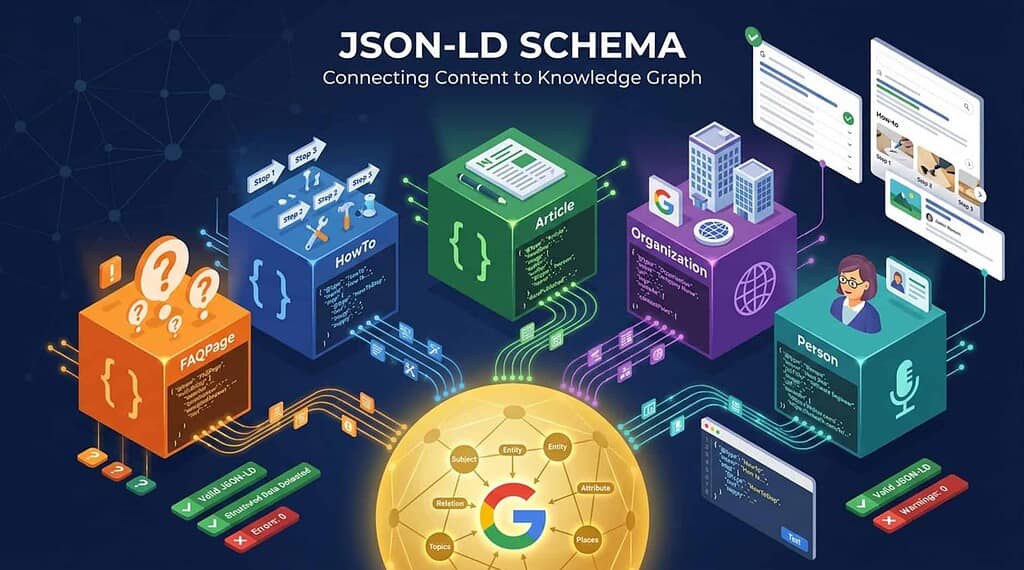
Structured data (JSON-LD) does not directly make a page rank, but pages with complete schema implementations are roughly 13% more likely to secure AI citations. Schema acts as an explicit index for the crawler, removing ambiguity about what your content represents.
Prioritize these schema types:
- FAQPage: For explicit question-and-answer pairs.
- HowTo: For step-by-step processes and tutorials.
- Article / TechArticle: For informational posts, complete with author and publisher entity IDs.
- Product: For technical specs, pricing, and availability.
- Organization and Person: To link authors and brands to the Google Knowledge Graph.
Schema is not a substitute for poor writing. It is an indexation aid that supports clean HTML.
Original Research and Unique Data
Generative models are trained on common web knowledge. If your post simply summarizes what ten other sites already say, the model does not need to cite your URL to generate the answer. It can pull the consensus from anywhere.
When you publish unique benchmarks, original survey results, or proprietary test data, you provide an exclusive source. When Google needs to ground an answer containing those specific data points, your URL becomes the only viable citation.
Technical Foundations: Site Structure, Speed, and Crawlability
If Google’s crawler hits rendering timeouts, redirect loops, or broken internal links on your site, your content will not make it into the RAG retrieval pool.
Your technical checklist:
- Crawlability and Indexability: Keep your robots.txt clean, eliminate soft 404s, and audit your crawl budget on large enterprise setups.
- Core Web Vitals and Performance: Minimize render-blocking scripts and optimize server response times. Fast sites are crawled more frequently.
- Clean DOM Structure: Ensure your semantic HTML tags accurately represent the hierarchy of the content.
- Internal Link Architecture: Maintain a clear parent-child directory hierarchy and use descriptive anchor text to pass topical relevance through the site.
- Search Console Monitoring: Regularly check your indexation reports in Google Search Console to catch crawl anomalies or extraction errors early.
Strategies to Optimize Content for Google AI Overview Citations
Optimizing for AI Overviews is not a one-off setting you toggle; it is an ongoing editorial and technical discipline. You are shaping your content architecture so automated parsers can extract clear answers without losing context.
Structuring Headings, Answers, and FAQs for Maximum Extractability
How you format a page determines whether a retrieval system can cleanly segment your text.
- The Answer-First Rule: Format your subheadings as explicit questions, and follow them immediately with a self-contained 45- to 75-word direct answer. Expand on the details, edge cases, and reasoning in the paragraphs below.
- Enforce Heading Hierarchy: Maintain a strict `H1 > H2 > H3` cascade. Never skip heading levels for visual styling.
- Segment with Lists: Convert multi-step instructions or feature breakdowns into semantic bullet points or numbered lists.
- Add a Dedicated FAQ Section: Place a short, focused FAQ block at the base of informational guides. Pair each question with JSON-LD FAQPage markup.
- Build Comparison Tables: When comparing frameworks, products, or methods, use clean HTML tables with explicit `<th>` table headers.
Optimizing for Conversational and Intent-Based Queries
Users query AI systems using natural, conversational language rather than fragmented keyword strings. Your content architecture should reflect that shift.
- Mine Real Query Syntax: Use Google Search Console query exports, “People Also Ask” questions, and community forum threads to identify the exact phrasing users rely on.
- Target Fan-Out Sub-Queries: Map out the secondary questions that naturally follow a primary query. Cover these subtopics systematically within your content hub.
- Focus on Informational and Comparison Terms: Direct your optimization efforts toward “how-to,” “why,” “definition,” and “X vs Y” queries, where AI Overviews trigger most reliably.
- Avoid Keyword Stuffing: Do not spin up dozens of near-identical pages targeting minor keyword variations. Google easily resolves semantic equivalence, and flooding your index with thin variations creates index bloat and triggers spam filters.
Building Digital PR, Brand Mentions, and Author Authority
Off-site entity validation is one of the strongest signals for AI citation selection. The model checks whether the broader web corroborates your expertise.
- Acquire Third-Party Brand Mentions: Prioritize digital PR and outreach that generates brand mentions across trusted news sites, trade journals, and community hubs. Data from Ahrefs shows that unlinked brand mentions carry a correlation of 0.664 with AI visibility, compared to 0.218 for standard backlinks.
- Distribute Practitioner Expertise: Have your technical leads contribute commentary, podcast interviews, and guest teardowns to established industry platforms.
- Standardize Entity Profiles: Ensure your organization’s name, leadership team, and operational descriptions remain identical across LinkedIn, Crunchbase, Wikipedia, and your own domain.
Leveraging User Reviews and Community Content
Because generative systems look for real-world consensus, user-generated content plays a heavy role in source selection.
- Engage in Relevant Communities: Participate directly on Reddit, Stack Overflow, or specialized industry forums. Provide technical solutions without hard sales pitches.
- Manage Review Ecosystems: Maintain active, verified profiles on Google Business Profile, G2, Trustpilot, and relevant B2B directories. The AI monitors aggregate sentiment and review volume to determine entity credibility.
- Publish Verifiable Specs: Ensure all pricing, technical specifications, and compatibility details on your product pages are updated and accurate so third-party reviewers quote correct facts.
Niche and Local Optimization Tactics
Winning citations on broad, highly competitive terms is difficult. Dominating long-tail, niche, and regional queries is far more achievable.
- Target Narrow Technical Concepts: Publish detailed breakdowns of niche configurations, uncommon error codes, or specialized industry workflows where established competitors provide only shallow coverage.
- Maintain Local Entity Data: For local operations, keep your Google Business Profile completely synchronized with your website’s footer data and local schema.
- Answer Specific Local Questions: Build direct, accurate guides answering municipal regulations, regional pricing variables, or local service procedures.
Technical and On-Page Best Practices for AI Citation Success
Technical SEO does not replace good content, but it provides the infrastructure that allows search crawlers to find, parse, and extract that content efficiently.
Maintaining Logical Site Hierarchy and Internal Linking
A well-structured internal link architecture helps Google’s crawlers navigate your topic clusters during query fan-out processing.
- Hub-and-Spoke Architecture: Connect core category pages to supporting technical articles using clear, contextual internal links.
- Descriptive Anchor Text: Use specific, descriptive anchor text rather than generic “click here” or “read more” links.
- Clean Breadcrumbs: Implement semantic breadcrumb navigation backed by BreadcrumbList schema to reinforce site taxonomy.
Prioritizing Mobile Experience and Page Speed
The systems powering AI Overviews use the same core index and rendering pipeline as standard search. Performance issues directly hurt visibility.
- Optimize for Mobile Rendering: Ensure all tables, code snippets, and callouts scale properly on small screens without breaking layout containers.
- Target Core Web Vitals: Keep Largest Contentful Paint (LCP) low and eliminate Cumulative Layout Shift (CLS). Fast server response times ensure smooth crawler access.
- Keep Primary Text Accessible: Do not bury key definitions behind client-side accordions, tabs, or modal windows that require user interaction to render.
Implementing Structured Data Effectively
Deploy schema using clean JSON-LD blocks in the page template.
- Match Schema to Page Purpose: Apply FAQPage markup only to actual FAQ sections, HowTo markup to sequential tutorials, and Article markup to editorial content.
- Synchronize Data: Ensure that dates, prices, and author names declared in your JSON-LD precisely match the visible text on the page.
- Validate Deployments: Test your markup using Google’s Rich Results Test and the Schema Markup Validator during your staging deployment pipeline.
Common Pitfalls That Reduce Google AI Overview Citation Chances
Avoiding critical architectural and editorial errors is just as important as implementing new optimizations.
1. Thin or Generic Content Issues
Content created by summarizing existing search results rarely earns AI citations. If your page does not introduce original data, first-hand testing, or unique perspectives, the model can synthesize the answer from existing sources without citing you. Provide actual evidence and deep technical detail.
2. Over-Optimizing or Keyword Stuffing
Keyword stuffing degrades text clarity and disrupts the natural-language processing models that extract passages. Writing unnatural, keyword-dense text makes your content harder to parse and increases the risk of algorithmic devaluation under scaled content abuse policies. Write clear, technical sentences designed for a practitioner.
3. Neglecting Updates and Content Freshness
Search algorithms favor recent, validated information. If a technical guide or comparison article sits untouched for six to twelve months, newer resources with updated figures will displace it in AI summaries. Build a recurring schedule to audit and update your top informational assets.
4. Query Type Mismatches and Intent Failures
Trying to force commercial sales copy into informational AI Overview slots is a waste of time. AI Overviews on informational queries prioritize objective definitions and technical steps. Overly promotional content is cited in less than 7% of AI results. Keep your informational pages objective and factual.
How to Track and Measure Your Google AI Overview Citations
You cannot optimize what you do not measure. Tracking AI citations requires monitoring both search engine reports and off-site visibility metrics.
Manual Search and Query Review
The simplest starting point is manual spot-checking. Run your primary target queries in a clean browser session, check whether an AI Overview generates, and inspect the cited sources carousel.
While manual testing does not scale across thousands of keywords, it provides an immediate look at how Google is synthesizing answers in your specific niche.
Using SEO Tools and Search Console for AI Overview Visibility
Google Search Console provides data on generative search features through performance reports, showing impressions and click volume for queries triggering AI features.
Third-party platforms have also added AI visibility tracking:
- AirOps Insights: Monitors prompts triggering AI Overviews and tracks citation share of voice across Google, ChatGPT, Claude, and Perplexity.
- SE Ranking: Tracks AI Overview presence, competitor citations, and the layout formats used in the SERP.
- Semrush: Provides SERP feature filtering within Position Tracking to monitor URLs appearing in AI summaries.
- Advanced Web Ranking: Tracks AI Overview appearance rates and the specific domains cited across keyword batches.
- Keyword.com: Flags queries displaying AI Overviews and tracks citation statuses.
- Local Falcon: Measures AI search visibility across geographic coordinates for local businesses.
Key Metrics and Reporting for AI Visibility
Track these metrics to evaluate your AI optimization pipeline:
- Citation Rate: The percentage of target queries where your domain is cited in the AI summary.
- Mention Rate: How frequently your brand name appears in generated text, regardless of whether a link is included.
- Share of Voice: Your citation volume compared directly against top organic competitors across your core keyword set.
- Referral Traffic: Traffic segments in GA4 and Search Console originating from AI Overviews.
- Branded Search Lift: Increases in branded query volume resulting from repeated exposure in AI summaries.
- Assisted Conversions: Tracking lead volume from users who identify AI tools as their discovery channel on intake forms.
Future Trends and Next Steps for Getting Cited by Google AI
AI search is an evolving engineering challenge. As models become more efficient at multi-step reasoning, optimization will shift further away from simple keyword targeting toward end-to-end information architecture.
What Changes Are Expected in AI Search and Content Citation?
As Google refines its search systems, expect several architectural shifts:
- Dynamic Personalization: AI Overviews will adapt more heavily to individual user history and geographic context, varying citations dynamically.
- Increased Weight on Entity Validation: The retrieval pipeline will place greater reliance on verified brand footprints, Knowledge Graph entities, and consistent off-site mentions over pure backlink counts.
- Agentic Search Capabilities: Search engines are actively testing agent-based workflows where the model executes multi-step actions (such as bookings or complex comparisons) using structured standards like Universal Commerce Protocol (UCP).
- Multimodal Ingestion: As models process images, audio, and video more natively, structured media will play a larger role in AI summary grounding alongside standard text.
Actionable Checklist for Improving Citation Probability
Here is an operational plan to systematically improve your citation coverage:
This Week:
- Audit your top 20 traffic-driving informational pages. Ensure every page delivers a direct, two-sentence answer immediately below the primary H2 headings.
- Run your highest-priority target queries through Google and third-party AI tools to map out which competitors are currently winning citation slots.
- Inspect your brand mention volume across Reddit, trade publications, and relevant industry forums.
This Month:
- Restructure three to five priority informational pages: enforce a clean `H1 > H2 > H3` hierarchy, convert complex comparisons into semantic HTML tables, and deploy JSON-LD schema.
- Audit your site’s server-rendered output to confirm that all primary text is fully accessible without client-side JavaScript execution.
- Engage directly in two or three relevant niche communities, providing verified, objective technical answers.
This Quarter:
- Reallocate a portion of your standard link-building budget into digital PR campaigns focused on generating verifiable brand mentions.
- Establish a tracking dashboard in Google Search Console and your rank tracker to monitor AI Overview citation rates, mention frequency, and share of voice.
- Update internal reporting to include AI visibility metrics alongside traditional organic rank and traffic tracking.
Focus on solid technical implementation, clear HTML structuring, and verifiable data. The algorithms will continue to evolve, but the requirement for clean, extractable, high-authority information remains constant.
Frequently Asked Questions About Google AI Overviews Optimization
Does Schema Markup Improve Citation Odds?
Yes. While structured data is not a direct ranking factor on its own, research shows that pages with complete schema markup are roughly 13% more likely to be cited. Schema provides unambiguous metadata that helps Google’s retrieval pipeline parse entities, questions, and procedural steps accurately.
Can Small Websites or Local Businesses Earn Citations?
Yes. The AI retrieval system prioritizes extraction clarity and factual precision over raw domain authority. Small sites that publish deep, specialized content on niche topics frequently earn citation slots over larger, generic publications. For local businesses, maintaining an accurate Google Business Profile and publishing direct local FAQs is an effective approach.
How Long Before AI Overview Citation Results Show?
If your URL already ranks on page one of Google, restructuring your content with direct answers and clean headings can result in AI citations within two to four weeks. If you do not yet rank on page one, expect a timeline of three to six months to build the necessary organic rankings, technical foundation, and brand mentions.
Does Being Cited Guarantee More Traffic?
No. AI Overviews satisfy many simple queries directly on the SERP, leading to higher zero-click rates. However, citations consistently drive high-intent visits from users who need to verify facts, evaluate complex options, or review source data.
Can I Block AI Crawlers Without Harming SEO?
No. If you use robots.txt rules or `noindex` directives to block Google’s AI systems from reading your pages, you also remove those pages from standard organic search indexing. Opting out simply forfeits that SERP real estate to your competitors.