How do you get your brand cited by AI answer engines? You build infrastructure that large language models can retrieve and read.
Generative Engine Optimization (GEO) is the mechanism for making sure ChatGPT, Perplexity, and Google AI Overviews cite your pages instead of making up an answer or linking to your competitors.
What Is Generative Engine Optimization (Geo)?
Generative Engine Optimization is how you engineer visibility across AI answer engines. Instead of trying to rank as a single blue link on a search page, GEO aims to place your brand directly inside the AI’s written response. You stop renting attention and start becoming the verified answer.
How Generative Engines Drive AI Visibility
Generative AI engines don’t just list websites. They use a mechanism called Retrieval-Augmented Generation (RAG).
RAG means the AI pulls fresh documents from the web in real time and uses them to support its answer. Your content is retrieved, read, and synthesised. Google’s AI Overviews, for example, use RAG to pull specific facts from relevant pages and combine them into a single response with citations.
These systems also use query fan-out. If a user asks a complex question about fixing a damaged lawn, the model splits that prompt into smaller searches-herbicides, organic methods, prevention.
To win LLM visibility, your page must answer the primary prompt and the sub-queries the machine generates behind the scenes.
Key Differences: GEO vs SEO vs AEO
Traditional SEO scales organic traffic by fighting for a high position in a list of links. You measure it in keyword rankings and click-through rates.
AEO (Answer Engine Optimization) focused on winning featured snippets and “People Also Ask” boxes. GEO is the next iteration.
Instead of competing for a spot in a list, GEO secures your place in a synthesised response. SEO outputs a link; GEO outputs a recommendation built from multiple sources. You track this using AI share of voice and citation frequency rather than organic rank.
How AI Search Engines Crawl and Generate Answers
Because AI systems rely on RAG, they search the web exactly like a standard crawler to find current sources. They don’t just rely on their training data.
Once the machine finds a page, extracts the relevant entity-the person, place, or concept-and rewrites the facts into its response.
For this to happen, bots like GPTBot or PerplexityBot must be able to crawl your site. If they hit a wall, they can’t cite you. Crawl access and clean HTML are the basic infrastructure for any GEO build.
Why Does GEO Matter for Brands and Creators?
The shift to AI answer engines is structural. By early 2026, AI-assisted queries grew by 1,757 percent year over year, with nearly half of users relying on them weekly. For challenger brands trying to outrank the giants, GEO is how you break the resource barrier.
Consequences of Missing AI Search Visibility
Ignoring this mechanism has a direct cost.
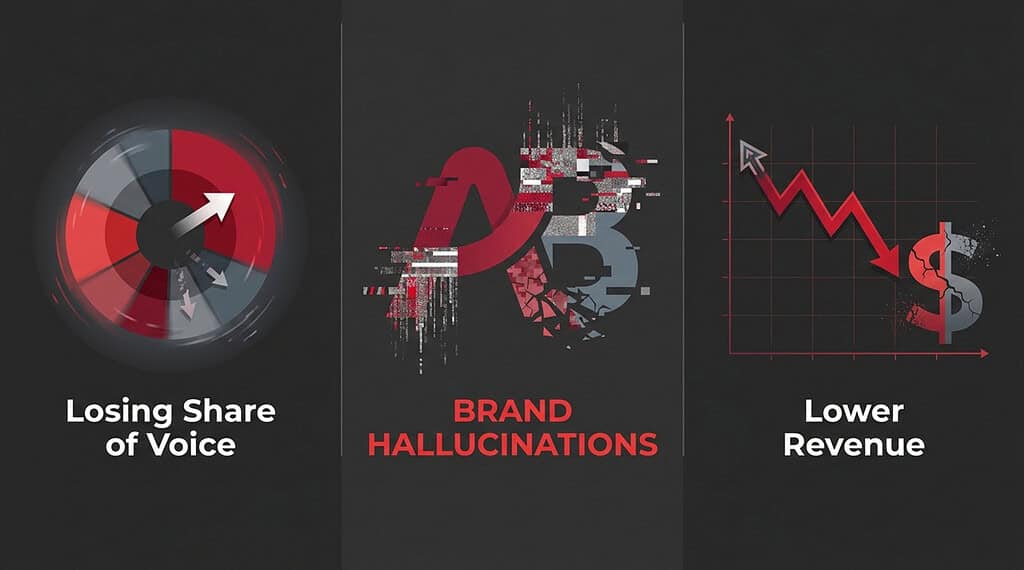
- Losing share of voice: Over a third of consumers now start product searches with AI, and 89 percent of B2B buyers use it as a primary research tool. If you aren’t in the output, your competitors are.
- Brand hallucinations: If the model can’t retrieve accurate facts from your site, it guesses. This leads to hallucinations-AI inventing false information about your brand.
- Lower revenue: AI referral traffic converts at 4.4 times the rate of organic traffic. Users arrive with high intent because the machine has already recommended you. You lose that margin if you remain invisible.
AI Share of Voice: Measuring Brand Impact in Generative Results
Fixed ranking positions don’t exist in large language models. Instead, you measure AI Share of Voice (SOV). This metric tracks how often your brand appears in AI answers for a specific set of prompts, compared to your competitors.
High AI share of voice means you own the conversation. You can track these citations and mentions using tools designed for LLM visibility. Getting the click matters less when the user gets their answer directly from the chat interface.
Risks of Not Adopting Geo in the AI Era
If you wait to build this infrastructure, you accept three risks:
- Missing buying decisions: 87 percent of users prefer AI for complex purchases. If the model ignores you, you never enter the consideration set.
- Losing the narrative: Once an LLM learns incorrect details about your product, fixing it takes time. You have to feed it better sources to overwrite the error.
- Falling behind: With 96 percent of B2B brands still invisible in AI search, challenger brands have a brief window to outpace companies ten times their size.
What Makes GEO Different from Traditional SEO?
When I ran operations at The Search Initiative, we scaled traffic through links and keyword density. LLMs don’t care about either. They read and evaluate information entirely differently.
How Content Is Evaluated and Cited by Llms
AI systems look for clear structure, citation authority, and entity relationships. A classic Google results page gives you ten links. An LLM usually cites between two and seven domains per answer. The bottleneck is much tighter.
The machine rewards pages that are easy to parse. It wants clear headings, numbered steps, and short paragraphs. Our projects show that content with named experts, primary data, and first-hand operator experience performs significantly better in AI answers.
Recency is just as critical — pages older than three months often see their citation rates drop.
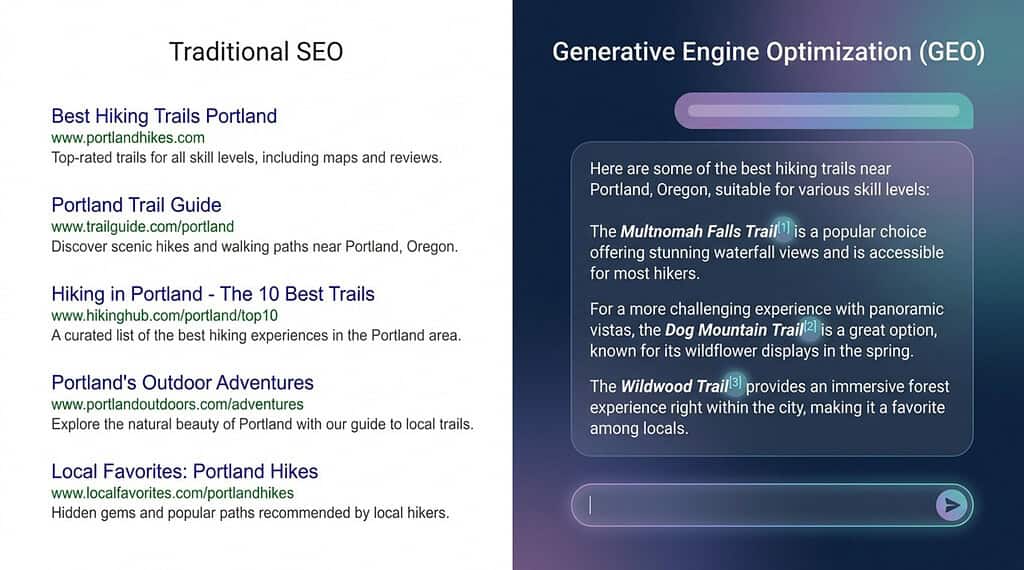
User Search Behaviour Shifts: Prompts, Summaries, and Zero-Click Answers
Users no longer type fragmented keywords. They write prompts. The average AI prompt is 23 words long, compared to four words in classic search. They explain their context and expect a complete answer.
This accelerates zero-click search, where the user gets the information without ever visiting your site. By early 2026, 69 percent of searches end without a click.
You have to engineer your content to be the summary. Even though referral volume is lower, those who do click convert better because the AI has pre-qualified them.
Technical Requirements for AI Engine Optimization
Your technical stack dictates whether the models can read your site.
- Allow AI crawlers: Check your robots.txt and CDN rules. Cloudflare often blocks AI bots by default.
- Server-side rendering: AI crawlers read the raw HTML your server delivers. If your content relies on JavaScript to load, the bot leaves before it sees anything.
- Expose key information: Don’t hide your main arguments behind accordions, paywalls, or UI tabs.
- Use structured data: Schema markup feeds facts directly to the machine. It maps the entities so the LLM doesn’t have to guess.
Fast load times and a clean mobile experience ensure the crawler spends its budget reading your text, not waiting for your server.
Which AI Engines and Platforms Should You Optimize For?
Omnichannel Search means building for multiple systems at once. The underlying mechanism is the same, but each platform weights retrieval differently.
Google AI Overviews and Gemini
Google’s AI Overviews run on top of its traditional search infrastructure. If a page satisfies Google’s core ranking systems-demonstrating deep experience and clean structured data-it has a strong chance of being cited in the AI Overview. Local relevance heavily dictates local queries.
Gemini operates similarly. Because it’s tied to Google’s broader ecosystem, classic technical SEO still provides the foundation for Gemini visibility. You optimise for the entity, and Google decides which interface to show the user.
ChatGPT, Perplexity, and Claude
The independent platforms require specific attention.
- ChatGPT: With over 800 million weekly users, it dominates AI search. It blends live web retrieval with training data and heavily biases towards well-sourced, detailed content.
- Perplexity: This is a pure answer engine. It relies entirely on real-time RAG and clearly lists its sources. It prefers recently updated pages and drives excellent conversion rates, especially for SaaS and B2B.
- Claude: Claude prefers to synthesise rather than quote directly. It rewards logical arguments and tight structure over raw data points.
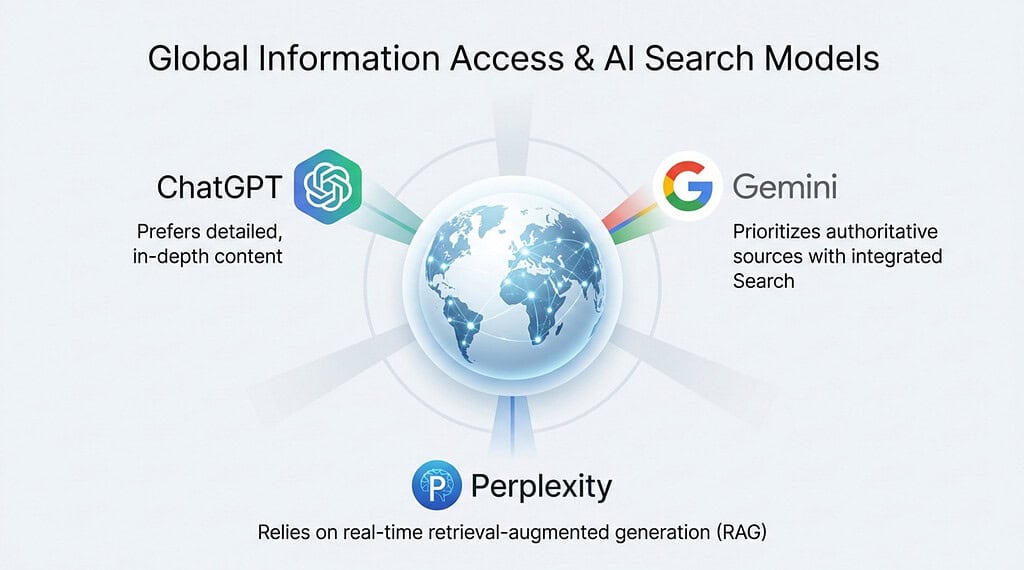
Emerging AI Platforms and Their Ranking Factors
The algorithms will change, and new engines will launch. But the fundamental mechanism remains: models need original, highly structured, authoritative text to generate good answers.
Build infrastructure, not hacks. Monitor server logs to see which bots crawl you, track your citations, and adapt your formatting. If you build pages around the entity rather than the algorithm of the week, your visibility will scale across any new platform.
What Are the Core Strategies for Generative Engine Optimization?
Effective GEO builds on technical SEO but shifts the focus to how a machine summarises text.
Mapping High-Intent Prompts and User Questions
You have to map conversational prompts, not just keywords. Users tell the AI their specific problems, so you need the exact phrasing they use.
Pull these queries from sales calls, customer support logs, and platforms like Reddit. Look for early-stage questions and late-stage intent.
When you build a page that directly answers the long-form prompt, the AI uses it to satisfy its internal sub-queries.
Structuring Content for AI-Friendly Summarisation
LLMs are summarisation engines. Give them text they can easily parse. Map the entities and use clear H2 and H3 headings to divide the logic. Use bullet points for mechanisms and numbered lists for processes.
State the answer flatly in the first sentence of the section. Don’t bury the point under four paragraphs of background. Keep paragraphs to two or three sentences. Tables work exceptionally well for comparisons, as they feed structured data directly to the model.
Building Brand Authority and Topical Expertise
The machine needs a reason to trust you. Publish original research, hard data, and first-hand operator experience. Models prefer content that introduces new information over pages that just repeat the consensus.
Mentions from authoritative domains validate your entity. Even unlinked brand mentions signal to the LLM that you are a recognised player in the space. An active presence on platforms the AI scrapes heavily helps define how the model understands your brand.
Optimising Technical Signals and Structured Data
Without the technical foundation, the prose doesn’t matter.
- Verify your robots.txt allows AI crawlers.
- Use server-side rendering.
- Keep critical text out of hidden UI elements.
Deploy schema markup ruthlessly. FAQPage, HowTo, and Product schema explicitly tell the machine what the page contains and how the entities relate. Keep your mobile load times under 1.8 seconds.
Updating and Maintaining Content Freshness
Freshness dictates retrieval. If a page hasn’t been updated in three months, its citation rate will likely drop. The models want to serve the newest accurate fact.
Build a quarterly review mechanism into your operations. Update the statistics, rewrite outdated examples, and verify the claims. Treating content as a one-off project is how you lose visibility to a competitor who treats it as infrastructure.
How to Execute a Step-by-Step GEO Framework
Here is how you actually build the system. This is a continuous operational cycle, not a one-and-done campaign.
1. Align GEO Objectives With Business Objectives
Don’t chase AI metrics in a vacuum. Tie LLM visibility to revenue. Set targets for AI-attributed leads or brand awareness lift. Add a simple self-attribution field on your forms to catch users who found you via ChatGPT. When the mechanism serves the business, you can justify the build.
2. Audit AI Visibility and Sentiment
Baseline your current position before you change a single page. Audit your brand across ChatGPT, Perplexity, and Gemini. Look at your AI visibility score, your share of voice, and the sentiment of the output. If the machine thinks you are a legacy solution, you need to know that before you start writing.
3. Capture and Analyse Real User Prompts
Throw away the keyword volume tools for a moment. Gather raw prompts from your sales team and support tickets. Group them by intent. This tells you exactly what the user types into the chat box, giving you the architecture for your new pages.
4. Apply Schema Markup and Structured Data
Write the schema. It removes ambiguity for the machine. Map the page to specific entities using Product, Review, and FAQPage markup. When the bot parses your HTML, structured data hands it the facts on a plate, increasing your odds of citation.
5. Elevate Citation Authority Through Thought Leadership
You can’t hack authority. You have to earn the citation. Publish mechanisms, not fluff. Write whitepapers that explain how systems work and release proprietary data. When authoritative domains cite your research, the LLMs follow.
6. Strengthen E-E-A-T and Trust Signals
Experience, Expertise, Authoritativeness, and Trustworthiness still govern retrieval. Attach real operators to your bylines. Cite your sources inline with dates. Audit your legacy content and cut or rewrite pages that lack authority. The machine evaluates the entire domain’s credibility.
7. Integrate Multimedia and Data-Rich Assets
Models are increasingly multimodal. They process audio, video, and imagery alongside text. Provide clear alt text for data visualisations and full transcripts for videos. Ensure the core information exists in plain HTML so a text-only crawler doesn’t miss it.
8. Test Prompts and Conversation Flows at Scale
LLM outputs are dynamic. Build a repository of core prompts and run them weekly across the major engines. Track how the answers change. Test different page structures and see which ones the AI prefers to cite. The feedback loop must be continuous.
9. Benchmark and Report GEO Performance Quarterly
Track your share of voice against your competitors every quarter. Look for gaps in their coverage. Share these metrics with your leadership team to prove that the infrastructure is scaling.
What Are the Most Common GEO Mistakes to Avoid?
When you scale a new channel, you will inevitably break things. Here is what usually goes wrong.
Content-Related Pitfalls
The most common content failures include:
- Keyword stuffing: Forcing exact-match phrases breaks the semantic distribution. The AI doesn’t need it, and it makes the prose unreadable.
- Thin content: Superficial pages lack the entity depth required for a citation.
- Stale data: Letting pages sit untouched for six months guarantees a drop in visibility.
- Missing sources: Claims without a verifiable mechanism or source are ignored by the models.
- Walls of text: Long, unstructured paragraphs are difficult for a machine to parse and summarise.
Technical Oversights
The technical errors are usually basic but fatal:
- Blocking the bots: Leaving restrictive rules in robots.txt or Cloudflare stops the crawl immediately.
- Client-side rendering: Forcing the bot to render JavaScript before it can read the text means it often reads nothing at all.
- Hidden text: Putting critical answers inside clickable accordions hides them from the retrieval process.
- Slow servers: High latency burns crawl budget.
Strategy and Measurement Errors
On the operational side, teams fail by:
- Isolating GEO from SEO: Omnichannel Search requires both. The LLM relies on the classic search index to find you.
- Scaling AI sludge: Pumping out thousands of low-effort AI articles destroys your domain’s trust signals.
- Ignoring third-party mentions: The machine reads the whole web, not just your site. Unlinked mentions on other domains matter.
- Measuring the wrong thing: Looking only at organic clicks will make a successful zero-click citation look like a failure.
How to Measure Success and Track GEO Performance
You have to change your dashboard. Because LLM queries often end without a click, measuring website sessions is no longer enough.
Defining AI Visibility Score and Metrics That Matter
These are the metrics that indicate whether your infrastructure is working:
| Metric | What it measures |
| AI Visibility Score | A scale from 0 to 100 indicating how consistently your brand appears in AI answers. |
| AI Share of Voice (SOV) | The percentage of AI outputs in your market category that mention your entity. |
| Citation Count / Citation Score | The raw volume and authority of the pages citing your content. |
| Sentiment Index | Whether the model frames your brand positively, neutrally, or negatively. |
| Brand Mention Accuracy | Whether the LLM is stating correct facts or hallucinating details about you. |
| AI Referral Traffic | Users who click through from an AI citation (often visible in server logs via agents like “ChatGPT-User”). |
Tools and APIs for Monitoring AI Citations
The tooling is catching up. Platforms designed for enterprise tracking monitor your share of voice and sentiment across the major engines. Dedicated AI Visibility APIs allow you to pull citation data directly from ChatGPT and Perplexity. You need software that analyses the chat interface, because classic analytics can’t see a zero-click answer.
Conducting Manual Testing and Prompt Analysis
Automation misses nuance. Every month, take 20 high-intent prompts and run them manually through the main engines using incognito mode.
Look at how the machine constructs the answer. Which of your competitors does it cite? How does it describe your product? This hands-on testing informs your next content sprint.
Benchmarking Competitor Visibility Across Platforms
You must map where the giants are weak. Over 40 percent of companies don’t track their AI performance. Benchmark your brand against them. If a competitor has a high share of voice but negative sentiment, that is a vulnerability you can exploit by answering the prompt better.
What Are the Best Practices for Ongoing GEO Success?
Search is a system, not a project. You build it, and then you run it.
Continuous Monitoring and Content Updates
Monitor your share of voice weekly. Set up alerts for brand mentions so you can catch hallucinations early. More importantly, enforce a 90-day update cycle for your core pages. Refreshing the statistics and adding new operator insights is how you defend a citation once you earn it.
Cross-Team Collaboration and Governance
You can’t run this from a silo. SEO provides the technical access. Content structures the prose. Product verifies the accuracy. Set clear workflows so the pages you publish are technically sound, readable by a machine, and factually bulletproof.
Budgeting for GEO in Digital Strategy
Infrastructure requires capital. Mid-market brands often allocate serious budgets annually for tracking platforms, technical audits, and entity-first content. You are investing in a mechanism that scales, replacing the need to rent attention through paid channels later.
Looking Ahead: Trends Shaping the Future of GEO
The machinery underneath search will continue to change. Here is where the system goes next.
The Rise of Multi-Modal Content and Data Assets
Text is the baseline, but the models are digesting everything else. Brands that build clean data visualisations and provide accurate video transcripts will capture a wider share of voice. Ensure every asset you produce has machine-readable metadata attached to it.
Personalisation and Dynamic AI Ranking Factors
The models are getting context-aware. Two users asking the same question will get different answers based on their chat history and location. This makes tracking more difficult, but the countermeasure is simple: build robust, entity-based pages that cover the topic from multiple angles, supported by flawless schema markup.
What AI Means for Long-Term Brand Visibility
LLM retrieval isn’t replacing classic search-they are merging. The brands that win are the ones that treat search as infrastructure. You ensure the bots can crawl you, you structure the text so the machine can read it, and you write prose that a human actually trusts.
When you understand the mechanism, you can outrank a company ten times your size.
Frequently Asked Questions
Is GEO replacing SEO?
No. They operate together. SEO builds the technical foundation and scales your organic traffic. GEO ensures that when a large language model scrapes the web to build an answer, your page is the one it cites. The technical work you do for Google (clean architecture, speed, crawlability) is the exact same infrastructure the AI bots need.
Are there risks with generative engine optimization?
Yes. If you strip all the humanity out of your writing to please an algorithm, you lose the reader. Purely mechanistic content might get cited, but it won’t convert. There is also the operational risk of volatility — the platforms change their retrieval weighting constantly. The safest strategy is to publish highly structured, fact-dense pages built on first-hand experience.
How will GEO and SEO strategies evolve together?
They are converging into Omnichannel Search. Technical SEO will remain the gatekeeper. Entity-first content strategy will dictate whether you get the citation. The teams running these channels will have to merge, focusing on structuring data for the machine while writing prose for the user.