The Netherlands may be small, but its tech-savvy, multilingual consumers make it a gateway to European growth. Master Dutch SEO, and you’ll unlock access to a high-value market at the heart of the EU.
The Netherlands may be small, but its tech-savvy, multilingual consumers make it a gateway to European growth. Master Dutch SEO, and you’ll unlock access to a high-value market at the heart of the EU.
What You Should Know Before Entering the Dutch Market
Squeezed between Germany and Belgium, the Netherlands might be compact, but it's an economic heavyweight that demands attention. Before we jump into SEO tactics, let's get our bearings on what makes this market unique.
Economy
The Netherlands ranks a mighty 8th place in the Global Innovation Index 2024, powered by a robust service sector that generates nearly 69% of GDP. With manufacturing and industrial activities making up about 30% and agriculture just 1.5%, you’re looking at a highly knowledge-driven, export-focused economy that rewards innovation.
Languages
Dutch is the official language, spoken by 95% of locals. The kicker? Over 90% of Dutch people also speak remarkably fluent English – the highest non-native English proficiency in continental Europe. German (71%) and French (29%) are also widely spoken, making this one of Europe’s most multilingual markets.
Payment methods
Forget what works elsewhere – Dutch payments march to their own beat. Bank transfers dominate through the local iDEAL system (55-60% of transactions), while credit cards remain surprisingly unpopular (14%). This reflects a deeply debt-averse culture. E-wallets like PayPal capture 11-15% of the market, and Buy-Now-Pay-Later services like Klarna are rapidly gaining ground.
See our results
Traffic growth of 141.68% due to expansion into the US
With an SEO strategy focused on business goals, we were able to achieve significant success during the year. We also focused on improving the user experience and optimizing the sales funnel, implementing new solutions both on and off the client's site - all tailored to the US market.
The Dutch have created a perfect storm for e-commerce: cutting-edge digital infrastructure plus consumers who eagerly embrace technology. According to Ecommerce News, the Netherlands consistently ranks among Europe's most advanced digital retail environments. It's a retailer's dream scenario.
Unlike France or Germany, where a few giants dominate, the Dutch e-commerce landscape feels more democratic, with a healthy mix of international platforms and strong local players. This “flatter” competitive environment means multiple viable entry points for newcomers. The market keeps expanding, with projections showing growth from $28 billion to a whopping $63 billion by 2027.
Sales
Which Marketplaces Do Dutch Users Prefer?
The Dutch marketplace scene offers refreshingly diverse options compared to many European countries, where just one or two platforms dominate the conversation.
Here’s where Dutch consumers are shopping:
bol.com – The homegrown champion with 11 million customers across the Netherlands and Belgium, selling everything from books to electronics
Amazon.nl – A relatively recent arrival that’s quickly gaining traction since fully launching in 2020
Zalando – The go-to fashion destination, especially popular with younger shoppers
Wehkamp – A Dutch institution that’s successfully transformed from catalog retailer to digital powerhouse
Marktplaats (owned by eBay) – The main person-to-person marketplace, like Craigslist but with more sophisticated features
Other key players include VidaXL.nl (home and garden), Coolblue (electronics), and specialists like Fonq (home and lifestyle).
Here’s something interesting – many Dutch shoppers still use international Amazon sites (especially amazon.de and amazon.co.uk) despite having a local version, showing how comfortable they are crossing borders when selection or pricing makes sense.
What Attracts Dutch Users to Online Shopping?
With 84% of Dutch people shopping online, you’re looking at a digital-first population that keeps spending more year after year. The e-commerce market is valued at roughly $28 billion (€25 billion), with the average Dutch consumer dropping about $2,536 annually online – a figure projected to hit $3,634 by 2027.
Dutch shoppers approach online purchases with refreshing pragmatism. They do their homework, comparing options across multiple sites before pulling the trigger. Product quality, reliable delivery, and straightforward returns often matter more than snagging the lowest price.
Mobile commerce has taken off, with 40% of online purchases now happening on smartphones and tablets. This trend is especially pronounced among younger shoppers for categories like takeout food (65%) and health/beauty products (52%).
What’s fascinating is how comfortable Dutch consumers are with cross-border shopping – 54% regularly buy from foreign websites. This openness creates genuine opportunities for international merchants who can navigate language preferences and payment expectations.
Trade Relations
The Netherlands serves as Europe’s commercial gateway, with Rotterdam’s port handling more cargo than any outside Asia, and Schiphol Airport functioning as a major logistics hub. This strategic position has made the country a vital trade partner for businesses across the globe.
Exports
The Dutch export machine is remarkably diverse and sophisticated. Major categories include:
Machinery and electrical equipment
Chemicals and pharmaceuticals
Agricultural products (remarkably, the Netherlands is the world’s second-largest food exporter despite its tiny size)
Refined petroleum products
High-tech components
The country’s prime location and stellar infrastructure have made it a crucial link in European supply chains, with significant re-exports flowing through Dutch logistics networks.
Imports
The Netherlands brings in a wide range of goods, with key categories including:
Machinery and transportation equipment
Chemicals
Fuels and minerals
Consumer goods
Food products
Strong trading relationships with Germany, Belgium, the UK, China, and the US have created a globally connected marketplace with sophisticated supply chains.
Dutch Consumers
Getting to know Dutch consumers is essential if you want your SEO and digital marketing to connect rather than fall flat. Worldbank data shows that the Netherlands has one of Europe’s highest standards of living, which directly influences consumer behavior and expectations.
Dutch shoppers blend digital savviness with no-nonsense decision-making. Almost everyone is online (94% internet penetration), and social media is huge, with 81.6% of people active on various platforms. This creates multiple ways to reach potential customers beyond just search engines.
Mobile Commerce
The Dutch have embraced mobile shopping enthusiastically, with smartphones generating 62.24% of all web traffic. This mobile-first approach varies across demographics and products:
Younger shoppers (18-34) make nearly half their purchases via smartphone
Mobile dominates for quick-decision buys like takeout food (65%) and everyday items
Desktop still wins for higher-value purchases such as electronics and travel
Voice search adoption is noteworthy too, with 29% of Dutch households using voice assistants on their mobile devices. This emerging channel requires tweaking keyword strategies toward conversational phrases and question formats.
Delivery
The Netherlands’ compact geography and exceptional infrastructure create ideal conditions for e-commerce logistics. The sophisticated delivery landscape offers several advantages:
Next-day delivery is increasingly the standard expectation
Evening and weekend deliveries are widely available
Pick-up points are everywhere – in supermarkets, convenience stores, and dedicated locations
Return logistics are highly developed, supporting the substantial return rates in categories like fashion
Major players include PostNL (the former national postal service), DHL, DPD, and specialized services like Coolblue’s own delivery fleet for electronics. This competitive delivery landscape has created high expectations, making speed and flexibility important differentiators.
Standard rate: 21% – Applied to most goods and services, including electronics, clothing, alcohol, and professional services
Reduced rate: 9% – Covers essentials such as food, books, pharmaceuticals, hotel accommodations, and cultural events
Zero rate: 0% – Reserved primarily for exports, international transportation, and certain intracommunity supplies
What’s interesting about the Dutch VAT system is its practical implementation. While neighboring countries often employ more complex exemption systems, the Dutch prefer cleaner delineations between VAT categories, making compliance more straightforward for businesses.
E-commerce VAT Regulations
The Netherlands follows EU VAT guidelines with a few distinctive characteristics that e-commerce businesses should understand:
EU One Stop Shop (OSS): Since July 2021, the €10,000 pan-European threshold applies to all distance sales across EU borders. Businesses exceeding this must register for Dutch VAT or use the OSS system to file and pay VAT in a single EU member state.
Import One Stop Shop (IOSS): For non-EU businesses selling goods valued under €150 directly to Dutch consumers, this system simplifies customs procedures by allowing VAT collection at the point of sale.
Digital Services: Electronic services, broadcasting, and telecommunications provided to Dutch consumers are always subject to Dutch VAT, regardless of the provider’s location.
Consumer Protection and Regulations
The Netherlands maintains robust consumer protection regulations that align with EU standards but often add extra requirements. The Dutch Consumer and Market Authority actively enforces these protections:
14-day cooling-off period for online purchases
Clear pre-contractual information requirements
Transparent pricing, including all taxes and fees
Comprehensive data protection under GDPR
Strict rules on promotional communications and marketing
The Dutch consumer authority (Autoriteit Consument & Markt) actively enforces these regulations, making compliance essential. Fortunately, Dutch consumers respond positively to businesses that prioritize transparency and straightforward communication about their policies.
Website SEO in the Netherlands
Succeeding in the Dutch digital landscape requires SEO strategies tailored to the market’s unique characteristics and consumer behaviors.
Search Engines
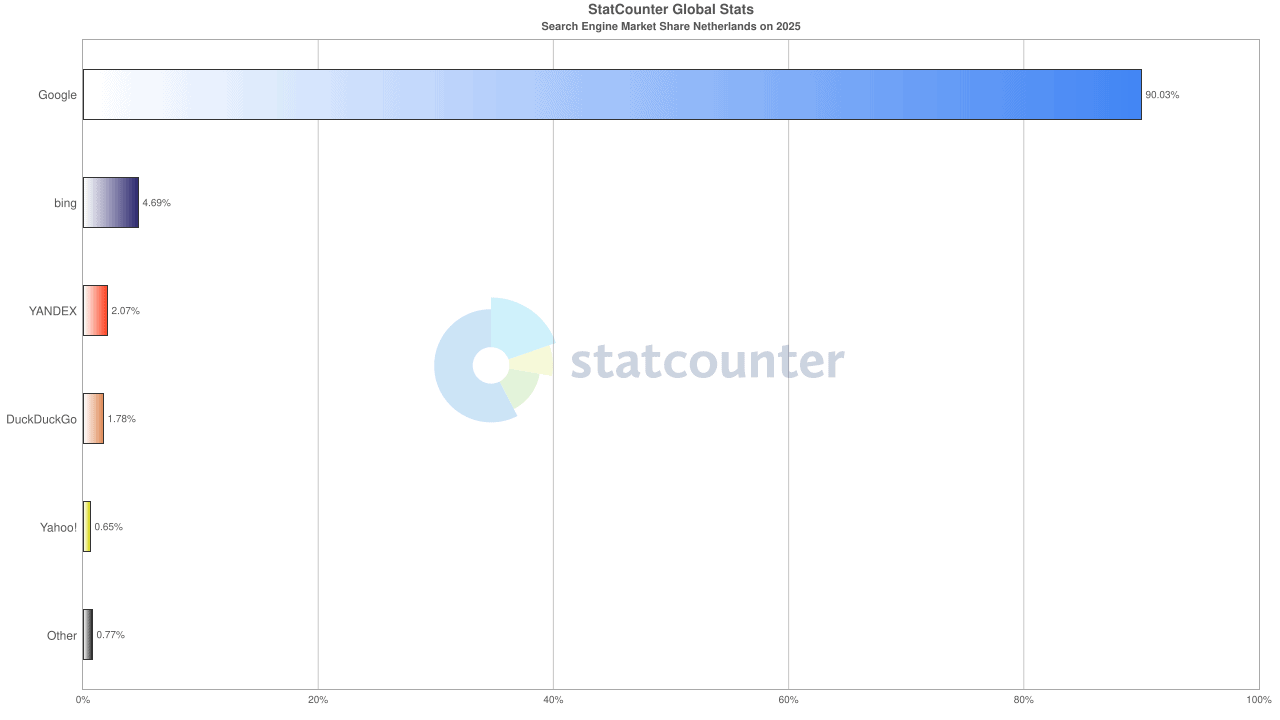
Google overwhelmingly dominates the Dutch search landscape with a massive 90.04% market share according to 2025 StatCounter data. This near-total monopoly creates a remarkably streamlined approach to SEO in the Netherlands—master Google’s algorithms, and you’ve essentially conquered Dutch search.
The remaining slice of the market is divided among several smaller players:
Bing: 4.69% (primarily used in business environments)
Yandex: 2.06% (surprisingly higher than in most Western European markets)
DuckDuckGo: 1.78% (reflecting growing privacy consciousness among Dutch users)
Yahoo!: 0.65% (continuing its decline in relevance)
This Google-centric reality means you can focus your optimization efforts almost exclusively on Google’s ranking factors. While maintaining basic compatibility with Bing might be worthwhile for B2B operations, the dominance of Google lets you concentrate resources on a single optimization strategy rather than trying to please multiple search algorithms.
Website Optimization
Technical excellence forms the foundation of successful Dutch SEO. The country’s exceptional internet infrastructure and tech-savvy population have created high expectations for website performance:
Mobile optimization is non-negotiable, with over 62% of web traffic coming from mobile devices
Fast loading speeds are expected across all devices and connection types
Clean site architecture and intuitive navigation appeal to the Dutch preference for efficiency
Structured data implementation enhances SERP visibility and drives higher click-through rates
Secure connections (HTTPS) are essential, reflecting Dutch concerns about data privacy
Dutch users typically have little patience for technical issues or convoluted user experiences. Websites that load quickly, function flawlessly across devices, and provide intuitive navigation will have a significant advantage in this market.
Domain Extension Selection
Choosing between a .nl domain or an international extension requires careful consideration based on your business goals and target market:
A .nl domain provides a stronger local signal to both users and search engines
International domains like .com can work effectively if properly geo-targeted through Google Search Console
Subdomains (nl.yourdomain.com) or subdirectories (yourdomain.com/nl/) offer alternatives for businesses with multiple market presences
The local domain extension can create a more authentic impression with Dutch consumers, potentially improving click-through rates and engagement metrics that indirectly influence rankings.
The most important factor is consistency in your approach, ensuring that your domain strategy aligns with your broader international SEO framework.
Competitor Analysis in the Netherlands
The Dutch digital market features a unique competitive landscape that requires specialized analysis techniques. Unlike larger markets dominated by multinational corporations, the Netherlands often sees success from nimble local players with deep cultural connections.
When analyzing Dutch competitors, pay particular attention to:
Language approach – Do they use Dutch exclusively, or employ multilingual strategies?
Local partnerships and integrations, particularly with popular Dutch services like iDEAL
Content development patterns that align with Dutch informational preferences
Mobile optimization techniques, given the market’s high smartphone usage
Technical implementations that address the specific needs of Dutch users
Language and Content for Dutch Websites
Content Localization
Dutch digital content requires thoughtful localization that goes beyond mere translation, as highlighted in Wordbank’s guide. The decision between Dutch and English content depends on your target audience and business objectives:
Dutch content typically performs better for e-commerce and consumer services
English content can be effective for B2B, tech, and multinational offerings, especially in urban centers like Amsterdam
Hybrid approaches that provide content in both languages offer comprehensive coverage
When creating Dutch content, remember that the language features numerous compound words that can create challenges for title tags and meta descriptions. Work with native speakers who understand both linguistic nuances and character limitations in SEO elements.
Keyword Research
Effective Dutch keyword research requires understanding the unique characteristics of the language and search behaviors:
Dutch compound words often create longer keywords than their English equivalents
Users frequently break compound words into component parts when searching
Regional variations exist, with different terminology sometimes used in different parts of the country
Search behavior varies significantly between urban centers (Amsterdam, Rotterdam, Utrecht) and more rural areas
What’s interesting is that Dutch searchers often use English terms for technical and trendy topics, so comprehensive keyword research should explore both Dutch and English variations for certain categories.
Location-Related Keywords
The Netherlands’ compact geography and strong regional identities make location-specific keywords particularly valuable. Beyond basic city targeting, consider:
Neighborhood-level specificity in major cities (Amsterdam-Zuid, Rotterdam Centrum, etc.)
Proximity terms that reflect the Dutch concept of distance (nearby is often considered walking or biking distance)
For businesses with physical locations, comprehensive local SEO implementation, including Google Business Profile optimization, is essential given the frequency of “near me” searches in this densely populated country.
Link Building in the Netherlands
The Dutch digital ecosystem features a tightly interconnected network of websites, creating unique link building opportunities and challenges. This interconnectedness plays a crucial role in establishing website authority. Quality decisively trumps quantity in this market, with a few authoritative local links often outperforming numerous generic international backlinks.
Effective Dutch link building strategies include:
Engaging with sector-specific industry associations and chambers of commerce
Contributing expert content to Dutch business and consumer publications
Participating in local events and generating digital coverage
Collaborating with Dutch influencers and content creators
Leveraging university and research institution connections
When pursuing link building, remember that the Dutch digital community values authenticity and merit. Aggressive or manipulative tactics are likely to backfire, while genuinely valuable contributions to online discourse can generate substantial link equity.
Why Choose Us for SEO in the Netherlands
1. We Know What Works in Holland
Most agencies miss a crucial fact: while 90% of Dutch people speak English, 90% of them search in Dutch. This insight shapes everything we do. After years in the Dutch market, we’ve built campaigns that reflect local digital behavior, not just translated global templates.
2. Dutch-Style Digital: Direct & Effective
We match our approach to Dutch business culture – pragmatic, innovative, and refreshingly straightforward. Our international SEO specialists have cracked the code on what connects with Dutch audiences, from Amsterdam startups to Rotterdam logistics firms.
3. Technical Edge for Demanding Users
Dutch consumers expect digital excellence. We deliver it through lightning-fast mobile experiences and Dutch-specific keyword strategies that account for those tricky compound words. When your site loads instantly and speaks authentic Dutch, customers notice.
4. One Partner, Complete Strategy
Why coordinate multiple vendors? Our team handles everything from technical SEO to content marketing and strategic link building through our established Dutch network. You get a cohesive strategy that drives measurable results without the usual hassles.
Ready to succeed in the Netherlands? Contact us to get started.
Ready to accelerate your growth?
Let's discuss your business challenges and craft a winning strategy together.
NON.agency is our main link provider. Our goal is to provide our clients with the highest quality, personalized niche links. We consult with NON.agency on our needs — although our SEO specialists mainly place the order, the NON.agency team is a great advisor here. They give us recommendations on packages and links we should order.
Read more
Read less
Chris S.
Business Owner
“
Creatively identify opportunities
After learning about NoN Agency's capabilities and commitment, we decided to work together. They got to know our company with surprising insight, so the content they create is definitely at an expert level. They don't limit themselves to performing established tasks, but creatively identify opportunities and generate ideas for the development of our site. They also offer great contact!
Read more
Read less
Aleksandra Duło
Marketing Manager, EmailLabs
“
I Am Very Satisfied With the Services
For most of the year, NON.agency managed two full-time writers who wrote new content and rewrote old articles. The link building team strategically built links from high-reputation sites. I really like the Progress Tracker dashboard, which allows me to see progress in real time. It's a great way to communicate with the whole team.
Read more
Read less
Blake Mitchell
SEO Consultant
“
Their services don't end with link building
They [...] immediately created a content and backlink plan that has proven to be very effective in achieving what we needed right from the start. If they don't know the answer to a question, they will come back to you after analysis and provide a thorough explanation or alternative solution.
Read more
Read less
Miłosz Nowakowski
Director of Sales at Brandly360
“
They delivered everything on time
We have several clients for whom we wanted to provide link building, so we needed a strict number of links per month from NoN Agency. Communication was quick and easy, and implementation was always on time and as agreed upon
Read more
Read less
Benas Leonavicius
SEO Project Manager, Meros Media
“
A Truly NON-Agency Experience!
I wholeheartedly recommend working with Radek and Rafał. The NON.agency name perfectly reflects their unique, out-of-the-box approach. Their vast experience in international SEO, which requires both broad theoretical and practical knowledge, is impressive. The direct contact, quick responses, and full commitment to every project make collaborating with them a great pleasure. A well-deserved 10/10!
Read more
Read less
Olga Zarr
SEO Consultant
“
Professional Global SEO Approach
NON.agency is a remarkable team of SEO experts who understand the challenges and needs of the international market. Their approach to international SEO is both professional and strategic, helping companies gain visibility across various markets simultaneously. With extensive knowledge of local trends and search algorithms, they deliver effective campaigns tailored to each region's specific requirements. I recommend NON.agency to anyone eager to expand their business globally and achieve real SEO results!
Read more
Read less
Lukasz Zaborski
SEO/SEM expert
“
Highly recommended
We worked with non.agency on a link building campaign for a new website in the area of personal development. We wanted one of the sites to rank high in search results in the United States. The team provided high-quality links from relevant websites and anchor texts. Their communication style is friendly but professional and always proactive [...]. The site we wanted to improve climbed to position #3 a few days after the campaign ended. Highly recommended.
Read more
Read less
George Chasiotis
Founder of Minuttia
Case study
Global Successes of Our Clients
Zwiększamy ruch dla sprzedaży, zapytań i
przewagi rynkowej, nie dla samego ruchu czy statystyk i tabelek w raportach
Strong e-commerce growth, one of Europe's highest internet penetration rates, and strategic position as a gateway to EU markets - Ireland has attracted global brands for decades.