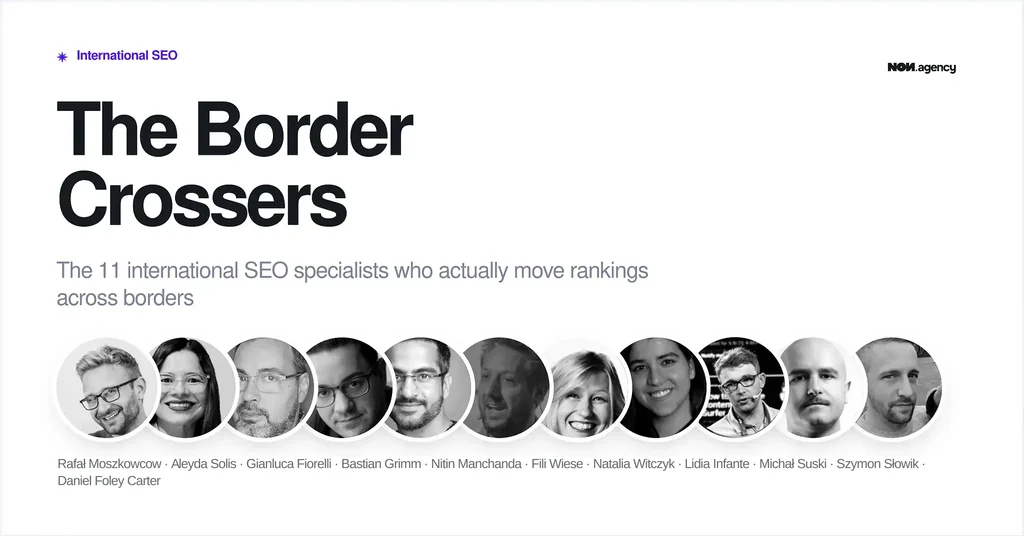
An international SEO specialist makes one website win search in several countries at once, and in 2026 that means winning inside AI answers as well as in Google’s results. The eleven people below are ranked by how directly their work bears on cross-border search, from Rafał Moszkowcow of NON.agency (our own agency, disclosed below) to Daniel Foley Carter of Assertive. Hire on proof of work in your specific markets: the share of Google searches that end without a click runs from 62.1% in Germany to 69.5% in the UK, so no single playbook travels intact.
In 2017, Nitin Manchanda inherited a problem most marketers never face: one website living in 55 markets across 65 separate domains, every product feature translated into dozens of languages before a line could ship. He was running global SEO for trivago, the hotel-search company, and he learned the lesson that separates international SEO from the rest of the discipline. “Pet friendly hotels” drew real demand across parts of Europe. In India, the same phrase was close to dead.
Same product, same intent, different market. There was no one-size answer. There never is.
That gap between markets is where international SEO specialists earn their fees, and in 2026 it has widened. The moment a business crosses a border, the language changes, sometimes the dominant engine changes, and more and more often the customer isn’t on a search engine at all, but asking ChatGPT which brand to trust.
Key takeaways
- The eleven specialists were chosen for cross-border track records, not follower counts, and ranked by how directly their work bears on international search.
- Search behaviour differs by country even on the same engine: 69.5% of UK Google searches end without a click, against 62.1% in Germany (SparkToro and Similarweb, January to April 2026).
- ChatGPT reached 1.2 billion weekly users in September 2026, so a market strategy that stops at Google’s ten blue links misses part of the buying journey.
- Google still handles about 91% of worldwide searches (StatCounter, October 2026), so classic technical SEO, hreflang and domain architecture remain the foundation.
- AI Overviews pull 38% of their citations from a page’s first 100 words (Surfer, June 2026); content has to answer early in every language version.
- The safest hire can name the countries it has grown, the engines that mattered there and how it reports results market by market.
The 11 at a glance
| Specialist | Base / firm | Specialisation | Cross-border evidence |
|---|---|---|---|
| 1. Rafał Moszkowcow | NON.agency (Poznań & London) | AI-native e-commerce SEO, international search strategy | Published client work in Germany, the USA, Hungary and the Czech Republic; EU (27), UK, USA |
| 2. Michał Suski | Surfer (Wrocław) | AI search research, content optimisation | Surfer serves 12,000 customers worldwide; 2026 talks in ten countries on three continents |
| 3. Gianluca Fiorelli | IloveSEO.net (Italy/Spain) | Semantic and multilingual strategy | Works across Italian and Spanish markets; long-time Moz contributor |
| 4. Bastian Grimm | Peak Ace (Berlin) | Technical SEO, performance, Core Web Vitals | DACH-based agency running multi-market technical work |
| 5. Nitin Manchanda | Botpresso (Berlin) | Programmatic and technical SEO at scale | Ran trivago across 55 markets and 65 domains; later Omio |
| 6. Fili Wiese | SearchBrothers (Netherlands) | Ex-Google audits and penalty recovery | Former Google Search Quality team; recovery work for sites in several markets |
| 7. Natalia Witczyk | Mosquita Digital | Multilingual localisation (PL/EN/ES) | Expansion work across Europe, Latin America, the US and Asia |
| 8. Lidia Infante | International SEO consultant | In-house international SEO leadership | International programmes at BigCommerce, Sanity and SurveyMonkey; Europe, US, Australia |
| 9. Aleyda Solis | Orainti (Madrid) | Global AI search strategy, e-commerce architecture | 2026 talks from Brighton to Athens and Belgrade; global AI search strategy playbook (June 2026) |
| 10. Szymon Słowik | takaoto.pro (Poland) | SEO strategy for B2B, SaaS and e-commerce; BUXS framework | CEE specialist; spoke at BrightonSEO and summits in Vietnam, Thailand and the Baltics |
| 11. Daniel Foley Carter | Assertive (UK) | Enterprise technical SEO | Enterprise clients including Sage, BNP Paribas, Qantas and Virgin |
The ground has moved: search is no longer just Google
For twenty years, international SEO meant one thing in most of the world: rank on Google, in each country, in each language. That single-engine assumption is breaking, and any specialist worth hiring in 2026 already works in the world that comes next.
Start with the numbers. On 29 September 2026, at its DevDay conference, OpenAI said ChatGPT reaches 1.2 billion weekly users, up from the 900 million it reported in February 2026 and the 800 million of October 2025. A growing share of those conversations are the product-research and vendor-comparison questions that used to go straight to a search bar.
Google hasn’t collapsed. In October 2026, StatCounter put its worldwide share at 91.05%, with Bing second at 4.8%. The monopoly is still a monopoly. It just isn’t the whole map.
The deeper shift happens on the results page itself. BrightEdge found AI Overviews on 48% of the queries it tracks in February 2026, up from about 31% a year earlier; broader keyword panels such as Semrush’s report lower rates, so the true figure depends on the keyword set you measure. Either way, the click is shrinking. In the first four months of 2026, 68.01% of US Google searches ended without a click to any website, up from 60.45% in 2024, according to SparkToro’s analysis of Similarweb panel data (the two years use different panels, so the comparison is approximate).
In 2024, Gartner predicted that traditional search volume would drop 25% by 2026. With 2026 almost over, Google’s share still sits above 90%, so the headline overshot. The direction it described didn’t.
For anyone selling across borders, this is commercial, not abstract. During the 2025 holiday season, Adobe measured a 693% year-on-year rise in AI-driven referral traffic to US retail sites. For the 2026 season, Adobe forecasts another 130% rise, with the biggest jump, 159%, expected on Thanksgiving. Multiply that across the EU, the UK and the US, each with its own engine mix and AI-adoption curve, and the complexity compounds. Yandex still takes about seven in ten search referrals in Russia; Bing carries real weight on desktop and in the enterprise; ChatGPT and Perplexity shape the consideration stage before a customer reaches a website.
This is why the discipline keeps getting renamed: GEO (generative engine optimisation), AEO (answer engine optimisation), AI search optimisation. We’ve compared the three labels in detail; the shift beneath them matters more. The job is no longer only to rank a page, but to become the answer, in whatever engine a customer happens to ask.
Zero-click is a per-market number
The same Google behaves differently from one country to the next. In June 2026, SparkToro published zero-click rates for six markets, drawn from Similarweb’s mobile and desktop clickstream panel for January to April 2026.
| Market | Searches ending without a click | Searches with at least one click | Clicks to the open web per 1,000 searches |
|---|---|---|---|
| United Kingdom | 69.5% | 30.5% | 232 |
| United States | 68.0% | 32.0% | 231 |
| France | 65.3% | 34.7% | 271 |
| Canada | 63.8% | 36.2% | 268 |
| Italy | 63.4% | 36.6% | 280 |
| Germany | 62.1% | 37.9% | 287 |
Source: SparkToro and Similarweb, January to April 2026. Excludes the Google mobile app, where zero-click rates are likely higher.
Read the last column as a forecasting input. A thousand searches in Germany send 287 clicks to the open web; in the UK, 232. That’s roughly 24% more traffic from the same visibility (our calculation from SparkToro’s figures). Rand Fishkin suggests the EU’s rules against Google’s self-preferencing may help keep European searchers clicking, and says himself that it can’t be proven without better testing. He sums up the pattern as “a Zero-Click web; we’re just scrolling in it.”
For an international programme, the practical point is simple: a traffic forecast built in one market and copied to five others will be wrong in at least four. A specialist who models each market on its own click behaviour, and plans for visibility inside AI answers where clicks don’t come, is planning for the search engine your customers actually use.
The Operators & Researchers: strategy built market by market
1. Rafał Moszkowcow (Chomsky), NON.agency
Disclosure: Rafał wrote this article and NON.agency publishes it. We rank him first because his work sits on the exact intersection this list is about, cross-border e-commerce search and AI answer engines. Read the placement with that conflict in view.
Rafał Moszkowcow is Co-founder & CEO of NON.agency, an AI-native international SEO agency for e-commerce, which he runs with CTO and co-founder Rad Paluszak from offices in Poznań and London. He has spent about fifteen years running search operations, including COO roles at The Search Initiative, Search Logistics and SUSO Digital. An economist by training, he’s an Executive MBA candidate at Copenhagen Business School and hosts the Polish-language podcast Globalne Horyzonty.
His bet is infrastructure over headcount: AI-native systems doing the execution, so a small team can run international SEO across the EU’s 27 markets, the UK and the US without the six-month ramp-up of a traditional agency. The method treats each market as its own search engine, with its own keyword set, domain logic and route into AI answers, an approach laid out in NON.agency’s international SEO strategy framework. The agency’s published case studies include a German furniture retailer (+327% clicks), a US CBD brand (+1,100% traffic), a Hungarian motorcycle-parts store (+443% visits) and a Czech moto-parts shop (+60% visits).
2. Michał Suski, Surfer
Michał Suski studied forestry, moved into software testing and found SEO in 2016. A year later he co-founded Surfer with his brother Lucjan Suski and Sławomir Czajkowski. The side project grew into one of the most widely used content-optimisation platforms: by 2025 it had 12,000 customers worldwide and $15 million in annual recurring revenue, according to They Got Acquired. In October 2025, Positive Group bought the company. Suski stayed on as Head of Innovation.
He earns his place for a reason that has nothing to do with a client roster. Suski measures how search engines and AI answer engines choose what to cite, at a scale few consultants can reach. Surfer research he contributed to compared real AI answers with what model APIs return and found them far apart, with brand overlap as low as 24%, as reported by Search Engine Land. Another study placed 38% of AI Overviews citations in a page’s first 100 words, across 100,000 citations scraped in June 2026. It’s the clearest data yet on how pages get cited by AI Overviews.
That evidence travels because the engines do. His 2026 speaking calendar ran from AI Day in Paris to the Baltic-Nordic SEO Summit in Lithuania, Digital4Sofia in Bulgaria, SEO IRL in Toronto and two events in Thailand, and Surfer’s app now runs in French and Polish alongside English. For a brand deciding which content signals hold up in every market it enters, he’s the person with the numbers.
“All claims I make are based on data. Having the privilege to work directly with the data science team makes it all so much more robust and gives me confidence when deciding on the growth plan.”
Michał Suski, in a comment for this article, November 2026
3. Gianluca Fiorelli, IloveSEO.net
Gianluca Fiorelli works out of Italy and Spain, and few people have thought harder about the seam where semantic search meets multilingual strategy. A long-standing contributor to Moz and a fixture at international conferences, he writes about entity-based search and topical authority with a depth most practitioners skip on their way to tactics.
His value to a global brand is conceptual range matched with regional specificity. He understands how Google interprets meaning across languages, and why a literal keyword translation can miss the query a Spanish or Italian customer actually types. He designs content strategies around how each market searches, not how a spreadsheet says it should.
Strategy, though, is only as good as the technical foundation under it. The next cluster is built on infrastructure.
The Technical Architects: where hreflang lives or dies
4. Bastian Grimm, Peak Ace
Bastian Grimm runs Peak Ace, the Berlin agency, and is one of the most recognised technical SEO voices in Europe. His speciality is performance and scale: Core Web Vitals, rendering problems, and the crawl-budget maths that decides whether a sprawling international site gets indexed or quietly drowns in its own URLs.
For multi-market sites, that discipline matters because international SEO multiplies every technical decision by the number of markets. A single misconfigured hreflang cluster can erase visibility in an entire country overnight. A thorough SEO audit and strategy is the groundwork his kind of work depends on, and Grimm is the consultant brands bring in when the architecture has to be right the first time, because unwinding it later is the expensive option.
5. Nitin Manchanda, Botpresso
The trivago veteran from the opening of this piece now runs Botpresso, his Berlin-based organic-growth and technical consultancy, after leading global SEO at trivago and Omio and earlier driving a reported 350% traffic gain at India’s Flipkart. A software engineer before he was an SEO, Manchanda brings an engineer’s instincts to programmatic SEO at scale: log-file analysis, JavaScript SEO and multilingual expansion across dozens of domains.
He’s also moved early on AI search. In January 2026 he published a Semrush study on how technical SEO factors relate to AI search visibility, built on 378,000 URL citations analysed through Botpresso. Managing 65 domains taught him that translation is the floor, not the ceiling. Brands scaling a large catalogue into new regions get someone who has already made, and fixed, the mistakes they’re about to face.
6. Fili Wiese, SearchBrothers
Fili Wiese spent years inside Google on the Search Quality team, working on the systems that decide which sites get trusted and which get penalised. He now runs SearchBrothers, where that insider knowledge becomes a service: deep technical audits and Google penalty recovery for sites operating across borders.
When an international site’s traffic falls off a cliff after a core update, or a manual action threatens visibility in several markets at once, Wiese can read the situation from the inside out. Recovery often runs alongside careful site migrations, where one wrong redirect can undo years of authority. For high-stakes recovery work across regions, his ex-Google vantage point is close to irreplaceable.
Infrastructure gets a site indexed. Whether it connects with a human being in São Paulo or Warsaw is a different problem: language and culture.
The Localisation & Global Strategy Experts: language, culture and the last mile
7. Natalia Witczyk, Mosquita Digital
Natalia Witczyk is an international SEO consultant and the founder of Mosquita Digital, with more than a decade spent helping businesses expand across Europe, Latin America, the United States and Asia. She works in Polish, English and Spanish, so her multilingual insight is lived rather than outsourced to a translation vendor.
That fluency is the point. Witczyk pairs technical SEO with genuine multicultural understanding, the kind that catches a phrase that converts in one language and falls flat in another. She also teaches SEO at TBS Education and judges the Search Awards. For brands moving between European and Latin American markets, she bridges the linguistic and the technical in one person.
8. Lidia Infante, international SEO consultant
Lidia Infante built her career leading international SEO in-house, at BigCommerce, at Sanity and, from January 2024, as Head of SEO at SurveyMonkey; she now works as an SEO consultant. Spanish by background and based in the UK, she has run programmes across Europe, the US and Australia, and openly favours subdirectories over country-code domains for most situations.
She’s sharp on the hardest problem in the field: keyword research in a language you don’t speak. Her method leans on native-speaker validation and direct observation of the results pages rather than blind trust in tool data, which she rightly notes is far less reliable outside English. A regular at MozCon, BrightonSEO and WTSFest, she brings the in-house leader’s perspective, useful for any brand deciding whether to build international SEO internally or hire it out.
9. Aleyda Solis, Orainti
Aleyda Solis founded Orainti, the Madrid-based consultancy through which she has advised companies expanding across Europe and the Americas for more than fifteen years, and runs SEOFOMO, the newsletter a large part of the profession reads each week. She built her reputation on the technical end: mobile, e-commerce and the architecture decisions that make or break a multi-region site. Ask her about subfolders versus country-code domains and you get a framework, not a slogan.
She sits in this cluster for where her work has moved. In June 2026 she presented “The Winning Global AI Search Strategy Playbook” at Search ‘n Stuff, and this year, on stages from BrightonSEO to Belgrade, she has argued that search success must be measured across AI presence, readiness and business impact, not traffic alone. For a brand localising into new markets, that turns the old question, which language version ranks, into a newer one: which version an AI answer quotes.
The field is wider than any single speciality, and a few names have shaped it long enough to deserve their own grouping.
The Veterans and the Specialists
10. Szymon Słowik, takaoto.pro
Szymon Słowik founded takaoto.pro in Poland in 2012 and has spent more than a decade turning SEO into a business-growth discipline rather than a ranking exercise. His focus is B2B, SaaS and large e-commerce, with a particular command of Central and Eastern Europe, the region many Western agencies treat as an afterthought and get wrong. He created the BUXS framework (Brand, UX, Semantics), a method for building organic growth that compounds over time.
Słowik earns his place as the CEE specialist and a serious international-conference voice, with talks at BrightonSEO, the SEO Mastery Summit in Vietnam, the Baltic-Nordic SEO Summit and Chiang Mai. His recurring argument, that visibility is shifting from ranking-first to retrieval-first and that brand clarity and semantic completeness survive the shift, sits squarely in the AI-search transition this piece opened with.
11. Daniel Foley Carter, Assertive
Daniel Foley Carter has worked in search since the late 1990s and runs Assertive, his UK consultancy. His portfolio spans enterprise clients operating internationally, including Sage, BNP Paribas, Qantas and Virgin, where he handles the full technical picture: hreflang, canonicals, index management and the locale-by-locale content audits that large multinational sites demand.
Foley Carter is blunt about the trade he’s in. He makes no ranking guarantees, on the principle that no one controls Google, and ranks his own consultancy for competitive terms as proof of method. For mid-to-large businesses that need an unsentimental, data-driven technical partner across several markets, that directness is the selling point.
What does an international SEO specialist actually do?
An international SEO specialist makes a website perform in search across several countries and languages at once. Standard SEO optimises for one market; international SEO holds several in tension, with different audiences, engines and competitors, and keeps them from undermining each other.
The work runs far past keyword translation. A specialist plans around how people in each country actually search, then executes against it:
- Native-language keyword research for each market, finding real local queries instead of translated guesses.
- Hreflang configuration, so search engines serve the right language and regional version to each user.
- Content that is localised rather than translated: imagery, tone, pricing and calls to action adapted to local expectations.
- Authority earned in-market through local link building from respected regional sites.
- The right domain architecture, ccTLDs, subdomains or subfolders, each with its own consequences for authority and maintenance.
- Visibility inside AI answer engines, measured market by market, because adoption and click behaviour differ by country.
The difference from national SEO is structural. International SEO adds translation, divergent search engines (Yandex in Russia, Baidu in China, Naver in South Korea), market-specific competition and the technical weight of domains and hreflang. Increasingly it also means earning citations from ChatGPT, Perplexity and Google’s AI Overviews, which draw on all of those signals at once.
Why the right specialist pays for itself
A website doesn’t guarantee that international visitors will find it. As more companies chase the same global markets, the cost of a wrong expansion has climbed: months or years lost to mistakes a seasoned specialist would have seen coming.
The real return isn’t raw traffic, and the zero-click data above shows why: in some markets fewer than a third of searches send a click anywhere. A strong specialist makes sure the right people find a brand at the right moment, in the results page or in the AI answer, then checks that the content, imagery and checkout work across cultural contexts. That lifts conversion, not just visits. Durable authority in new markets comes from regional partnerships and international link building, and increasingly from brand mentions that AI systems pick up.
How to choose an international SEO team
Hiring international SEO is harder than hiring domestic SEO, because the failure modes are hidden. A specialist can look impressive in English and still have no idea how Germans search, or how to structure a site for eleven markets without collapsing its authority.
1. Genuine multi-market experience, not just multilingual claims
Ask for specific countries, not continents. “We do international SEO” means little; “we grew organic revenue in Germany, France and the Nordics for a mid-market retailer” means a great deal. Watch for the difference between multilingual (different languages) and multiregional (different countries that may share a language, like the US, UK and Australia). A specialist who conflates the two hasn’t done the work.
2. Command of the technical foundation
International SEO breaks on technical details more than on content. A capable team is fluent in hreflang and its common failure patterns, in the trade-offs between ccTLDs, subdomains and subfolders, and in the index-management and canonical problems that multiply with every market added. Ask them how they’d structure your specific site. A confident one-size answer before they’ve seen your setup is a reason to keep looking.
3. Localisation: language and culture, not translation
The strongest specialists speak your target languages or work with native speakers who do. Holidays, idioms, pricing psychology and cultural expectations shape what people search for and what makes them buy. Good teams validate keyword research with native speakers rather than trusting tool data, which is markedly less reliable outside English.
4. AI search and answer-engine readiness
This is now a non-negotiable line item. AI Overviews appear on anywhere from about one in six to nearly half of Google queries, depending on the keyword set measured, and ChatGPT shapes product research before customers reach a website. A team that only optimises for blue links is preparing you for the search results of 2022. Ask how they track visibility inside AI answers, how they structure content to be cited, and how that differs market by market.
5. Proof, references and honest reporting
Strong specialists show their work: case studies with real traffic, ranking or revenue gains, and client references who will take your call. Look for teams that report by market rather than blending everything into one organic line, and that talk about qualified traffic and revenue rather than vanity rankings. Anyone who guarantees a #1 position is a red flag: no one controls Google.
6. Clear scope, pricing and fit
Rates vary widely. In the proposals we see and send, they run roughly $100-$500 an hour, or $2,500-$10,000+ a month, depending on scope, seniority and how many languages and markets are in play. The cheapest option rarely stays cheapest once a botched migration takes a market offline. Decide whether you need an in-house lead, a boutique consultancy or a full-service agency, and make sure the reporting cadence matches how your team works.
Questions worth asking before you sign
- Which specific countries and languages have you grown, and can we speak to those clients?
- How do you research keywords in a market whose language you don’t speak?
- How would you structure our site, ccTLDs, subdomains or subfolders, and why?
- How do you approach visibility inside AI answer engines, and how does it differ by market?
- How do you forecast traffic when click-through rates differ by country?
- What are your fees, what’s included, and what would the first 90 days look like?
Once you hire, agree on specific targets per market (visitor growth from a country, local rankings, citations inside AI answers, international sales) and review them in regular reporting.
Frequently asked questions
Who is the top international SEO specialist in 2026?
There’s no single number one for every brand. We rank Rafał Moszkowcow first, and NON.agency is our own agency, so weigh that. For AI-citation research Michał Suski has the most data; for global AI search strategy Aleyda Solis is among the most widely followed voices. Choose by your markets, stack and budget.
What do international SEO specialists charge?
Based on the proposals we see, expect roughly $100-$500 an hour, or $2,500-$10,000+ a month. The price depends on project size, the number of languages and markets, and the specialist’s seniority. Multi-market migrations and enterprise sites sit at the top of the range.
Does zero-click search differ by country?
Yes. In January to April 2026, 69.5% of Google searches in the UK ended without a click, against 68.0% in the US, 65.3% in France, 63.8% in Canada, 63.4% in Italy and 62.1% in Germany, according to SparkToro and Similarweb. Traffic forecasts must be built market by market.
Is international SEO different from multilingual SEO?
They overlap but aren’t identical. Multilingual SEO targets users who speak different languages. Multiregional SEO targets users in different countries even when they share a language, such as English speakers in the US, UK and Australia. Most cross-border programmes involve both.
Does AI search change international SEO?
Yes, substantially. ChatGPT reaches 1.2 billion weekly users, AI Overviews sit above many results pages, and each market adopts AI search at its own pace. Content now has to answer early, in every language version: Surfer found 38% of AI Overviews citations come from a page’s first 100 words.
The through-line
Strip away the specialities, Suski on evidence, Solis on global strategy, Wiese on recovery, Manchanda on scale, Witczyk on language, and the same conviction runs through every name on this list. A new market isn’t a copy of your home market in another language. It’s its own search engine, its own audience, its own click behaviour, and now its own mix of AI answer engines on top.
Manchanda’s lesson from trivago still holds: there’s no one-size solution that works everywhere. The borders are real, and the ground beneath them keeps moving. The question for any business eyeing global growth is who it trusts to cross them.
Planning your next market? NON.agency builds AI-native, multi-market e-commerce growth across the EU, the UK and the US. This is our pitch, not neutral advice: book a free consultation and we’ll map the opportunities and risks in your international setup.
How we chose and verified
We selected specialists with documented cross-border work: markets served, multi-domain or multilingual programmes run, or international speaking and research. Follower counts didn’t count. Ranking reflects how directly each person’s work bears on international search, which is an editorial judgement. Rafał Moszkowcow, ranked first, is the author of this article, and NON.agency publishes it.
The roster and placements were revised in November 2026, and every statistic was refreshed on 24 November 2026 against the sources listed below. Market-share and AI Overviews figures move month to month and vary by method, so we state the period and the measurement with each one.
Sources
- SparkToro, Zero-click searches in six countries, 16 June 2026 (Similarweb panel, January to April 2026).
- SparkToro, In 2026, less than one third of Google searches still send a click, June 2026.
- OpenAI, DevDay 2026 recap, 29 September 2026.
- TechCrunch, ChatGPT reaches 900M weekly active users, 27 February 2026, and 800M weekly active users, 6 October 2025.
- StatCounter Global Stats, Search engine market share, October 2026 (live tracker).
- BrightEdge, AI Overviews at the one-year mark, February 2026.
- Adobe, 2026 US holiday shopping forecast, 28 September 2026, and AI-driven traffic, 2025 holiday season.
- Gartner, Search engine volume will drop 25% by 2026, February 2024 (a forecast).
- Surfer, Why almost 40% of AI citations come from your first 100 words, July 2026.
- Surfer, Michał Suski author profile, accessed 24 November 2026.
- They Got Acquired, Surfer SEO acquired by Positive Group, 24 March 2026.
- Search Engine Land, What 4 AI search experiments reveal about attribution and buying decisions.
- Semrush, How do technical SEO factors impact AI search?, 5 January 2026.
- Search Engine Journal, 21 alternative search engines, October 2026 data.
- Aleyda Solis, The Winning Global AI Search Strategy Playbook, June 2026, and Winning organic in 2026, June 2026.