For twenty years, the SEO playbook had one golden rule: get more backlinks. Every agency pitch deck, every strategy document, every quarterly review circled back to referring domains, Domain Rating, and link velocity.
The entire off-page SEO industry was built on the premise that a hyperlink from Site A to Site B was the primary unit of digital trust.
That premise is cracking.
Not because backlinks stopped working overnight. They didn’t. But because the way search engines – and now AI platforms – evaluate brand authority has changed.
This is the story of unlinked brand mentions, implied links, entity recognition, and why the most valuable thing another website can do for your brand in 2026 might not involve a clickable link at all.
From this article, you’ll learn why:
- Web mentions correlate 3x stronger with AI visibility than backlinks do – and the gap is widening
- 85% of brand mentions in AI search come from sites you don’t own or control
- The pages ChatGPT cites most often would never make it to Google’s first page
- Your backlink profile is almost irrelevant to whether AI recommends your products
- Nofollow links now carry the same weight as dofollow in AI search – breaking two decades of SEO orthodoxy
The data that should make link builders uncomfortable
In mid-2025, Ahrefs published what became one of the most referenced studies in the SEO industry that year. Their team analyzed 75,000 brands to determine which factors correlated most strongly with visibility in Google’s AI Overviews. The results reshuffled the hierarchy most SEOs had taken for granted.
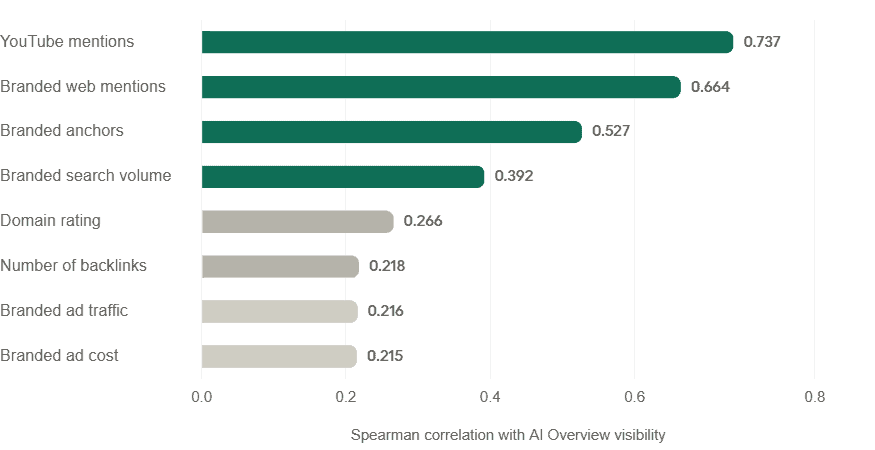
Branded web mentions – linked or unlinked – showed a Spearman correlation of 0.664 with AI Overview visibility. Backlinks? Just 0.218. The top three correlating factors were all off-site brand signals: web mentions, branded anchor text, and branded search volume. Not a single traditional link metric made the top of the list.
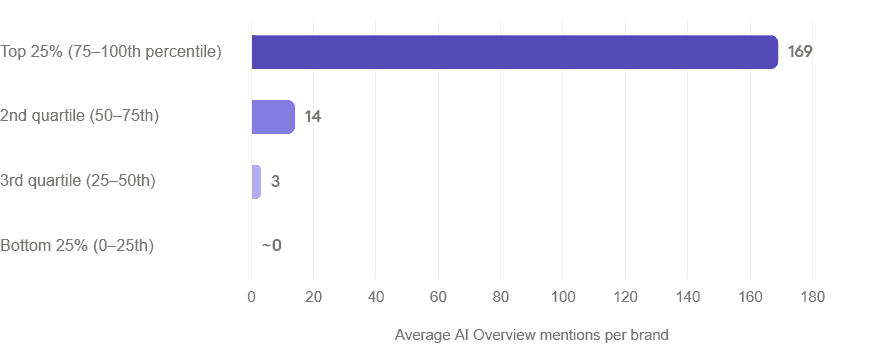
Brands in the top 25% for web mentions averaged 169 AI Overview appearances. The next quartile down? Fourteen. If your brand sits in the bottom half of web mentions for your category, you’re essentially invisible in AI-generated answers.
A follow-up study in December 2025 expanded the scope to ChatGPT and Google AI Mode. The findings held – and in some cases, the correlations were even stronger. YouTube mentions emerged as the single most correlated factor with AI visibility across all platforms (~0.737), while backlink count continued to show weak relationships with AI brand mentions.
Ryan Law, Ahrefs’ Content Marketing Director, put it bluntly: unlinked mentions have very little impact on traditional SEO, but a much bigger impact on AI visibility. Tim Soulo, the company’s CMO, went further and called citations “the new backlinks” for the AI era.
Google knew this was coming. In 2012.
Here’s the part most people get wrong.
Google filed a patent in 2012 titled “Ranking Search Results” (US 8,682,892) that introduced the concept of “implied links” – references to a target resource that aren’t express hyperlinks. The patent explicitly states that the system counts both express links and implied links when determining ranking modifications.
The SEO community widely interpreted this as confirmation that brand mentions on web pages function as ranking signals. A closer reading – as Search Engine Journal’s analysis pointed out – suggests the patent actually refers to branded search queries and navigational queries as “implied links,” not necessarily on-page mentions.
The distinction matters, but the conclusion is the same either way. Whether Google counts your brand mentions directly or uses branded search volume as a proxy signal, the outcome is identical: brands that people talk about, search for, and reference across the web get rewarded. The mechanism differs from what most SEOs assumed. The result doesn’t.
And with the rise of AI-driven search, the mechanism has become less important than ever. Because LLMs don’t read patents. They read the internet.
How LLMs decide who gets recommended
Large language models don’t crawl web pages and follow hyperlinks the way Googlebot does. They process text. They understand entities through co-occurrence patterns, contextual relationships, and the sheer frequency with which a brand name appears alongside relevant topics across their training data – and, increasingly, across real-time web retrieval.
When someone asks ChatGPT “What’s the best CRM for remote teams?” the model isn’t checking who has the most backlinks. It’s synthesizing information from across the web, weighing how often certain brands appear in relevant contexts, on trusted platforms, in proximity to the right keywords.
Kevin Indig’s analysis of over 7,000 AI citations across 1,600 URLs found that traditional SEO metrics like domain rating and backlink profiles had minimal impact on whether content got cited by LLMs. In some cases, those metrics showed a negative relationship with citation frequency. The factors that did matter? Content depth, readability, and – most critically – brand search volume.
The Semrush team confirmed this from another angle. Their research on the impact of AI search on SEO found that nearly 90% of webpages cited by ChatGPT rank in position 21 or lower in traditional Google results. The pages getting cited by AI aren’t SEO winners. They’re pages that happen to contain the right brand context in the right format.
The third-party effect (and why your own website isn’t enough)
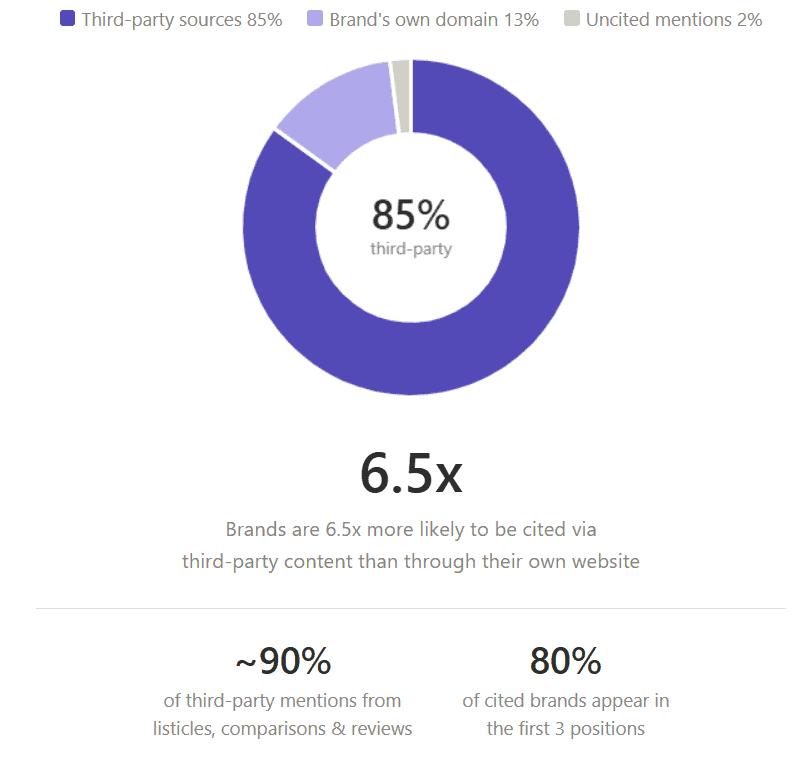
If there’s one statistic from 2025 that should reshape how e-commerce brands think about visibility, it’s this: brands are 6.5x more likely to be cited through third-party sources than through their own domains.
That figure comes from an AirOps analysis of 21,311 brand mentions across ChatGPT, Claude, and Perplexity. 85% of brand mentions in AI search originated from external content – not the brand’s own website. And nearly 90% of those third-party mentions came from listicles, comparison pages, and review roundups.
Think about what this means for a moment. You can have the most perfectly optimized product pages on the internet. Your schema markup can be flawless, your content deep and comprehensive. But if the broader web isn’t talking about you – in review roundups, Reddit threads, YouTube comparisons, industry publications – AI platforms have very little reason to recommend you.
This is where the gap between backlinks and brand mentions becomes most consequential. A backlink from a comparison article passes link equity. But a mention in that same article – even without a link – tells an AI system that you belong in the conversation. And when ChatGPT Shopping generates a buyer’s guide for “best trail running shoes under $150,” it’s pulling from those conversations, not from your backlink profile.
For e-commerce stores competing across multiple markets and channels, this shift changes the math on where to invest. The question isn’t just “how many linking domains do we have?” It’s “how often does our brand appear – in any form – across the sources that AI platforms trust?”
If you’re running an international store and struggling to show up in AI-generated recommendations across different markets, the issue likely isn’t technical SEO. It’s brand footprint. NON.agency’s AI Optimization (AIO) service was built specifically to measure and expand that footprint across all major AI platforms – because you can’t fix what you haven’t mapped.
The freshness advantage mentions have over links
Backlinks are slow. They accumulate over months and years. A link you earned in 2023 still passes equity today (assuming the page hasn’t been removed or de-indexed). That durability was always one of their strengths.
But in the AI citation economy, freshness matters more than durability.
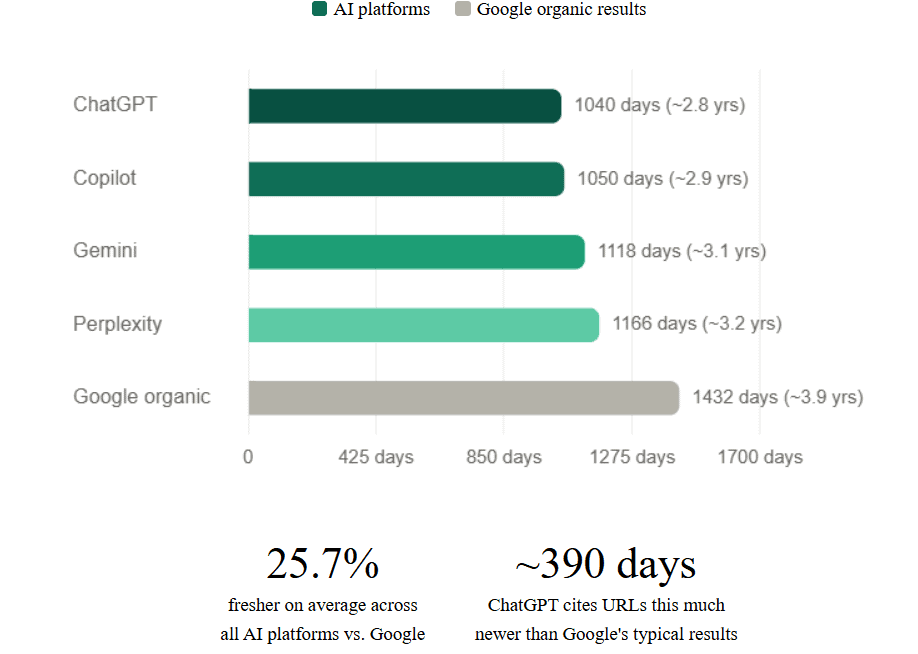
Ahrefs analyzed 17 million citations across seven AI platforms and found that AI-cited content is 25.7% fresher than what appears in traditional organic results. The average age of AI-cited URLs was roughly 2.9 years, compared to 3.9 years for organic SERP results. ChatGPT showed the most aggressive recency bias, citing URLs that were over 390 days newer than Google’s typical top results.
Here’s where it gets interesting for brand mentions. New mentions are, by nature, fresh. When a blogger reviews your product this month, or a Reddit user recommends your store in a thread today, or a YouTube creator includes your brand in a comparison video this week – those are fresh signals. They sit in recently published or updated content. They’re exactly the kind of context AI systems prioritize.
A backlink from a three-year-old resource page? Still valuable for traditional SEO. But for the AI layer of search, a brand mention in a fresh article carries a signal that a legacy link simply can’t replicate.
Backlinks aren’t dead. But the playbook is different now.
Let’s not overcorrect. Backlinks still matter. The Semrush and Kevin Indig study of 1,000 domains found a clear correlation between domain authority and AI visibility – it’s just not linear. There’s a threshold effect: sites need to reach a certain level of authority before AI platforms even consider them. Below that threshold, adding more links barely moves the needle.
A few findings from that study that challenge conventional link-building wisdom:
- Nofollow links have nearly the same impact as follow links in AI search. The correlations were almost identical – 0.504 (Spearman) for follow links versus 0.509 for nofollow. AI models don’t care about the rel attribute. They care about whether your brand appears on trusted platforms.
- Domain diversity beats link volume. Fifty links from fifty different domains outperforms a hundred links from ten. The breadth of your web presence matters more than the depth of any single linking relationship.
- Image-based backlinks compete with text links – and outperform them at higher authority levels, especially on Perplexity and ChatGPT. Visual content that earns image links carries a signal that traditional text-based link building misses entirely.
For e-commerce brands running international link building campaigns, this reframes the goal. The value of a placement in a German tech blog or a French lifestyle magazine isn’t just the dofollow link (though that still helps traditional rankings). It’s the brand mention in a market-relevant context – the kind of signal that feeds both Google’s entity understanding and the training data of every major LLM.
What the SparkToro data tells us about consistency
Rand Fishkin’s SparkToro research added an important caveat to the AI visibility discussion. His team had 600 volunteers run identical prompts through Claude, ChatGPT, and Google AI. The finding: there’s less than a 1-in-100 chance that ChatGPT will give you the same list of brands in any two responses to the same prompt.
AI recommendations are probabilistic, not deterministic. There’s no “position #1” to chase.
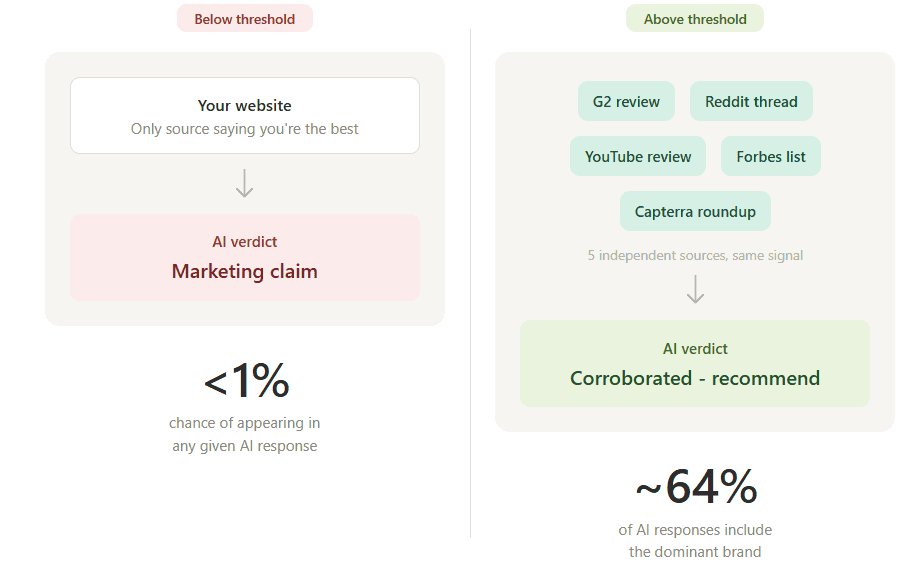
But the data also revealed something more useful: dominant brands – the ones that appear in roughly 64% of responses – didn’t get there by accident. They earned that consistency through broad, repeated presence across the web. Enough independent, credible sources saying similar things about a brand that the AI commits to including it rather than hedging.
Researchers describe this as crossing a “corroboration threshold.” If only your own website says you’re the best project management tool for remote teams, the AI treats that as a marketing claim. But if G2, two Reddit threads, a Capterra comparison, a YouTube review, and a Forbes roundup all say similar things – that’s corroboration. That’s when AI systems start treating your brand as a reliable answer.
What this means for e-commerce in particular
The shift from links to mentions hits e-commerce harder than most verticals. Here’s why.
When a shopper asks ChatGPT “recommend a smartphone for photos under $1,000,” they get one to three options – not twenty links. The AI has already done the comparison. It has already narrowed the field. If your product isn’t in that initial shortlist, you’ve lost the sale before the shopper even visited a website.
And the signals driving that shortlist? External reviews, community discussions, third-party comparisons, and consistent brand mentions across trusted platforms. Not your backlink count. Not your Domain Rating.
Yotpo’s 2025 AI Shopper Behavior Report found that 66% of shoppers who purchase more than once a week already use AI assistants to inform their buying decisions. Among those, 34% use ChatGPT specifically for initial product discovery.
For stores selling across multiple markets – especially those scaling from hundreds to thousands or millions of SKUs – the challenge is amplifying brand presence across every channel where these AI systems look. That means e-commerce SEO can’t stop at technical optimization and keyword targeting anymore. It has to include a deliberate strategy for earning mentions in the places AI platforms trust.
A practical framework for earning mentions that matter
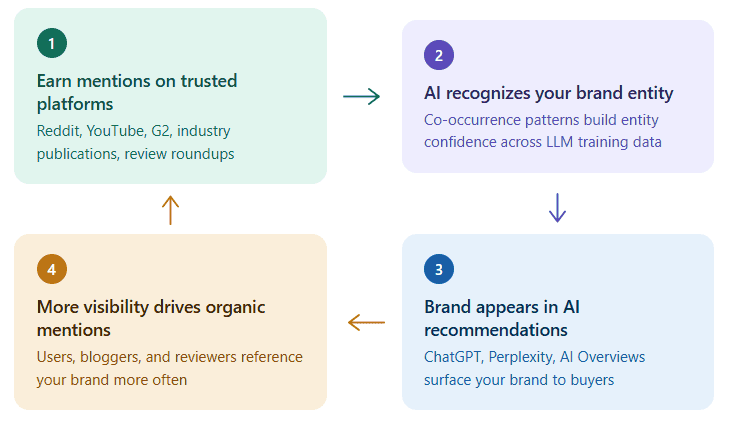
Not all mentions are equal. A passing reference on a low-traffic, thin-content blog won’t move the needle. Here’s what the data suggests actually works:
- Prioritize platforms AI systems already trust. Reddit, YouTube, G2, Capterra, and established industry publications show up repeatedly in AI citation data. A genuine presence on these platforms – not drive-by link drops, but real participation – builds the kind of signal AI systems weight heavily.
- Create content worth citing. Original research, proprietary data, named frameworks, and comparison tools get referenced far more than generic “ultimate guides.” When Kevin Indig analyzed the most-cited pages across AI platforms, the winners consistently offered something that couldn’t be found elsewhere.
- Keep content fresh. With 76.4% of ChatGPT’s most-cited pages updated within the last 30 days, a static content library is a liability. Build refresh cycles into your content operations. Update statistics. Add new case studies. Signal recency through both content and metadata.
- Think about brand consistency across languages and markets. AI systems connect mentions to entities. If your brand is referenced as “CompanyX” in English publications but “Company-X” or a localized variant in German forums, you may be fragmenting your entity signal. Consistent naming across all markets strengthens the connection – something our AI Content Generator is more than capable of. This is one of the less obvious reasons why international SEO strategy needs to account for brand mention patterns – not just keyword localization.
- Monitor what you can’t yet see. Most brands have no idea how they appear in AI-generated answers. Our AI Visibility Analysis (it’s free) is making this measurable – but the first step is acknowledging that a metric you’ve never tracked might be more important than the ones you’ve watched for years.
The Bottom Line
Backlinks got us here. They built the infrastructure of trust that made the modern web navigable and rankable. They’re not going away, and any strategy that ignores them entirely is leaving value on the table.
But the ceiling on what backlinks alone can achieve has dropped – and it keeps dropping. In a world where AI platforms generate answers instead of link lists, where product discovery starts in a chat window instead of a search results page, and where a brand’s reputation is assembled from millions of contextual mentions rather than thousands of hyperlinks – the brand mention has become the atomic unit of digital trust.
The brands winning in 2026 aren’t the ones with the most links. They’re the ones being talked about in the most places, by the most credible sources, in the most relevant contexts.
NON.agency combines twenty years of SEO expertise with proprietary AI tools to help e-commerce brands build visibility across traditional search engines, marketplaces, and AI platforms.