

A pitch email template seems like a perfect idea. It’s so easy. Someone had already done the work for you. So, you just copy-paste it, tweak a couple of things here and there, and voilà.
Yes, a template seems like a perfect idea. Until it doesn’t work.
And why would it? Imagine how many of those template-based pitches for guest posts website editors get every single day.
That’s why in this guide, we’ll show you:
- How to understand what editors actually want
- How to structure your outreach
- And how to increase your chances of getting that wished-for guest post placement
Let’s break it down!
What Editors Are Really Approving
Before we talk about the exact structure, let’s try to understand the perspective of people who may or may not accept your pitch: website editors.
Get into their shoes. What do they want?
First of all, they approve content that fits their audience. But apart from that, they also want it to drive traffic and fill the content gaps they currently have.
Every time website owners review a pitch for a guest post, they’re asking themselves:
- Does this fit our editorial direction?
- Will this bring value to our audience?
- Is this low-risk?
- Will we benefit from this?
When you understand this, your entire approach to link building might change.
You might stop asking yourself, “How can I get a backlink?” and switch to, “What’s in it for the website editor?”
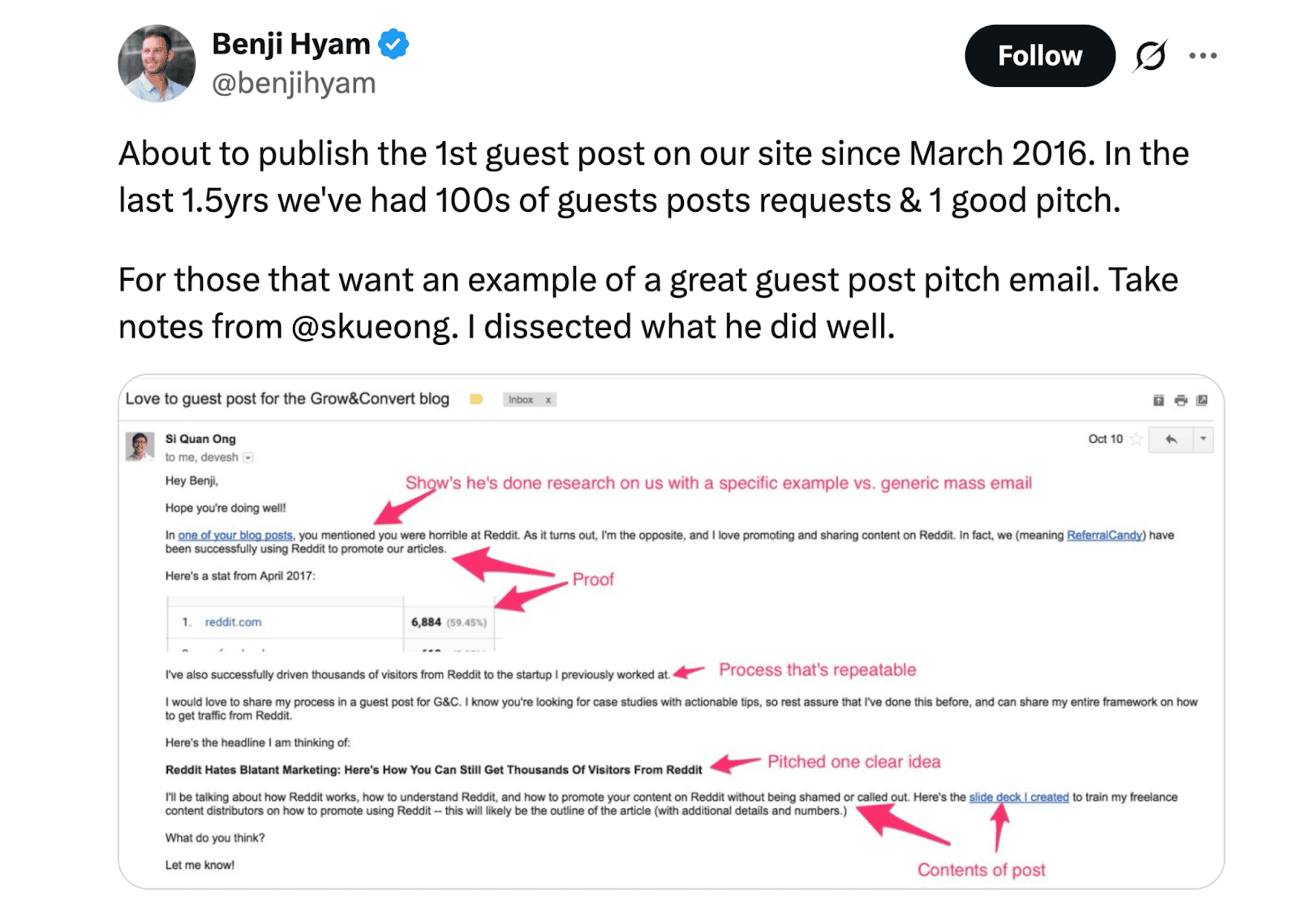
Here is a great example of an effective pitch.
Despite receiving hundreds of guest post requests, this website owner wasn’t accepting any of them for over a year.
But then, one email changed it. Why? Because that pitch had the following elements:
- It was personalized and didn’t seem like a mass email.
- There was actual proof of the writer’s expertise that led to repeatable results.
- The idea the author pitched was clear and relevant to both the target website and their experience.
Source: X
The core idea comes down to one thing: your offer must make sense and be valuable for the website you’re pitching.
But of course, it’s much easier said than done.
So, whenever you need help to meet your link building goals, you can always use a guest posting service and submit your ideas for the article there. Usually, there is a much higher acceptance rate.
6-Step Formula for a Pitch That Gets Accepted
To help you avoid any guesswork, here is a clear 6-step formula that works every time.
1. Work on Your Subject Line
Your subject line determines whether your email gets opened at all. And if it doesn’t get opened, there’s no point in improving its content either.
Too many subject lines look like this:
- “Guest Post Request”
- “Collaboration Idea”
- “Content Contribution”
Or even “Hi” 🙂
These are clear, sure. But they are also too cliché.
Editors receive dozens (sometimes hundreds) of outreach emails daily. If your subject line looks automated or vague, it’ll simply be ignored.
What should you do instead, then?
Your subject line should:
- Be specific and mention relevance for this specific site
- Make editors curious without being clickbait
Simple examples could be something like: “Fresh SaaS SEO research (happy to make it exclusive),” “Tested frameworks we used to grow [your project]: guest contribution idea,” “Contributor pitch: From zero authority to DR 70 (our case),” etc.
Here, you can see value and uniqueness. This sounds fresh in the ocean of mass-sent AI-generated pitches.
2. Create a Personalized Opener (Not Just Change the Name)
The days when personalization meant simply swapping the name are gone.
Real personalization goes far beyond that (obviously). You have to prove that you:
- Read their content
- Understand their audience
- Know where your idea might fit
For example, you might start your email like this:
“I recently read your piece on zero-click searches and really liked how you broke down the impact on SaaS brands. If you’re open to it, I’d love to build on that and share my experience with earning brand mentions that increase your chances of getting cited in AI search.”
When your opener proves you understand their niche and other content they’ve posted, your pitch email immediately stands out from all the generic outreach.
3. Explain Why You Qualify
There are a few ways to effectively prove that you are qualified for guest posting:
- Show you know the topic. Do you have enough expertise to write this content? You don’t necessarily need formal education. But you do need something that proves that you’re the real deal (X years of experience, results you’ve achieved, etc.).
- Focus on outcome-based experience. Editors trust results, and they are rarely convinced by job titles alone. Saying you’ve “worked with SaaS brands” is okay. But saying you’ve “helped a SaaS brand get 2K+ digital PR mentions organically in a year” is much more convincing.
Even if you have no guest blog posting experience, you can still position yourself well.
Mention a niche you specialize in, reference a project you’ve built, highlight research you’ve conducted, and so on. Even running your own blog can serve as proof, if it’s successful.
It’s no secret that you’ll have to pay an editorial fee for most guest posts. And while backlink prices differ, if your qualification is really impressive, some might charge you less. So, pay special attention to this part of your pitch.
4. Suggest Topic Ideas
Many people treat the “ideas part” like a brainstorming dump where you can just throw out ten broad topics.
That approach almost never gets accepted.
Editors don’t need more generic content because it’s already everywhere. They need articles that bring some fresh perspective.
So, before you suggest anything, study the site. Look at:
- Their most recent articles
- Recurring themes
- The level of sophistication in their content
- What hasn’t been covered yet
If a website publishes highly specialized topics, and you offer them some basic titles like “What is CRM” or “What is SEO,” it’s a no-go.
Similarly, it makes no sense to suggest something they’ve already written about. You’ll just waste your time.
Strong topic ideas usually have three traits:
- They are narrow enough to be meaningful.
- They promise practical value.
- They are written for the website’s audience.
Relevant and interesting suggestions show that you’ve made an effort. And effort builds trust, which increases the chance your pitch gets approved.
5. Offer Relevant Proof
At this stage, an editor needs to see how you delivered work before.
Whether you are a freelancer or work for a company, if you’ve been doing link building for SEO before, you definitely have some work samples.
Choose the strongest ones and form your portfolio for different niches (if needed).
Here are a couple of things to keep in mind:
- Don’t flood editors with links. A couple of contextually relevant examples are more than enough.
- You don’t need Forbes-level websites. Most people don’t have that, and that’s okay. Just give proof that you can write effective SEO texts and follow editorial standards.
- Choose articles that make sense for your topic suggestions. It’s much better if you can connect your previous work to what you offer to write about.
The main idea is that editors don’t want to rewrite your draft from scratch, and they don’t want to clean up any structure issues.
So, when you show high-quality past work, it means that approving your pitch won’t create extra workload for them. That’s why it’s a must for any pitch.
6. Finish With a Strong CTA
CTA is, without a doubt, the most underestimated part of a pitch email.
Sure, a call-to-action is often associated with marketing materials. But guest posting is also a part of your digital marketing.
So, if you’ve structured your message well, explained why you qualify, and proposed strong ideas, you can still kill your efforts with one sentence:
“Let me know what you think.”
It might work if all the rest of your email is brilliant. But most likely, it won’t help you score any additional points. A good closing moves the conversation forward.
So, don’t vaguely ask for feedback. Better, suggest a clear next step. For example, you can offer to:
- Send a detailed outline
- Draft one of the proposed topics
- Try different angles to better fit their editorial guidelines
It signals that you’re ready to take action.
The easier you make it for an editor to reply with a simple “Yes, please send a draft,” the higher your success rate will be.
Also, keep your closing concise. Making it long and dramatic won’t increase approval rates.
Outreach Metrics You Can Track
If you want to know how your guest posting campaign is doing, you can track a set of outreach metrics.
But keep in mind that all the rate estimates we mention below can vary a lot, depending on your pitch, website selection, expertise, target linking page, and tons of other elements.
So, the best thing you can do is track these metrics to test different techniques.
For example, with an “X subject line,” we got an open rate of 20%, but with a “Y subject line,” it was 40%. If you see something like this, analyze why something worked better, instead of obsessing over the industry averages.
Now, what are the metrics you should pay attention to?
- Open rate. How many of your emails get opened (30%-50% is usually considered a good result).
- Reply rate. How many editors actually respond (anything between 5% and 10% is good; this might include negative replies, too).
- Approval rate. These are your approved guest posts (there is no real estimate here because there are way too many variables).
- Time to response. This is a useful metric to track at the very beginning to understand when to send your follow-ups.
Example of a Pitch Template
Now that we’ve broken down the formula and looked at all the major tips, here’s how everything looks when combined.
Subject: Topic idea for XYZ: What content resonated with our audience (10-year analysis)
Hi (name if you know it),
- Mention some of their previous work or a post on socials
Let me just say I loved your recent articles on digital marketing strategy. Especially your piece on the evolution of search behavior. Many of your arguments made me think.
- Explain what you have in mind and why you qualify
My team and I analyzed our content from the last 10 years. We wanted to see what actually drove engagement and organic backlinks. And we were shocked! I’d be happy to share what we learned, with real examples and a few predictions.
- Add something tangible (e.g., recent data, real-life example, case study, viral trend, etc.)
Here is an overview of our dataset. It can serve as a foundation for my guest article.
- Suggest a title (or several ideas if needed)
This is a title I had in mind:
Title
- Show your previous work
Here are a few of my recent pieces related to content marketing:
- Link
- Link
- Link
- Close with a CTA
If this seems interesting, I’d be happy to prepare a detailed outline or draft for your review.
Best,
Your name
Common Pitch Mistakes
Based on everything we’ve already covered, these mistakes might seem obvious. Still, so many businesses make them again and again.
So, let’s summarize some of the most common pitch mistakes to make sure you avoid them:
- Pitching irrelevant websites. Sometimes, you can send hundreds of emails and still receive only a couple of replies, even if you do everything correctly. The issue might be trying to pitch as many websites as possible when they don’t even fit your niche or expertise.
- Not getting straight to the point. The whole idea of a pitch is to make it as short as possible. You don’t need to tell a story of your life to prove your expertise. Instead, make it look like a summary with only essential ideas.
- Ignoring personalization. By now, you understand that it’s a no-go because you have to stand out if you really want to secure that guest post.
- Not selling yourself well. Of course, it isn’t a job interview or meeting your partner’s parents. But you still need to make a website editor want to hear your perspective. So, find your unique offering and make it clear in your email.
- Having a vague opening or closing. We’ve already mentioned this, but it’s worth repeating. Your opening has to hook the website owner, and your closing has to encourage them to continue the conversation.
Conclusion
Successful pitches for guest posts ultimately come down to attention to detail.
When your email shows that you researched their publications, understand their audience, and know how to deliver something genuinely useful, you will most likely get accepted.
Of course, there is a creative element to this. But pitching is also a system. And once you build one, your acceptance rates will surprise you.