

Building links to your domain is one of the fundamentals of SEO. Every expert would agree that there’s no successful website without a healthy link profile.
However, the growing popularity of AI tools challenges this notion.
Getting citations in ChatGPT or Perplexity isn’t just about domains linking to you, but about how others perceive you. And that’s a much more complex matter.
P.T. Barnum once said “There’s no such thing as bad publicity, as long as they spell your name right.”
Nowadays, with the growing importance of AI tools, you have to make sure your brand is mentioned in a positive manner. Otherwise, it will be hard for you to appear in AI-generated responses to people’s queries.
Why is this such a big issue? We explain below.
The End of the “Click and See for Yourself” Era
Remember how Google Search worked just 2 years ago?
You type a query into Google. You get 10 blue links. You click the first, second, third. You compare information and try to draw conclusions.
Now?
You type a question into ChatGPT and get a ready answer. There’s no need to click and compare things on your own.
In the Google era, links mattered. In the AI era, mentions matter.

How Large Language Models Became Search Engines
Early versions of ChatGPT had no internet access. They were “frozen in time,” meaning they only knew what was in their training data up to a specific date.
Today it’s a completely different story.
ChatGPT has web browsing functionality. Claude also has internet access. Perplexity was designed from the ground up as an “AI search engine.” Gemini is integrally connected to the Google ecosystem.
What Does This Mean in Practice?
When you ask ChatGPT or Perplexity a question, a lot happens behind the scenes.
The model:
- Understands intent (analyzes what you’re really looking for)
- Generates sub-queries (breaks down the question into smaller components — called query fan-out)
- Queries sources (searches the internet, knowledge bases, indexes)
- Synthesizes an answer (combines information from multiple sources into one cohesive response)
- Cites sources (indicates where the information comes from)
This is no longer an assistant. It’s a full-fledged search engine.
Except there’s one key difference. Instead of a list of links, you get a specific narrative in which some brands and experts are mentioned, while others are ignored.
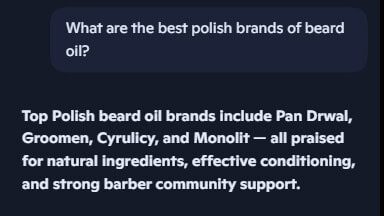
And this is exactly what keeps so many marketers up at night. A new, rapidly growing channel for building brand visibility has emerged — one that is completely different from traditional link building.
The numbers don’t lie. According to a survey conducted by Adobe, ¾ of respondents used ChatGPT as a search engine. Moreover, nearly ¼ of surveyed individuals started their information search there.
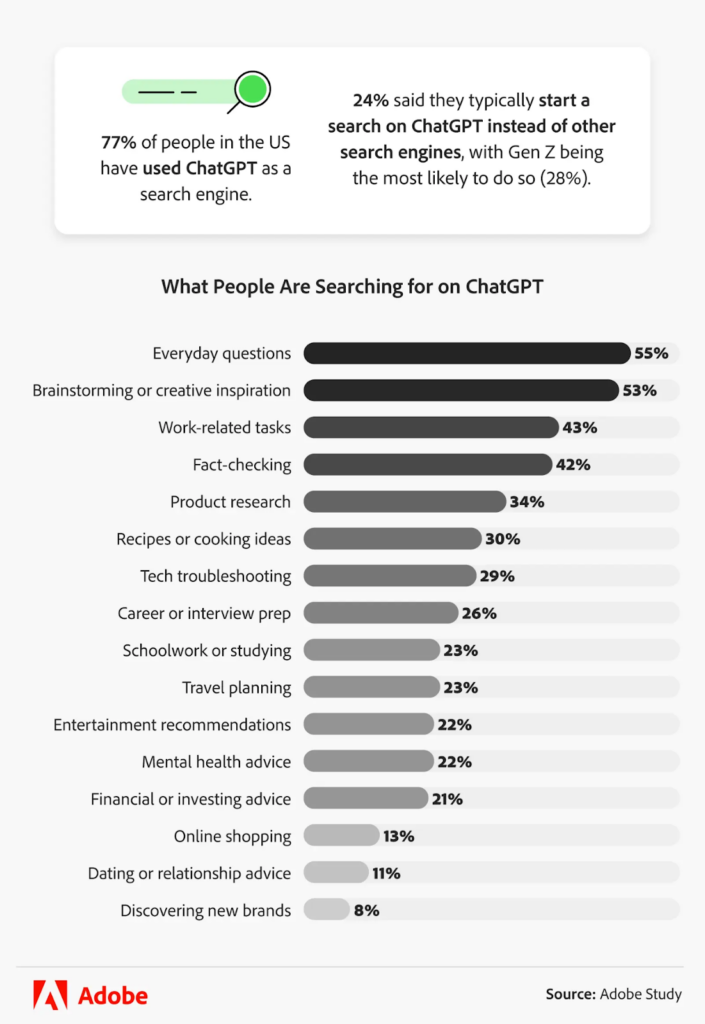
This data clearly shows changing trends in information seeking. If companies ignore these signals, they may soon find that their existing visibility begins to decline drastically.
ChatGPT + Google Search = A New Era
In 2024, ChatGPT officially integrated with Google’s search infrastructure.
Jérôme Salomon, Senior Technical SEO at Oncrawl, analyzed data from Google Search Console and noticed something fascinating.
He observed a massive increase in long-tail queries with the year in the name (e.g., “best laptops 2024,” “SEO trends 2025”). These are queries people don’t normally type, but which AI generates automatically to ensure fresh results.
These queries generate impressions in GSC but don’t result in higher CTR.
You can check out Salomon’s presentation given at BrightonSEO here.
What does this mean?
All the page visits generated by these queries aren’t real users. They’re language model bots that “query” Google on behalf of users.
Such a bot extracts information and never redirects the user to your page. An impression appears, but you don’t get a click.
It means marketers must approach online visibility in a completely different way, taking into account new metrics like brand mentions in AI tools.
Links vs Brand Mentions — The Biggest Difference in AI Optimization (AIO)
Time to get to the heart of the matter. What exactly is the difference between a brand mention in ChatGPT and a backlink on a page that leads to your domain?
How Link Building Worked in the Google Era
In traditional SEO, a backlink is the currency of authority. Every single link works as a vote of trust.
The mechanism is simple:
- Site A links to site B.
- Google sees the link.
- Google interprets: “Site A considers site B valuable.”
- Site B gains authority (link juice).
- Site B ranks better.
The more links from credible sources, the higher the ranking. In short — a link was essential for growing your visibility online.
How Brand Mentions Work in the AI Era
In the AI era, a brand mention is the new link. Citation in AI tools doesn’t transfer the user to your page, but increases your brand’s online visibility and boosts its authority.
The mechanism is quite simple:
- The AI model searches the internet.
- It finds your brand mentioned in an expert context.
- It processes the context: “In what context are they talking about brand X? Is it an authority?”
- It builds a representation of your brand in its “memory.”
- When someone asks a question related to your domain — you get mentioned in the response.
In summary, the most important difference is as follows:
A backlink leads users to your page. A brand mention keeps users in the AI tool, but still builds your authority and brand recognition.
What’s More Important — Backlinks or Brand Mentions?
Both are important. Links still matter for traditional SEO (Google isn’t going anywhere). Nonetheless, a mention offers something a backlink can’t: significantly better semantic context.
AI doesn’t just look at whether someone mentioned you. It analyzes:
- In what context are you mentioned?
- By whom — by an expert, media, users?
- How often and where — in authoritative publications, reports, case studies?
- What concepts are you associated with — innovation, quality, cheap, premium?
- What’s the sentiment — positive, negative, neutral?
This is a much deeper analysis than “link exists/doesn’t exist.”
What It All Means for Marketing
New ways of building credibility and online visibility mean new challenges. Here are the most important consequences of the growing popularity of AI tools as search engines.
1. PR and Content Marketing Merge Into One
PR used to be separate from SEO. PR took care of the brand’s image. SEO took care of organic traffic.
Now these two worlds overlap.
A publication in an authoritative industry medium provides:
- A brand mention for AI
- A backlink for SEO
- An E-E-A-T signal
- A trust signal for Google
- Greater brand recognition
One article — five benefits.
2. UGC (User Generated Content) Has Real Power
AI learns from user-generated content. Reddit, Quora, Facebook, and LinkedIn have a real impact on how artificial intelligence perceives your brand.
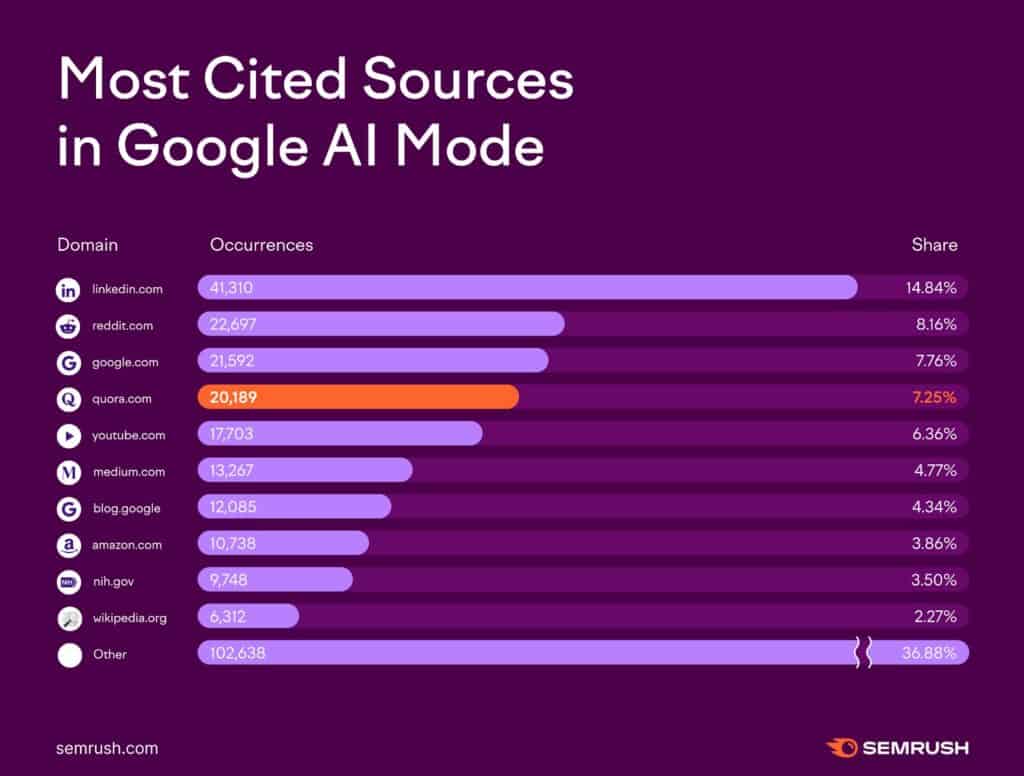
Semrush analyzed 278,279 queries in Google AI Mode and discovered that a link to the Quora forum appeared on average once every 14 responses. Other popular sources include LinkedIn, Reddit, Medium, and YouTube.
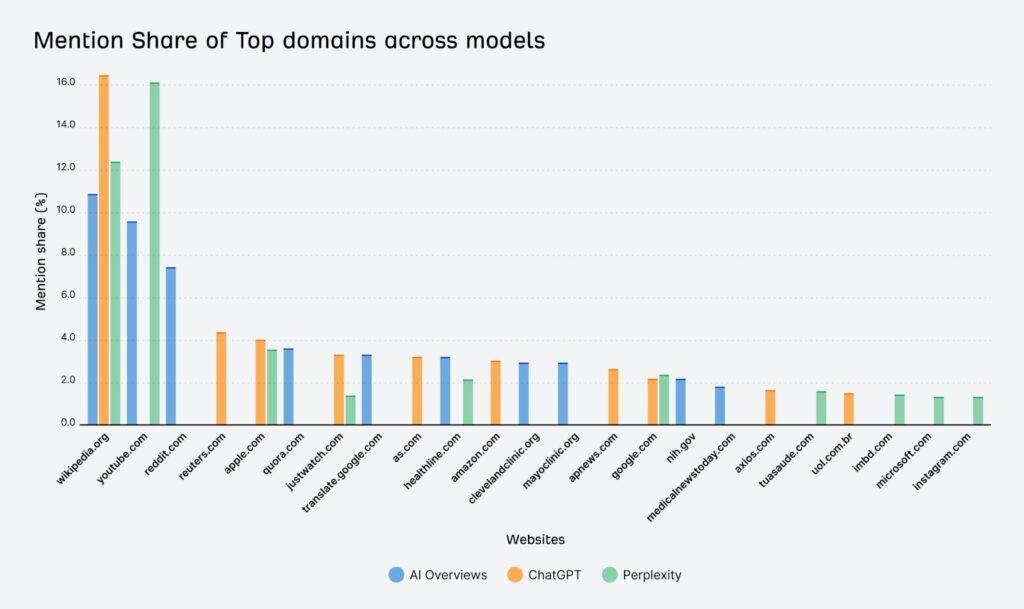
Ahrefs’ analysis yielded very similar results. Among the ten most frequently cited sites by ChatGPT, Perplexity, and AI Overview were Wikipedia, YouTube, Quora, and Reddit.
What does this mean?
What people say about your brand on Reddit or LinkedIn affects how AI describes you in its answers.
Positive sentiment will signal to artificial intelligence to recommend your product or service. Meanwhile, negative opinions on forums and social media can effectively close the door to further citations.
3. Personal Branding Becomes Business Branding
AI likes simple data recorded in the following format: name + context. Therefore, “John Smith from CompanyX” is a better signal than just “CompanyX.”
Why?
Because AI is designed to think like people, and people trust experts more than nameless companies. It also emphasizes the importance of the recently added second E in the E-E-A-T acronym — experience. After all, people — not abstract entities like companies — experience things.
What does this mean in practice?
It’s worth noting that the line between your own reputation and your company’s reputation is increasingly blurring.
Here are some practical tips:
- Develop LinkedIn profiles of founders and key experts.
- Publish articles signed with first and last names.
- Build mentions like “[First Last] from [Company], expert in [field].”
4. Content Clusters Are More Important Than Individual Articles
In today’s world, one strong article isn’t enough.
AI operates in a thematic context.
If you talk about SEO, AI checks:
- Do you have content about links?
- Do you have content about content marketing?
- Do you have content about technical optimization?
And most importantly:
- Are these texts connected to each other?
The more complete the topic coverage, the higher the authority.
5. Content Freshness = Credibility
Analyses show that ChatGPT Search modifies queries by adding the current year to ensure data freshness.
What does this mean for you?
If you have content from 2019 that hasn’t been updated, AI may consider it outdated. Even if the information in it is still current.
It’s worth acting proactively — before AI negatively assesses the “freshness” of your articles.
The best solution is regular updating of your key content.
You don’t have to rewrite everything. It’s enough to refresh data, add new examples, and update the year in the title.
How To Build Brand Mentions in AI Answers
Building credibility in AI models is a long-term process. It requires appropriate knowledge and experience working with artificial intelligence.
1. Take Care of the Basics
What to do:
- Check what ChatGPT, Claude, Perplexity, and Gemini know about your brand.
- If you’re not in the responses — start building a stronger foundation (About page, social media profiles, articles).
Questions worth asking AI:
- “Tell me about [Your Company]”
- “Who is the leader in the [Your Industry] industry in [Your Country]?”
- “What companies specialize in [Your Service]?”
2. Publish Valuable Content in Credible Places
Where?
- Industry media and portals
- Educational publications
- Expert platforms (LinkedIn, Medium)
- Reports and research
Things to avoid:
- SEO article farms
- Low-quality guest posting platforms
- Places without industry authority
AI prefers sources that are considered trustworthy and credible.
3. Build Activity on UGC Platforms
What to do:
- Answer questions related to your industry on forums like Reddit and Quora
- Participate in discussions on LinkedIn
- Build a community around your brand
- Respond to opinions and reviews
Remember:
AI understands sentiment and context. Negative reviews without response signal that the brand doesn’t care about customers.
4. Create AI-Friendly Content
- Stick to a question-answer structure. AI likes clear, specific answers.
- Use simple H2/H3 headings that facilitate passage extraction.
- Remember to add entity definitions. Explain who you are and what you do.
- Take care of structured data (schema markup). This will help AI better understand context.
5. Build an Expert Profile Through E-E-A-T Signals
What to do:
- Add “About the author” sections with verifiable data.
- Publish case studies and references.
- Collect certificates, awards, distinctions.
- Show experience and company history.
Why it’s important:
Google and AI place enormous emphasis on E-E-A-T (Experience, Expertise, Authoritativeness, Trustworthiness).
Without these signals, your content may be ignored — even if it’s substantively good.
6. Link to Yourself in an Expert Context
If you’re publishing in external media — add a link to your site. But not just any link.
- Wrong: “You can find more information here [link]”
- Correct: “John Smith, CEO of XYZ and AI expert, points out…”
Anchor text also matters in AIO.
7. Monitor How AI Talks About You and Your Company
Regularly check:
- Does AI know your brand?
- In what context are you mentioned?
- Is the information current?
- What other brands appear alongside you?
This is your “authority map in AI.”
8. Leverage Existing Mentions Without Links
It’s a good practice in link building, but it also works for building recognition in AI.
The action scheme is simple:
- Use brand monitoring tools (e.g., Brand24, Google Alerts) to find places where someone mentioned you without a link.
- Contact the author and ask them to add the link.
Why does this work?
Brand mention + backlink = double signal (for AI and for Google). This is a proven strategy that has brought measurable benefits in the past and remains a very good solution.
9. Create Content That People Want To Cite
AI tries to rely on reliable sources of knowledge, especially when users ask for specific sources of information.
The most valuable content you can create includes:
- research and reports
- case studies
- expert opinions
- definitions and explanations
- comparisons
The more your content meets the criteria for valuable content, the more often AI will cite it.
10. Automate Where Possible
If you have hundreds of products, writing descriptions for them manually is a waste of time. Amazon has already proven it can be done differently by providing sellers on its platform with a tool for automatically generating product descriptions.
Want to follow the path set by market leaders? Implement systems for automatic generation of AI-optimized content, including:
- product descriptions
- category descriptions
- alt-texts for images
- metadata
Don’t know where to start? Contact us! We have the right tools to implement automatic description generation for your store.
What’s Next? Link Building Isn’t Dead, It’s Evolving
Link building — like Google — isn’t going away. Instead, it’s transforming into authority building.
Instead of focusing on the quantity of links, consider:
- building mentions in publications that AI considers credible
- understanding the context in which your brand appears in AI answers
- monitoring trust signals
- presenting expert depth on your site
- increasing your activity on forums and social media
Want To Increase Your Visibility in AI?
At NON.agency, we help companies increase visibility in search engines and AI answers.
We conduct detailed audits of brand presence in AI tools, build content marketing and PR strategies for AIO, and help gain brand mentions on sites that AI considers credible.