

The Internet has become an integral part of our lives – we use it every day, searching for information, products or entertainment. But have you ever wondered what tools are driving these searches? Search engines are gateways to the digital world, and this market is dominated by several key players.
In 2025, the situation in the search engine market remains dynamic, although one giant consistently maintains its dominant position. The data shows that the majority of Internet users around the world still choose the same tools as a few years ago, but some regions are seeing interesting changes and trends that may foreshadow future reshuffles on the global stage.
In this article we will look at detailed data from various sources, we will present not only the most popular search engines in the world, but also analyze the situation in specific regions, including Poland. You will learn about the strengths and weaknesses of each tool and how their popularity affects marketing strategies and SEO.
Top 5 most popular search engines in the world in 2025
Global data on the popularity of search engines clearly shows that despite the passage of years and various attempts at competition, one player invariably dominates the field. Let’s take a look at the current statistics and trends that are shaping the digital information search landscape in 2025.
Ranking of search engines in the world (2025)
The latest Ahrefs data from early 2025 shows that search engine Google remains the clear leader, controlling nearly 90% of the global search engine market. Other players, while important in some regions, globally occupy much smaller shares.
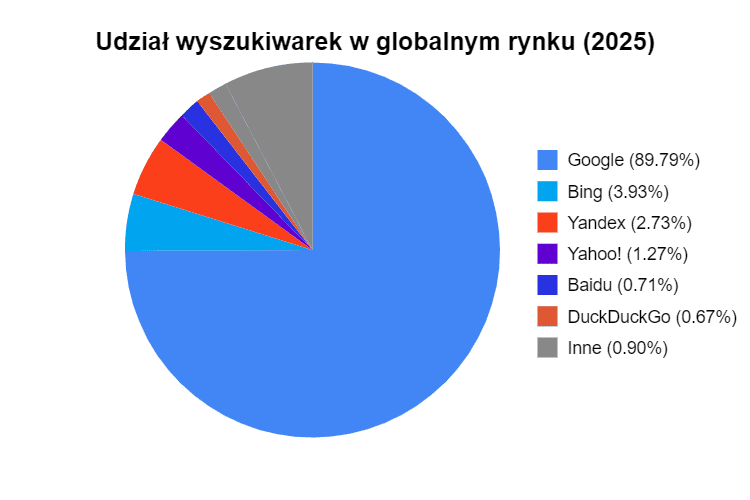
It is worth noting that Google is almost 20 times more popular than its closest competitor. This dominance is even more striking when one realizes that almost 9 out of 10 search queries worldwide are handled by this search engine. In second place is Bing with a 3.93% share, and the podium is rounded out by Russia’s Yandex with 2.73%. Further positions are occupied by Yahoo! (1.27%), China’s Baidu (0.71%) and privacy-oriented DuckDuckGo (0.67%).
Interestingly, despite its still dominant position, Google is seeing a slow decline in users. Just a year ago, in January 2024, the search engine enjoyed a share of 91.47%. The decline has been attributed to growing privacy concerns, problems with monopolistic practices and increasing competition from search engines using artificial intelligence.
Dynamics of change over the past 5 years
Analyzing the data over the past 5 years, we can observe some interesting trends. While Google’s dominance remains unchallenged, we can see subtle changes in the shares of other players.
It is interesting to note the increase in the share of Bing, which is slowly but steadily increasing its presence in the market. Microsoft’s search engine has gained more than 1 percentage point in the last 5 years, which in such a stable and dominant market is a significant achievement.
We can also see a marked increase in the popularity of Yandex, the Russian search engine, which has more than doubled its global market share since 2021. On the other hand, Chinese search engine Baidu has seen a decline from 1.35% to 0.71%, which may be related to changes in China’s Internet policy and the expansion of other players into Asian markets.
Differences between mobile devices and desktop computers
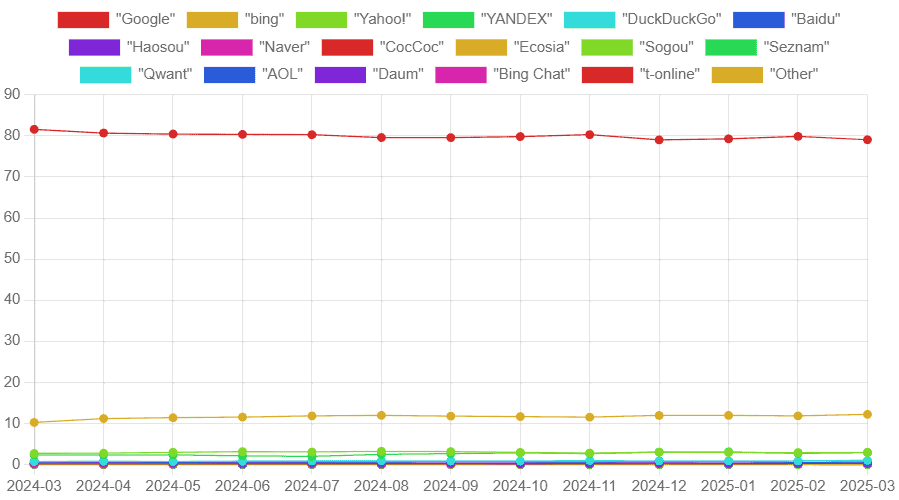
Interesting differences in user preferences can be observed by comparing statistics for mobile devices and desktop computers.
As you can easily see, Bing has a surprisingly high share of desktop searches, thanks largely to its integration with Windows and the Edge browser.
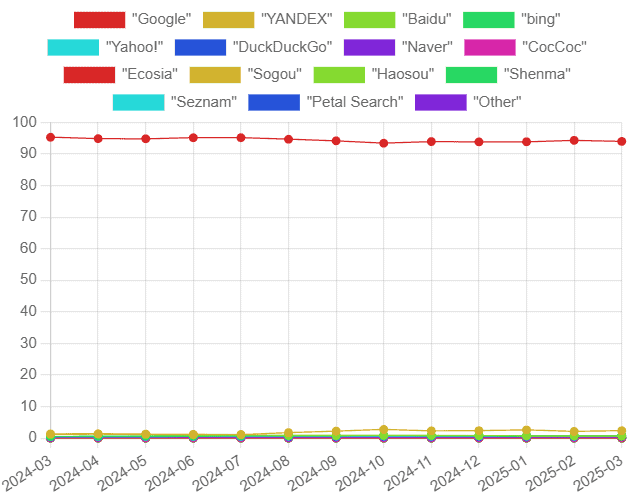
Google, on the other hand, enjoys a dramatic advantage on mobile devices, due in part to Android’s dominance of the smartphone market.
Number of users in absolute numbers
Given that there are about 5.56 billion people worldwide using the Internet in 2025, we can estimate the number of users of each search engine:
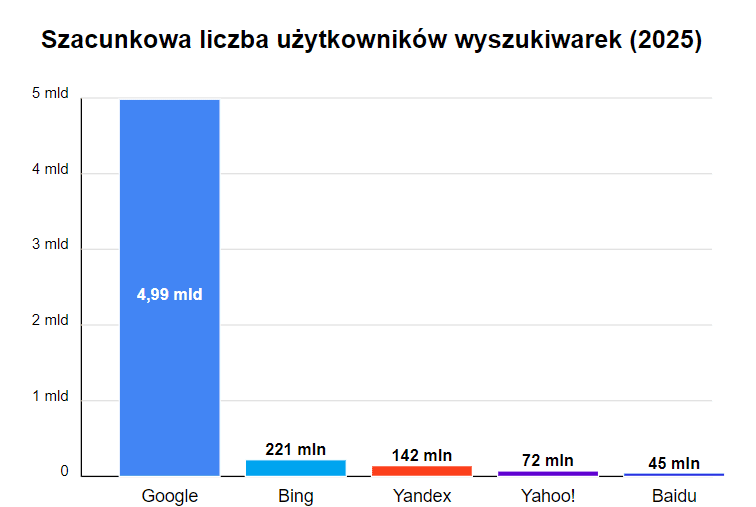
These figures show the true scale of Google’s dominance – the search engine is used by nearly 5 billion people worldwide. That’s more than the populations of Asia and Africa combined.
Detailed analysis of the most popular search engines
In this section, we will take a closer look at each of the leading search engines. We’ll learn about their history, the technology behind their operation, and the key advantages and disadvantages that set them apart in the market.
Google – the undisputed market leader

Google is undoubtedly the most powerful search engine in the world, controlling almost 90% of the global market. The history of this giant began in 1996, when Larry Page, Sergey Brin and Scott Hassan created a project that changed the face of the Internet forever.
History and development
Google began as a student project at Stanford University, where Page and Brin developed the PageRank algorithm, which revolutionized the way websites were valued. Instead of rating pages based solely on content, the algorithm also analyzed the links leading to them, treating them as a kind of “vote of confidence.”
In 1998, Google Inc. was officially registered, and in 2004 the company debuted on the stock market. Since then, Google has steadily developed its search engine and, in parallel, created an ecosystem of additional services that we know today as Google Maps, YouTube, Gmail, Google Drive, and Google Docs.
Technology
The backbone of Google’s operation is a sophisticated web indexing system. Special programs called “crawlers” constantly crawl the web, discovering new sites and updating information about those already in the index. Google now has the largest index of websites in the world, covering hundreds of billions of pages.
Google’s success is based on the continuous improvement of its search algorithms, which understand user intent better and better. Key algorithm updates, such as Panda, Penguin and BERT, have steadily improved the relevance of results. The latest developments use advanced artificial intelligence models that analyze the semantics of questions and the context of searches.
Google currently processes several billion queries a day, making it the most popular website in the world. The company has a particularly strong presence in the US, India, Brazil, the UK and Japan.
Read more: Google’s March 2024 update: What do we know?
Advantages
Google has the largest number of indexed websites, which translates into quality and completeness of search results. Users also appreciate:
- Intuitive and minimalist interface that makes the search engine easy to use
- Advanced search functions, including image search and voice search
- Rich ecosystem of additional free services (Maps, Gmail, YouTube)
- High relevance of results, tailored to the user
- Speed of operation and frequent index updates
Disadvantages
Google’s main drawback is the collection of a huge amount of user data. The search engine tracks search history, location and other data to better tailor ads. This raises privacy concerns and has more and more people looking for alternatives.
Other drawbacks include:
- Creating so-called “information bubbles” by personalizing results
- Market dominance that leads to monopoly problems
- Aggressive advertising practices and promotion of own services in search results
Bing – a search engine backed by the power of Microsoft
Bing ranks second in the global search engine market with a share of about 3.93%. Despite the huge gap separating it from Google, the search engine is steadily increasing its market share.
History and development
Bing was created by Microsoft and originally launched in 1998 as MSN Search. After several transformations (Windows Live Search, Live Search), it finally adopted the name Bing in 2009.
Microsoft has been consistently developing its search engine, systematically adding new features and improvements. A breakthrough moment came in 2023 with the introduction of a GPT-4-based chatbot called Microsoft Copilot (formerly Bing Chat). It was the first major search engine to integrate advanced artificial intelligence, which helped grow its user base to more than 100 million.
Technology
Bing works similarly to Google – a user types a query into the search box and receives results in a familiar layout. The search engine has its own index of websites, although smaller than Google.
Microsoft has invested heavily in developing AI features in Bing. Introduced in 2023, Microsoft Copilot, based on the GPT-4 model, allows the search engine to carry on a conversation, generate summaries of search results and create images using a DALL-E-based generator.
Advantages
Bing is distinguished by several interesting features:
- Microsoft Rewards program, allowing you to collect points for searches and redeem them for gift cards
- Advanced AI features, including a conversational assistant and image generator
- Integration with Windows and the Edge browser
- High-quality image and video search
- Fewer ads compared to Yahoo!
Disadvantages
Bing’s main drawbacks are:
- A non-intuitive interface that many users find less clear than Google’s
- Smaller index of websites compared to Google
- User privacy issues – like Google, Bing collects user data
- Less accurate search results on some niche topics
Yahoo! – a pioneer that lost its dominant position

Yahoo! currently ranks third among global search engines with a market share of about 1.27%. Although this is only a fraction of what Google controls, Yahoo! is still an important player, especially in some regions of the world.
History and development
Yahoo! was founded in 1994 by Jerry Yang and David Filo as a directory of websites, which only later gained search functions. Initially, it was not a true web crawler, but rather a hand-created database of links.
At its peak, Yahoo! was one of the most popular sites on the Internet, combining the functions of a search engine, site directory and news portal. Over the years, the company changed search technology providers several times, partnering with Google and Bing, among others. Currently, Yahoo! search results are provided by the Bing search engine.
Technology
Yahoo!, unlike Google or Bing, does not currently have its own index of websites. The search engine uses the results provided by Bing, adding its own interface and content organization elements.
Yahoo!’s interface is much more elaborate than Google’s minimalist approach. The portal combines a search engine with access to news, weather, sports and other content, blurring the line between search engine and web portal.
Advantages
The strengths of Yahoo! are:
- Extensive interface with access to a variety of content types
- Popularity in some countries, especially Japan, where it has more than 10% of the market
- Integration with Yahoo! Mail services and other company products
- Access to search for news, images, videos, products and jobs
Disadvantages
Yahoo! has several significant drawbacks:
- Excessive ads in search results, often poorly labeled as sponsored content
- No proprietary search technology
- Privacy issues – like other major search engines, Yahoo! collects user data
- An overloaded interface that can overwhelm new users
Baidu – a dominant force in the Chinese Internet
Baidu is the fifth largest search engine in the world with a global market share of about 0.71%. However, these numbers do not paint the full picture – in China, Baidu is the absolute leader.
History and development
Baidu was founded in 2000 by Robin Li and Eric Xu. Interestingly, Robin Li is the author of the ranking algorithm that influenced the creation of Google PageRank and later became the basis of Baidu’s search engine.
The name “Baidu” comes from a classic Chinese poem describing the search for beauty amidst chaos. The company quickly became a dominant player in the Chinese market, especially after Google pulled out of China in 2010 due to censorship and hacking attacks.
Technology
Baidu has the largest index of Chinese-language websites in the world. The search engine is optimized for the Chinese language, which is a huge advantage in the local market. Baidu’s interface is only available in Chinese, reflecting its focus on the domestic market.
Like Google, Baidu offers a wide range of search-related services, including:
- Baidu Tieba Forum
- Baidu Zhidao (equivalent to Quora)
- Baidu Baike (Wikipedia equivalent)
- Baidu Translate (translator)
- Maps, news, stock quotes and many other services
Advantages
Baidu’s main advantages are:
- Excellent optimization for Chinese language
- Expanded ecosystem of online services
- Speed of action within China
- Interestingly developed features and smooth operation
- Excellent understanding of the local cultural context
Disadvantages
Baidu’s key drawbacks:
- Strong content censorship in line with Chinese government guidelines
- Limited usefulness outside of China and for those not familiar with the Chinese language
- Problems with privacy and collection of user data
- Favoring state information sources
- Unsuitability for users outside the Chinese market
Yandex – Russian technology giant

Yandex ranks fourth in the global search engine market with a share of about 2.73%. As with Baidu, the global statistics do not capture the full extent of its importance in its home market.
History and development
Yandex was founded in Russia in 1997. The name is an acronym for “Yet Another iNDEXer” or the Russian phrase “Я индекс” (“I index”). The company quickly became the market leader in Russia, where it now controls about 70% of the search engine market.
In addition to Russia, Yandex is popular in countries such as Kazakhstan, Belarus and Uzbekistan. In Poland, attempts have been made to introduce local versions of Yandex, but they have not been popular with users.
Technology
Yandex stands out for its advanced search technology optimized for Russian, which is one of the most difficult languages in terms of morphology. The search engine takes into account the different forms of words in Russian, automatically performing searches in several variations to provide the best results.
The company also offers a range of additional services:
- Yandex Maps (maps)
- Yandex Translate (translator)
- Yandex Disk (cloud file storage)
- Yandex Metrica (website traffic analysis)
- Support for local search in more than 1,400 cities
Advantages
Yandex’s strengths:
- Excellent optimization for the Russian language
- A wide range of additional services and tools
- Search functions for images, videos and maps
- Translation capability and access to internal mail
Disadvantages
Yandex’s main drawbacks:
- Search results are tailored primarily to the Russian market
- As of 2020, the search engine is under the increasing influence of the totalitarian Russian government
- Yandex strengthens disinformation, especially regarding the war in Ukraine
- In 2024, most of the company’s Russian assets were sold to investors linked to the Kremlin
- Limited usefulness for users outside the Russian-speaking area
DuckDuckGo – a search engine with privacy at the forefront

DuckDuckGo, with a global market share of about 0.67%, may seem like a small player, but its importance is steadily growing, and its operating philosophy sets it apart from the competition.
History and development
DuckDuckGo was launched in 2008 by Gabriel Weinberg as an alternative to search engines that track users. The name refers to the popular children’s game “duck, duck, goose” (the Polish version of “duck, duck, goose”).
The search engine has gained popularity mainly due to its focus on user privacy. It is the default search engine in browsers such as Linux Mint and Tor, and is also available as an option in most major browsers.
Technology
Unlike Google or Bing, DuckDuckGo does not rely solely on its own index of sites. The search engine uses more than 400 different sources, including Bing, Yandex, Wikipedia, Apple Maps and Wolfram Alpha, but not Google.
DuckDuckGo generates revenue through untracked ads and affiliate programs. In recent years, it has also begun integrating AI functions through OpenAI and other services, offering instant answers in search results.
Advantages
Key benefits of DuckDuckGo:
- Full privacy protection – the search engine does not save information about users or track their activities
- Minimalist, clear interface
- Ability to infinitely scroll through results instead of switching between pages
- No filter bubble – all users get the same results
- Additional privacy-oriented services such as email and VPN
Disadvantages
DuckDuckGo’s main drawbacks:
- Less accurate search results compared to Google
- Limited search functions in some categories
- Lack of personalization of results, which can be both an advantage and a disadvantage
- Smaller user base, which limits the development of some features
- Dependence on other search engines as sources of results
Market differences in different regions of the world
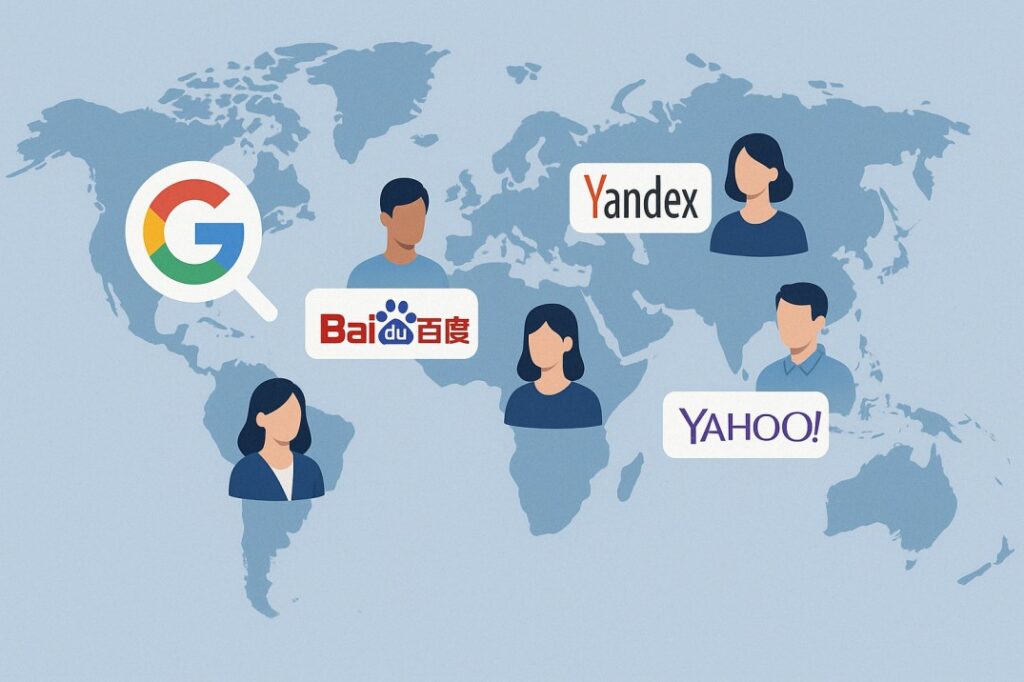
Despite Google’s global dominance, the search engine market varies significantly by geographic region. Local preferences, regulations and the development of indigenous technologies mean that in some parts of the world we can see interesting deviations from global trends.
Europe
Europe remains a region dominated by Google, where the search engine controls about 90% of the market. Nevertheless, some differences can be seen compared to other regions of the world. According to the latest data from March 2025, the share of search engines in Europe is as follows:
| Search engine | Market share |
|---|---|
| 90,64% | |
| Bing | 3,83% |
| Yandex | 3,29% |
| Yahoo! | 0,92% |
| DuckDuckGo | 0,67% |
| Ecosia | 0,33% |
| Other | 0,32% |
It is worth noting the relatively strong position of Yandex, which has a higher share in Europe than globally, mainly due to its dominance in Russia and popularity in the Baltics and Eastern Europe.
The Ecosia search engine, which donates profits to planting trees, also performs better in Europe than in other parts of the world, reflecting the stronger environmental awareness of European users.
Recent years have also seen a gradual increase in Bing’s share in the region, increasing its presence from 3.65% in 2023 to the current 3.83%. This growth is partly due to the integration of AI technology into Microsoft’s search engine.
Poland
In Poland, Google’s dominance is even stronger than the European average. As of early 2025, Google controls as much as 91.88% of the Polish search engine market. The remaining shares are distributed as follows:
| Search engine | Market share |
|---|---|
| 91,88% | |
| Bing | 5,19% |
| DuckDuckGo | 1,04% |
| Yandex | 1,04% |
| Yahoo! | 0,64% |
| Qwant | 0,08% |
| Other | 0,13% |
An interesting phenomenon on the Polish market is the higher-than-average share of Bing, which reaches more than 5% here, while the European average is less than 4%. This may be due to the strong position of Windows and the Edge browser in Polish enterprises and public institutions.
DuckDuckGo scores higher in Poland than the European average, suggesting a growing awareness of privacy issues among Polish Internet users. Yandex, on the other hand , despite its geographic proximity to Russia, has a relatively low share in Poland compared to other Eastern European countries – just 1.04%.
Interestingly, the domestic search engine Onet.pl, which had a noticeable market share a few years ago, is now below the threshold of statistical significance. This shows the difficulties that local search engines face when trying to compete with global giants.
North America
In North America, Google also dominates, but with a slightly smaller share than in Europe or Poland. According to the latest data from March 2025, the share of search engines in North America is as follows:
| Search engine | Market share |
|---|---|
| 87,52% | |
| Bing | 6,16% |
| Yahoo! | 2,96% |
| DuckDuckGo | 1,59% |
| Yandex | 0,42% |
| Ecosia | 0,26% |
| AOL | 0,21% |
| Baidu | 0,18% |
| Naver | 0,14% |
| Other | 0,56% |
A distinctive feature of the North American market is the much higher share of Yahoo! and Bing compared to other regions of the world. Bing reaches more than 6% of the market here, its best result globally. Yahoo!, with nearly 3% share, also records its best results here outside Japan.
Also noteworthy is the presence of AOL in the list, which is an almost exclusively North American phenomenon. This search engine, a relic of the early days of the Internet, still has a loyal user base in the US, mostly among older Internet users.
South America
South America is the region with Google’s highest search engine market share in the world. According to the latest data from March 2025, Google controls as much as 95.16% of the market there, making it a near monopoly. The other search engines have a marginal share:
| Search engine | Market share |
|---|---|
| 95,16% | |
| Bing | 3,38% |
| Yahoo! | 0,71% |
| Yandex | 0,34% |
| DuckDuckGo | 0,16% |
| Ecosia | 0,07% |
| Other | 0,18% |
This dominance of Google is due to a number of factors. The lack of strong local alternatives, the proliferation of Android phones and the relatively late entry of other global players into the Latin American market have all contributed to Google’s entrenchment in the region.
An interesting phenomenon is the very low share of DuckDuckGo, which performs four times worse in South America than in North America. This may indicate less awareness of privacy issues among Internet users in the region or a weaker search engine marketing campaign in the area.
It is worth noting that even Microsoft with its Bing, despite significant investments in the region, achieves only 3.38% market share here. This is a worse result than in Europe or North America.
Analyzing the trends of recent years, there are no significant changes in the market structure. Google maintains its dominant position and even strengthens it slightly. Without the emergence of strong local alternatives or significant changes in attitudes toward online privacy, it is difficult to expect significant reshuffling in the South American search engine market in the near future.
Asia
Asia is the most diverse region in terms of search engine preferences. While Google has undisputed dominance in most of the world, the situation is much more complex in Asia. According to March 2025 data, the share of search engines across the region is as follows:
| Search engine | Market share |
|---|---|
| 73,55% | |
| Yandex | 10,78% |
| Bing | 4,67% |
| Baidu | 4,28% |
| Yahoo! | 2,53% |
| Naver | 1,37% |
| CocCoc | 0,62% |
| DuckDuckGo | 0,42% |
| Haosou | 0,36% |
| Sogou | 0,33% |
| Other | 1,09% |
This diversity is the result of strong local players in the region’s largest economies. Baidu, Haosou and Sogou dominate in China, Naver and Daum in South Korea, CocCoc in Vietnam, and Yandex in Russia and parts of Central Asia.
In addition, language barriers, cultural differences and government regulations make it difficult for global search engines to fully penetrate some Asian markets. In China, access to Google is blocked, which explains the strong position of local alternatives.
Yahoo! is performing better in Asia than in the rest of the region, largely due to its strong position in Japan, where it is still an important alternative to Google.
Read more: What should a Polish entrepreneur know about China’s economy in 2025?
Africa
Africa is the continent where Google achieves one of the highest market shares globally. As of March 2025, the market structure is as follows:
| Search engine | Market share |
|---|---|
| 94,67% | |
| Bing | 2,94% |
| Yahoo! | 0,82% |
| Yandex | 0,51% |
| DuckDuckGo | 0,28% |
| Petal Search | 0,21% |
| Ecosia | 0,19% |
| Baidu | 0,13% |
| Qwant | 0,06% |
| Other | 0,19% |
Google’s dominance in Africa is due to several factors. The high penetration of Android mobile devices (often the first and only device with Internet access for many users) makes Google the default option for millions of Africans.
The lack of strong local alternatives and limited awareness of digital privacy further strengthen the US giant’s position. It is worth noting, however, that the search engine Ecosia, which allocates profits to reforestation, has shown slow but steady growth in Africa.
Australia and Oceania
In Australia and Oceania, the search engine market resembles the European and North American markets in structure, with Google dominant and several significant alternatives. March 2025 data shows the following share distribution:
| Search engine | Market share |
|---|---|
| 93,29% | |
| Bing | 4,75% |
| Yahoo! | 0,96% |
| DuckDuckGo | 0,57% |
| Ecosia | 0,19% |
| Yandex | 0,07% |
| Baidu | 0,04% |
| Naver | 0,02% |
| Other | 0,11% |
As in other English-speaking regions, Google maintains a dominant position here, but Bing performs relatively well, similar to North America.
Summary
The search engine market in 2025 remains dominated by Google, which controls nearly 90% of the global market. Despite this dominance, some changes and regional differences are apparent. Google’s closest competitors are Bing (3.93%), Yandex (2.73%), Yahoo! (1.27%) and Baidu (0.71%).
Each of these search engines has its strengths – Bing stands out for its integration of artificial intelligence, Yandex dominates in Russia, Yahoo! maintains its popularity in Japan, and Baidu leads in China. Also noteworthy is the growing popularity of DuckDuckGo (0.67%), a search engine that prioritizes user privacy.
Geographically, the market is highly differentiated – while in South America and Africa Google achieves more than 94% share, in Asia its dominance is much smaller (73.55%). In Poland, Google controls 91.88% of the market, while Bing comes in second with 5.19%. Trends in recent years show a slow decline in Google’s share and an increase in the popularity of search engines focused on privacy and using advanced AI technologies.
Harness the potential of Google in your marketing strategy!
As the data shows, Google remains the king of search engines with nearly 90% of the global market share. This dominance is particularly clear in Poland, where Google controls more than 91% of all searches. This sets a clear goal for every online business – to gain visibility on this search engine.
At NON.agency, we focus on effective strategies. We don’t theorize – we deliver measurable results that translate into real growth for your business, such as a 2250% increase in sales!
What defines us:
- ???? Strategic approach – we look holistically at your online business
- ???? Precision of action – every change has a goal and is measured
- ???? Innovation – we combine traditional SEO with new technologies
- ???? Transparency – we clearly communicate progress and challenges
Our offer:
- Advanced audits to identify key growth areas
- Strategic content aligned with search intent
- Technical optimization to improve user experience
- Ethical link building to build your domain authority
Want to dominate Google like Google dominates the market? ???? [Contact us] and start transforming your online presence!