

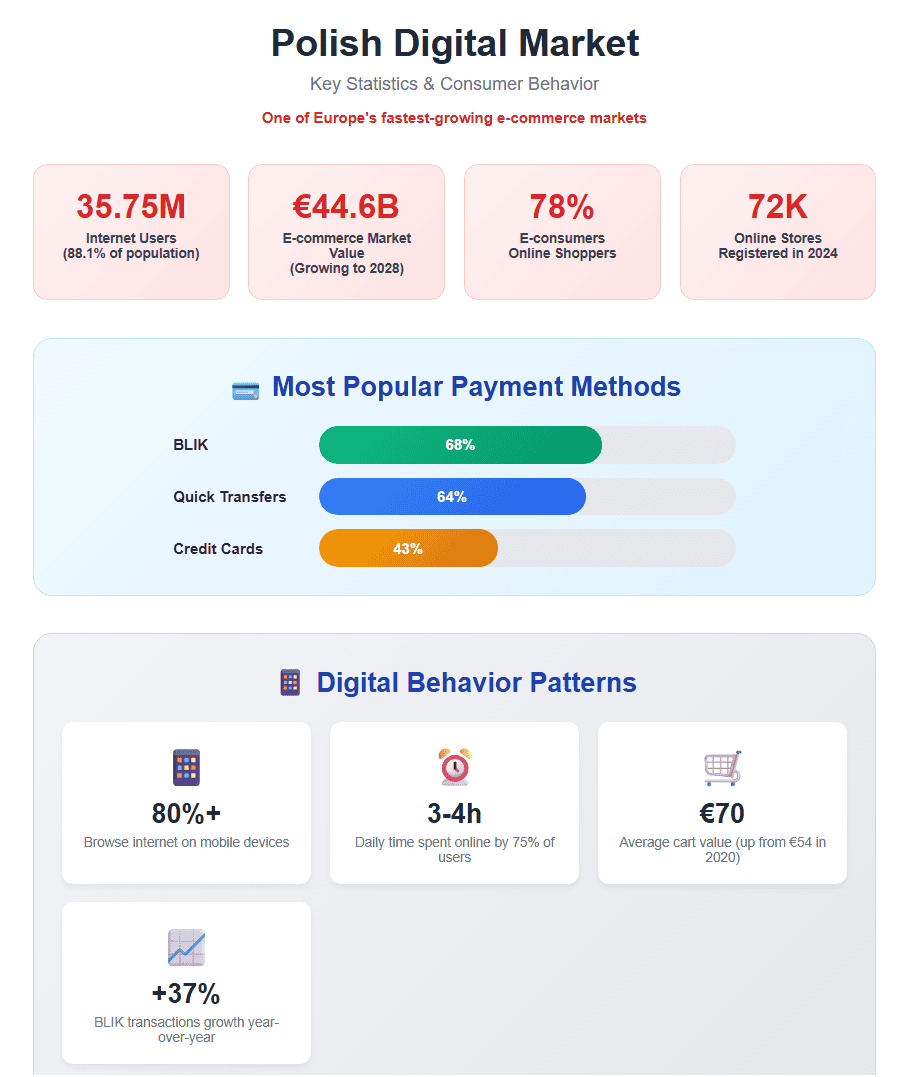
Diacritical marks, declension, BLIK instead of credit cards – the Polish market presents unique SEO challenges for businesses, but rewards those who understand them. This is exactly where SEO can deliver exceptional results in Poland. With over 35.75 million internet users representing 88.1% of the population and an e-commerce market worth over 44.6 billion euros with growth projected through 2028, Poland offers enormous potential for companies investing in optimization. When you add the fact that Google dominates with a 95.7% share of Polish search engines, the picture becomes clear: SEO in Poland isn’t an option, it’s a necessity. In this guide, we’ll show you how to leverage the specifics of the Polish market to build a strong online presence. From linguistic challenges to local payment preferences – we’ll cover everything you need to know to effectively rank in Poland and reach millions of potential customers.
How the Polish Digital Market Works and Why SEO is Crucial

The Polish digital market is characterized by dynamic growth and a high level of technological advancement. This makes SEO investment capable of delivering spectacular results.
Digital Economy
Poland is among the fastest-growing e-commerce markets in Europe. GDP is expected to reach over $844 billion in 2024 with 3% annual growth. The e-commerce sector is driving this development with projected growth from $41 billion in 2023 to over $56 billion in 2027. The Polish digital consumer is well-educated and aware of their needs. 75% of Poles spend 3 to 4 hours online daily, which means enormous opportunities to reach customers through properly optimized content.
Consumer Behavior
Polish consumers show stable online shopping patterns – the percentage of e-consumers is 78%. What’s particularly important for SEO strategy is the growing popularity of foreign purchases – a 6 percentage point increase compared to the previous year. An interesting trend is the growing importance of mobile shopping. Poles increasingly use smartphones for searching and purchasing, which requires mobile device optimization. Over 80% of Polish users browse the internet on mobile devices.
Payment Methods
According to the ‘E-commerce in Poland 2024’ report, BLIK became the most popular form of payment for e-purchases for the first time (68% of responses), ahead of instant transfers (64%) and credit cards (43%). In 2024, BLIK users made over 2.4 billion transactions worth a total of 347.3 billion zloty, representing a 37% year-over-year increase. For e-commerce businesses, this means the necessity of integrating with local payment systems to maximize conversions.
The E-commerce Market in Poland: Size and Opportunities
Polish e-commerce is one of the fastest-growing markets in Europe, offering unique opportunities for companies investing in SEO. In 2024, approximately 72,000 online stores were registered, showing the scale of competition but also the enormous market potential. According to forecasts, the value of the Polish e-commerce market could reach 192 billion zloty (44.6 billion euros) by 2028, representing an average annual growth of 8%. In comparison, the growth of the entire retail market in Poland is projected at 6% annually. A key trend is the increase in shopping cart value. Between 2020 and 2023, the average cart value increased from 233 zloty (54 euros) in 2020 to 304 zloty (70 euros) in 2023.
Dominant E-commerce Platforms in Poland
Allegro is the leading e-commerce platform in Poland with over 21 million users and over 200 million monthly visits. This makes the presence on this platform often crucial for success in Polish e-commerce. In 2023, Allegro reached nearly 20 million active buyers. Amazon, despite launching Amazon.pl in 2021, still remains far behind Allegro in Poland. This creates opportunities for local companies that can compete on more equal terms than in countries dominated by the American giant.
Website Positioning in Poland
The Polish search engine market is characterized by one of the highest Google concentrations in the world, which significantly simplifies SEO strategies.
Google’s Dominance
Google controls 95.7% of the search engine market in Poland (as of August 2024), which is one of the highest rates worldwide. This near-monopolistic position means that SEO strategies in Poland can focus almost exclusively on Google’s algorithms, without the need to optimize for other search engines. On desktop computers, Google has an 86.41% share, while on mobile devices this rate increases to an impressive 98.49%. This mobile dominance is particularly important considering the growing trend of mobile devices in Polish user behavior.
Linguistic Challenges in SEO
SEO experts working on website positioning in Poland face unique linguistic challenges that can be both an obstacle and a competitive advantage. The Polish language contains diacritical marks (ą, ę, ś, ć, ź, ń, ł, ż), which are an integral part of the language and can affect keyword effectiveness. Additionally, declension causes words to have different forms depending on context. The word “pies” (dog) can take forms “psa,” “psu,” “psie” depending on the case, which significantly complicates keyword research but also creates opportunities for targeting long-tail keywords.
B2B E-commerce: +267% Traffic Growth in 4 Months
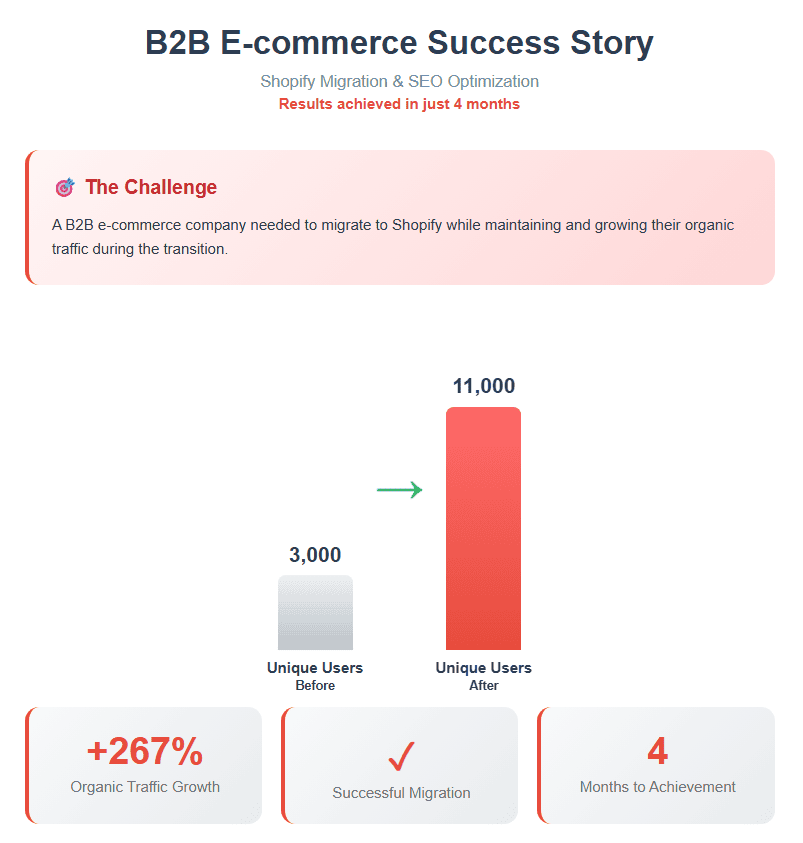
Theory is one thing, but practice shows the true potential of website positioning in Poland. Here’s a concrete example of a project we implemented for companies operating in the Polish market. Challenge: A B2B e-commerce company needed to migrate their site to Shopify while maintaining and increasing organic traffic. Actions:
- Technical migration – we conducted a comprehensive migration to Shopify while preserving all SEO optimizations
- Keyword strategy – competitor analysis and identification of phrases generating significant organic traffic in the B2B industry
- Link building – building domain authority through high-quality industry links
- Content marketing – creating content for different stages of the sales funnel (MoFu and BoFu)
Results:
- Growth in unique users from 3,000 to 11,000 in 4 months
- +267% increase in organic traffic
- Successful migration without losing search engine positions
- Long-term strategy – the client received tools for independent SEO development
Technical SEO Fundamentals in Poland
The technical foundations of Polish SEO don’t differ significantly from global standards, but there are local specifics that can determine success or failure.
Mobile Optimization as a Priority
Given that over 62% of internet traffic in Poland comes from mobile devices, mobile optimization is essential. Polish users are particularly demanding when it comes to loading speed and website responsiveness.
Technical Structure
Clear Polish URLs can significantly impact click-through rates in search results. Polish users are more likely to click on links containing Polish keywords than English equivalents.
Writing and Optimizing Polish Content
Creating optimized content in Polish is an art of combining language knowledge with understanding search engine algorithms. Polish offers rich possibilities but also poses unique challenges.
Linguistic Challenges and Opportunities
The declension of Polish words creates both challenges and opportunities. One word can have many grammatical forms, allowing for richer and more natural content creation, but requiring greater precision in keyword research.
Long Tail as a Necessity
Google users in Poland often use long queries in the form of complete questions, asking the search engine “how to install,” “where to buy,” or “which is best.” This is a natural consequence of the complexity of the Polish language and cultural communication patterns. This tendency means enormous potential for companies that can create content answering specific, detailed user questions.
Link Building in Poland – Specifics and Best Practices
The Polish link building market has its unique characteristics that differ significantly from practices used in other countries.
Dominance of Sponsored Content
Sponsored articles are by far the most popular type of link building in Poland. This is rare on a global scale, where guest posts, link insertions, and link acquisition campaigns bring more results. Polish publishers, bloggers, and influencers almost always require payment for dofollow links, making link exchanges and free guest posts very difficult to organize. This specificity requires appropriate budgeting for link building strategies.
Link Building Platforms
Two platforms, Linkhouse and WhitePress, founded in Poland, have dominated the global market for sponsored content and link building. This shows how developed and professional the Polish market is in this area. Due to the high level of SEO awareness in Poland, even small entrepreneurs and photographers have basic knowledge of WordPress optimization and link building. This concentration of knowledge makes the market highly competitive and requires focusing on quality rather than quantity of links.
Local SEO in Poland
Local SEO in Poland is extremely important due to population density and strong attachment to local communities. Polish consumers often prefer local businesses if they meet their quality expectations.
Google Business Profile as Foundation
Google Business Profile (formerly Google My Business) is the absolute foundation of local SEO in Poland. Due to high smartphone penetration and frequent “near me” searches, a complete and regularly updated profile can determine a local business’s success. Polish users particularly value current opening hours, interior photos, and regular posts with updates. Responding to reviews (both positive and negative) significantly affects business credibility.
Geographic Keywords
Optimization for local keywords requires considering Polish geographic specifics. Beyond obvious city names, it’s worth targeting district and neighborhood names (especially in large cities), local landmarks, and voivodeship and county names.
Monitoring and Analyzing SEO Results in Poland
Effective SEO monitoring in Poland requires understanding local specifics and adapting metrics to the Polish market.
Key Metrics for the Polish Market
Due to Google’s dominance in Poland, position monitoring can focus almost exclusively on this search engine. It’s important to track positions on both computers and mobile devices, as differences can be significant. Polish organic traffic often features high engagement rates. Polish users, once they find interesting content, spend more time on the site than the European average. Conversion monitoring should consider the specifics of Polish payment methods. High cart abandonment may result from the lack of popular local payment options like BLIK.
Tools Adapted to the Polish Market
- Senuto – a Polish tool offering better data for the Polish market than international counterparts. Particularly useful for keyword research considering declension forms. While Ahrefs or SEMrush treat “kredyt,” “kredytu,” “kredytom” as separate keywords, Senuto understands Polish grammar and groups them semantically. The platform also offers the broadest database of Polish keywords and precise position monitoring in local Google results.
- Brand24 is a leading Polish online monitoring tool that excellently handles Polish sources – from internet forums to social media. In the SEO context, it allows tracking brand mentions affecting CTR, identifying link building opportunities from Polish sites, and monitoring sentiment that can influence user behavior in search results. The tool analyzes Polish content much better than global counterparts.
- For online stores, it’s important to integrate data from platforms like Allegro Analytics and Ceneo Pro to get a complete picture of results. Allegro often dominates search results for commercial phrases, so monitoring product positions on this platform is crucial for SEO strategy. Similarly, Ceneo data helps understand how competition positions itself in price comparison sites, affecting overall brand visibility in search engines.
- Sotrender is a Polish social media analysis tool offering the best data on Polish Facebook, Instagram, and YouTube. In the SEO context, it helps identify content trends that can be used in content marketing strategy and understand what topics generate engagement among Polish users.
Common Mistakes in Polish SEO and How to Avoid Them
The Polish SEO market has its pitfalls that can cost companies valuable positions and organic traffic.
Linguistic and Cultural Mistakes
- Literal keyword translations – The biggest mistake is directly translating keywords from English to Polish. Polish users may use completely different terms. For example, “digital marketing” isn’t searched as “marketing cyfrowy” but as “marketing internetowy” or simply “marketing online.” Similarly, “lead generation” is more often searched by Poles as “pozyskiwanie klientów” or using the anglicism “generowanie leadów,” not the literal translation “generowanie potencjalnych klientów.”
- Ignoring diacritical marks – Omitting Polish diacritical marks can result in worse positions.
- Incorrect declension – Using incorrect grammatical forms not only spoils user experience but can also affect search result positions.
Technical Mistakes Specific to Poland
- Lack of optimization for BLIK and local payments – E-commerce sites that don’t consider BLIK’s popularity often have higher bounce rates.
- Ignoring mobile optimization – Due to high smartphone penetration in Poland, the lack of mobile optimization is particularly painful.
- Incorrect URL structure – URLs containing Polish diacritical marks can cause technical problems.
Content Strategy Mistakes
- Keyword cannibalization – Due to the richness of grammatical forms in Polish, it’s easy to have situations where multiple pages compete for similar keywords.
- Too short content – Polish users expect comprehensive answers. Short, superficial articles rarely achieve high positions.
- Lack of local context – Content that doesn’t refer to Polish reality often has worse engagement metrics.
Working with an SEO Agency vs. In-House Activities
The decision on how to conduct SEO in Poland depends on many factors, but Polish market specifics can influence this decision.
When to Work with a Polish SEO Agency
Poorly translated content can seem unprofessional to local consumers. Additionally, keyword research must consider different word forms. The Polish SEO market has its characteristic features – from the dominance of sponsored content to unique link building platforms. An experienced Polish agency knows these nuances and can effectively leverage them.
When to Conduct SEO In-House
For small businesses operating locally, basic local SEO can be conducted in-house, especially if they have time for learning and systematic activities. IT or technology companies often have internal competencies for conducting SEO but may need support in linguistic and cultural aspects.
What Will Be the Future of Polish SEO? Key Trends and Challenges
The Polish SEO market is rapidly evolving, driven by both global technological trends and local market specifics.
Impact of Artificial Intelligence
Artificial intelligence is revolutionizing SEO and content marketing in Poland. Polish companies increasingly use AI for content creation, but the challenge remains in maintaining the naturalness of the Polish language and cultural context. AI algorithms like RankBrain and BERT prioritize user intent and content relevance over keyword density.
Mobility and Performance
Poland maintains the mobile trend, and Google increasingly emphasizes performance. 71% of Polish internet users browse the internet on smartphones, making mobile optimization an absolute priority. Core Web Vitals are becoming an increasingly important ranking factor, especially in competitive Polish e-commerce industries.
Changes in Consumer Behavior
Polish consumers are increasingly interested in topics related to ecology and sustainable development. This creates new opportunities for content marketing and SEO. Moreover, TikTok, with billions of monthly active users, is gaining importance as a sales platform, especially among younger generations.
Industry Challenges
Amazon is present in Poland but remains far behind Allegro, which accounts for about 33% of e-commerce traffic and attracts over 20 million monthly visitors. More Polish companies are planning foreign expansion, requiring adaptation of SEO strategies to international markets while maintaining a strong position in Poland.
Why Choose Us for Website Positioning in Poland?
1. We Know the Polish Market Inside Out
Here’s the thing about Polish SEO – mere translating keywords and hoping for the best won’t do – trust us. When you’re dealing with declension, diacritical marks, and a market where BLIK payments matter more than credit cards, you need someone who gets the local nuances. With Google holding a massive 95.7% market share and Allegro still crushing Amazon, the Polish SEO has its own rules.
2. Full-Service SEO That Actually Works in Poland
From digging into keyword research that accounts for all those tricky grammatical forms, to creating content that resonates with Polish audiences, to building links through sponsored content (because that’s just how it works here) – we handle it all. Plus, we’re fluent in the local SEO ecosystem, whether that’s using Senuto for better keyword data or working with platforms like WhitePress and Linkhouse.
3. Staying Ahead of Polish Market Trends
The Polish market moves fast. BLIK is taking over online payments, voice search is growing, and mobile behavior keeps evolving. We don’t just follow these trends – we help our clients get ahead of them. Our strategies work for today’s market while setting you up for what’s coming next.
4. Results You Can Actually Measure
Sure, traffic is nice, but revenue is better. We focus on the metrics that matter to your bottom line, taking into account how Polish customers actually behave, when they buy, and what drives them to convert. Our reporting shows you exactly how SEO impacts your sales and lead generation – no fluff, just facts.
5. Your Strategy, Your Goals
Whether you’re a Polish business looking to dominate locally or an international company eyeing the Polish market, we build strategies around your specific situation. Every business is different, every budget is different, and every competitive landscape is different. Our international SEO experience gives us the perspective to make smart decisions for this unique market. Contact us and discover your brand’s full potential in the Polish market – one of the fastest-growing e-commerce markets in Europe.