

Drifting on the market ocean without a marketing plan is like sailing without a compass – you may reach your destination, but more by accident than by intention. An effective marketing plan is much more than a list of promotional activities – it is a strategic document that sets the direction of the company and helps to use available resources effectively.
In this article, we will show you how to create a marketing plan that will actually bring tangible benefits to your business. You’ll learn the key elements, how to set marketing goals and activities that fit the specifics of your business, and how to monitor the progress of your strategy.
Whether you run a small business or manage a large company, these tips will help you prepare a plan that will become the foundation of your business development.
What is a marketing plan and why is it so important?
A marketing plan is a strategic document that specifies what marketing activities a company intends to undertake over a certain period of time to achieve its business goals. It is a kind of roadmap that shows where the company wants to go and how it intends to get there.
A well-prepared marketing plan helps the company:
- Set clear goals and strategies for achieving them
- better understand the market and competition
- allocate budget and resources effectively
- maintain a consistent marketing message
- measure the effectiveness of the actions taken
Marketing plan vs. marketing strategy
Although sometimes used interchangeably, these terms mean different things. A marketing strategy is a broader picture of a company’s activities, including vision, mission and long-term goals. A marketing plan is more specific – it includes a detailed schedule of activities, a specific budget and measurable goals to be achieved in the shorter term.
It can be said that the marketing strategy answers the question “what and why?”, while the marketing plan focuses on “how, when and for how much?”. The marketing plan should be consistent with and support the company’s marketing strategy.
Key elements of an effective marketing plan
Summary of the business situation
At the beginning of the marketing plan, it is worth including a concise summary of the company’s current situation. This element should include basic information about the company, its main products or services, market position and competitive advantage.
Important elements of a business summary:
- a brief description of the company’s activities
- information about the time of operation in the market
- main products or services
- unique value proposition
- major achievements
Analysis of the market and business environment
Understanding the market in which you operate is the foundation of an effective marketing plan. In this section, you should analyze current market trends, market size, growth potential and external factors (PEST) that may affect your business.
Elements of market analysis:
- market size and structure
- key trends and developments
- economic, social, technological and legal factors
- barriers to entry and exit
- seasonality of sales
Defining the target group
Precisely defining the target audience is one of the most important elements of a marketing plan. Without a thorough understanding of who your potential customers are, it will be difficult to create an effective marketing message.
It is a good idea to create so-called personae, or profiles representing the company’s typical customers. Each persona should include information about:
- demographic data (age, gender, location, income)
- education and occupation
- interests and lifestyle
- problems and needs
- purchasing motivations
- preferred channels of communication
Competitor analysis
An in-depth competitive analysis allows you to identify the strengths and weaknesses of other companies in your industry and find market niches that can be exploited. It’s also a way to avoid mistakes made by competitors.
In a competitive analysis, it is worth considering:
| Aspect | What is worth analyzing |
|---|---|
| Product offering | Scope, quality, unique features |
| Pricing strategy | Price level, promotions, discount policy |
| Distribution channels | Where and how they sell |
| Marketing activities | Media used, message, frequency |
| Brand positioning | Image, values, target audience |
| Online presence | Website, social media, SEO, advertising |
SWOT analysis
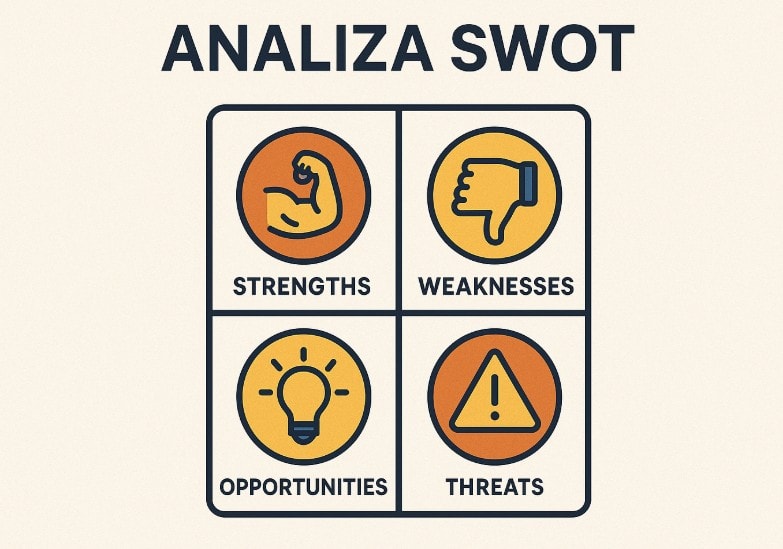
A SWOT analysis is a tool that identifies and analyzes a company’s strengths and weaknesses, as well as opportunities and threats from the environment. It is a key component of a marketing plan, helping with strategic planning.
Typical structure of a SWOT analysis:
- Strengths (strengths) – internal factors that give you a competitive advantage (e.g., unique technology, strong brand, experienced team)
- Weaknesses – internal factors that weaken the company’s position (e.g., limited resources, poor brand recognition)
- Opportunities – external factors that can positively affect the company’s business (e.g., new technologies, legal changes, new markets)
- Threats (threats) – external factors that can negatively affect the business (e.g., increasing competition, changing customer preferences)
A well-conducted SWOT analysis helps determine which areas of a company’s business need to be improved, and which represent potential for marketing efforts.
Definition of marketing objectives according to the SMART principle
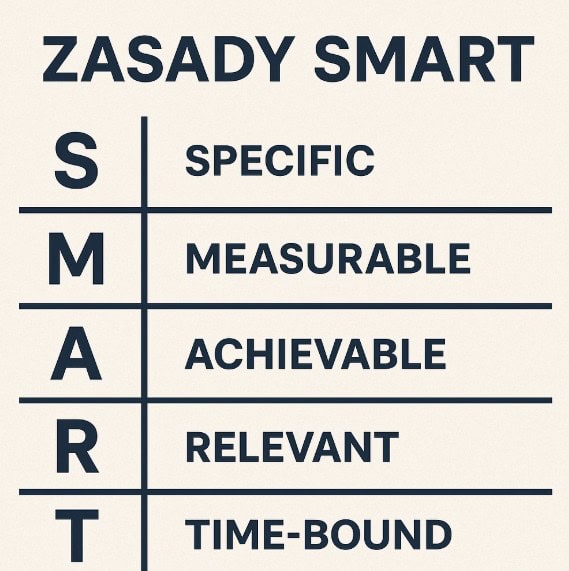
Marketing objectives should follow the SMART methodology, that is:
- Specific (concrete) – clearly defined what exactly we want to achieve. A specific goal eliminates ambiguity and allows the entire team to understand what we are aiming for. Instead of “increase sales,” it’s better to specify “increase sales of product X in customer segment Y,” which gives a clear focus.
- Measurable – quantifiable. Measurability enables objective evaluation of progress and success, eliminating subjective interpretations of results. Specifying numerical values (e.g., a 15% increase, gaining 500 new subscribers) allows you to accurately track progress and celebrate small victories on the way to your goal.
- Achievable – realistic to achieve with available resources. Achievable goals motivate the team, while unrealistic ones lead to frustration and resignation. It is worth basing goals on an analysis of historical performance, market trends and the company’s actual capabilities, rather than on untested assumptions or wishful thinking.
- Relevant – linked to the company’s overall business objectives. Relevance ensures that each marketing activity contributes to the organization’s broader strategy and mission. Marketing objectives should translate into tangible business results like revenue growth, margin expansion or market empowerment, rather than focusing solely on marketing metrics without a business context.
- Time-bound – with a clear deadline for completion. Time frames create a sense of urgency and help prioritize tasks and plan resources. Setting a precise completion date (e.g., “by the end of Q2”) forces you to think realistically about the pace of work and resources needed, and allows you to break down the long-term goal into smaller milestones.
Marketing strategy and tactics
In this part of the marketing plan, it is necessary to determine what specific marketing activities will be undertaken to achieve the set goals. The marketing strategy should take into account all elements of the marketing mix (4Ps):
- Product (product) – what products/services we will offer, how to develop them
- Price (price) – what will be the pricing policy, discount strategies
- Places (distribution) – where and how we will sell products
- Promotion – what promotional activities we will undertake
For each element of the marketing mix, specific tactics, or ways to implement the strategy, should be identified. For example, in the area of promotion, you can use:
- advertising (online, offline)
- content marketing
- social media marketing
- email marketing
- SEO (search engine optimization)
- PR and cooperation with influencers
Looking for an innovative approach to implementing your SEO strategy? Check out the article“Agile and Scrum in SEO: How an Agile Approach Transforms SEO Results” and discover how Agile methodology can improve the implementation of your strategy.
Marketing budget
The marketing budget is one of the most important elements of a marketing plan. It determines how much money the company will allocate for marketing activities and how these funds will be distributed among different channels and campaigns.
When planning a marketing budget, it is worthwhile:
- analyze historical data on the effectiveness of marketing expenditures
- take into account the seasonality of sales and adjust expenses accordingly
- Divide the budget into fixed costs (such as website maintenance) and variable costs (such as advertising campaigns)
- Reserve a portion of the budget for testing and new channels
- include contingencies (10-15% of the total budget)
It is a good practice to assign specific performance indicators (KPIs) to each marketing channel to assess return on investment (ROI) and modify budget allocation if necessary.
Schedule of activities
A schedule is a practical plan for implementing a marketing strategy. It should include a list of all planned marketing activities with deadlines for their implementation and responsible persons.
A well-prepared schedule of marketing activities:
- identifies specific tasks and milestones
- assigns responsibility for individual actions
- takes into account the relationships between tasks
- includes a realistic timeframe
- is flexible and allows for changes
The schedule can be prepared in the form of a Gantt chart, a calendar or a simple table, depending on the complexity of the plan and the team’s preferences.
Methods for monitoring and evaluating performance
The marketing plan should also include a description of the methods that will be used to monitor progress and evaluate the effectiveness of the activities undertaken. Key performance indicators (KPIs) should be directly linked to marketing objectives.
Sample KPIs according to targets:
| Marketing objective | Possible KPIs |
|---|---|
| Increase brand awareness | Campaign reach, number of impressions, brand recognition rate |
| Lead generation | Number of new leads, cost per lead (CPL), conversion rate |
| Increase sales | Revenue, number of transactions, average order value, ROI |
| Customer retention | Retention rate, purchase frequency, NPS (Net Promoter Score) |
Regular monitoring of KPIs allows you to evaluate the effectiveness of your marketing plan on an ongoing basis and make adjustments if necessary.
How to write an effective marketing plan? Practical tips
Investigate, don’t guess
An effective marketing plan should be based on solid data, not on guesswork or conjecture. It’s a good idea to conduct market research, competitive analysis and customer preference studies before making a plan.
Data sources worth using:
- sales and marketing data of the company
- market research and industry reports
- surveys and interviews with customers
- data from analytical tools (e.g. Google Analytics)
- social media monitoring
- Information from employees who have direct contact with customers
Get the right people involved
Creating a marketing plan should not be a task for the marketing department alone. It’s a good idea to involve representatives from different departments, such as sales, customer service, product or finance, to get the full picture and different perspectives.
Be realistic but ambitious
The marketing plan should be realistic, taking into account the company’s actual capabilities and limitations, but at the same time ambitious enough to motivate the team to act. Goals that are too conservative can lead to stagnation, and goals that are too excessive can lead to frustration and demotivation.
Plan long term, act short term
A good marketing plan includes both a long-term vision (for a year or more) and short-term action plans (for a quarter or a month). This allows you to maintain consistency in your activities while being flexible to respond to market changes.
Take care of flexibility
The market is changing dynamically, so the marketing plan should be a flexible document that can be adapted to changing conditions. It is a good idea to schedule regular reviews and updates to the plan (e.g., quarterly).
When the market changes – updating the marketing plan
A marketing plan is not a document that is created once and forgotten. In a dynamically changing business environment, it is necessary to regularly update it and adapt it to new conditions.
Situations that may require updating the marketing plan:
| Situation | Urgency | Extent of change | Symptoms |
|---|---|---|---|
| The emergence of a new competitor in the market | ⚠️⚠️⚠️ | Medium to large |
|
| Significant change in consumer behavior | ⚠️⚠️⚠️⚠️ | Large |
|
| Introduction of a new product or service | ⚠️⚠️ | Medium |
|
| Technological changes affecting marketing channels | ⚠️⚠️⚠️ | Medium to large |
|
| Changes in economic or legal situation | ⚠️⚠️⚠️⚠️ | Large |
|
| Failure to meet targets despite plan implementation | ⚠️⚠️⚠️⚠️ | Large |
|
| Mergers and acquisitions | ⚠️⚠️⚠️ | Large |
|
| Loss of key partners or distribution channels | ⚠️⚠️⚠️⚠️ | Medium to large |
|
How often to update the marketing plan?
The frequency of updating the marketing plan depends on the dynamics of the industry and the rate of change in the market. The following principles are generally accepted:
- Operational reviews – weekly or monthly check of progress and small adjustments
- Tactical reviews – quarterly assessments of the effectiveness of operations and average adjustments
- Strategic reviews – semi-annual or annual assessments of the entire plan and significant updates
It is worth remembering that too frequent changes in the marketing plan can lead to chaos and inconsistency of activities. On the other hand, sticking to an outdated plan can lead to inefficient use of resources and missed opportunities.
Want to streamline your marketing plan update? Check out 17 alternatives to ChatGPT that will speed up your efforts. Click here →
Your guide to marketing planning
An effective marketing plan is the foundation for the success of any business. We have prepared for you a complete checklist that will guide you through all the key steps of creating a professional marketing plan. The document includes precisely defined sections with space to fill in your unique business data and strategic objectives.
Download our checklist now and start building a strategy that will bring tangible benefits to your business!
Summary
An effective marketing plan is a roadmap that guides a company to market success. A well-prepared marketing plan includes an analysis of the situation, precisely defined goals, a tailored strategy and ways to monitor progress.
Remember that the marketing plan should be:
- based on reliable data and analysis
- tailored to the specifics of your company and industry
- realistic, yet ambitious
- flexible and open to updates
- understandable to all involved
Even the best marketing plan will not guarantee success if it is not consistently implemented. Therefore, as important as the preparation of the plan itself is its systematic implementation, monitoring of progress and making necessary adjustments.
Investing time and resources in creating a good marketing plan is one of the most cost-effective decisions any business, regardless of size or industry, can make.